
REVIEW · KATHMANDU
Annapurna Circuit Trek
The high pass is only part of the story. This 12-day Annapurna Circuit trek links river valleys, pine forests, Buddhist villages, high mountain country, and the sunrise ridge at Poon Hill. I like the way the route combines serious Himalayan scenery with local transport, tea house stays, and time in Manang for acclimatization.
I also like the practical support. A guide handles the route and logistics, porters carry the main bags, and the price includes accommodation, meals during the trek, guide costs, taxes, and several long road transfers. The main caution is the pace: Thorung La reaches 5,416 meters, and the route includes several long walking days, including an eight-hour crossing day.
There is one important point to clear up before you pay. The tour summary refers to Sarangkot and a gentle hike, while the detailed schedule describes the much more demanding Annapurna Circuit, ending with Poon Hill and Pokhara. Ask Outfitter Nepal to confirm the exact route, included city nights, and starting point in writing.
Key points to know before booking
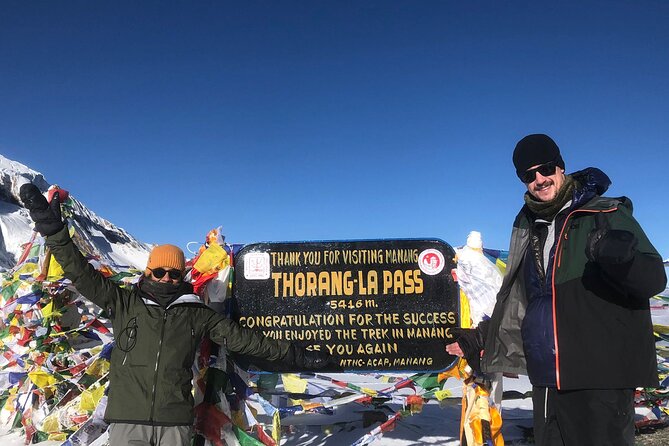
- Thorung La is the physical high point: The pass sits at 5,416 meters, with a long climb from Thorung Phedi and a steep descent to Muktinath.
- Manang gets a proper acclimatization day: You spend Day 6 in town, with optional walks and a visit to the Himalayan Rescue Association aid post.
- The route changes dramatically: Expect river valleys, terraced farmland, pine and rhododendron forests, dry high country, and the Kali Gandaki corridor.
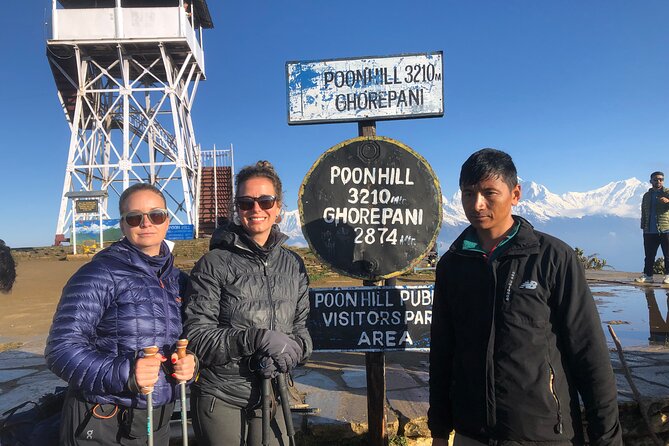
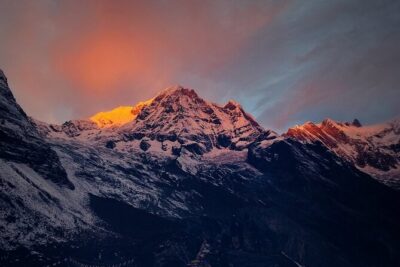
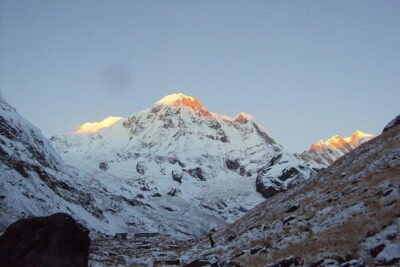
- Poon Hill adds a superb finale: An early sunrise walk offers views toward Dhaulagiri, Annapurna I, Annapurna South, Machhapuchhre, and several other peaks.
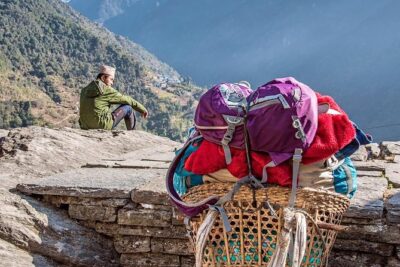
- Porters carry the main luggage: The stated arrangement is one porter for every two trekkers, carrying about 20 kilograms total.
- The group stays small: The maximum stated group size is 10 people, with extra guide support for larger arrangements.
What the $994 price really covers
At $994 per person, this is not simply a guided walk. The cost covers tea house or lodge accommodation throughout the trek, government taxes, service charges, an experienced guide, guide insurance and expenses, and a substantial list of meals.
The package includes 12 breakfasts, 12 lunches, and 11 dinners. It also includes ground transport from Kathmandu to Chamje, Muktinath to Tatopani, and Hile to Pokhara by local bus. That matters because road travel in this region can be tiring and confusing, especially after a high-altitude trek.
You still need to budget for drinks, desserts, city meals, tips, travel insurance, the Nepal visa, and personal purchases. Alcoholic and non-alcoholic drinks are excluded. A porter is included in the stated group arrangement, but the additional porter price is listed as $20 per day if you need one outside that arrangement.
The value is strongest for someone who wants a managed trek without paying for a fully private luxury trip. Accommodation is in lodges and tea houses, not high-end mountain hotels. Kathmandu and Pokhara accommodation is described as standard two or three-star lodging, with upgrades available at extra cost.
More Annapurna Treks in Kathmandu
- Annapurna Circuit Trek with Tilicho Lake
★ 5.0 · 368 reviews - Annapurna base camp trek 5 Days
★ 5.0 · 252 reviews - 14-Day Private Annapurna Base Camp Trek
★ 5.0 · 180 reviews
Day 1: Kathmandu to Besisahar and Chamje
Your guide collects you at about 7 a.m. and takes you to the bus terminal. The day begins with a bus ride toward Besisahar, following the Kathmandu to Pokhara highway until Dumre. From there, the road becomes more dramatic as it follows the Marshyangdi River.
At Besisahar, you change to a local jeep for the final ride to Chamje. This is a transport-heavy opening day, not a gentle sightseeing day. The road journey can feel long, but it places you close to the walking route and avoids spending an extra day on foot at lower elevation.
Have breakfast before leaving. The stated meeting time is 6:15 a.m., while the schedule says pickup is around 7 a.m., so confirm the exact time with the operator.
Day 2: Chamje to Dharapani through Tal
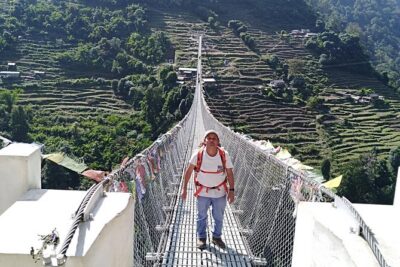
The trek begins with a descent to the river and a suspension bridge, followed by a steep climb toward Sattale. The path then undulates above the river before reaching Tal, a broad plain at roughly 1,700 meters.
Beyond Tal, the valley narrows. Parts of the trail are cut directly into rock, and the route passes Karte before continuing toward Dharapani. This is a good introduction to the circuit because you get river scenery, steep valley walls, bridges, and early mountain villages in one day.
The walk is listed at about six hours. The description includes steep and exposed sections, so the phrase all levels should not be taken too literally. You do not need technical climbing skills, but you do need steady footing and comfort with long mountain days.
Day 3: Dharapani to Chame and the first big peaks
The route climbs through pine and oak forest, passing Bagarchhap, a Bhote village marked by prayer flags and a Buddhist monastery. At Danaque, the trail continues toward Timang, below Lamjung Himal.
The walk to Chame takes about five hours. Annapurna II begins to appear ahead, and the forest gives the day a cooler, shaded feel. Chame is the administrative center of the Manang district and a useful overnight stop before the route climbs into more open mountain country.
This part of the trek is a fine example of why the circuit works so well. You are not looking at the same view every day. Villages, forests, bridges, prayer flags, and snow peaks arrive in stages.
Same trailhead, a longer or shorter day out:
- Everest Base Camp Trek – 14 Days
★ 5.0 · 1,499 reviews - Everest Base Camp Trek
★ 5.0 · 842 reviews - Everest Base Camp Trekking
★ 5.0 · 485 reviews - Everest Base Camp Trekking – 13 Day
★ 5.0 · 365 reviews
Day 4: Chame to Manang via Pisang
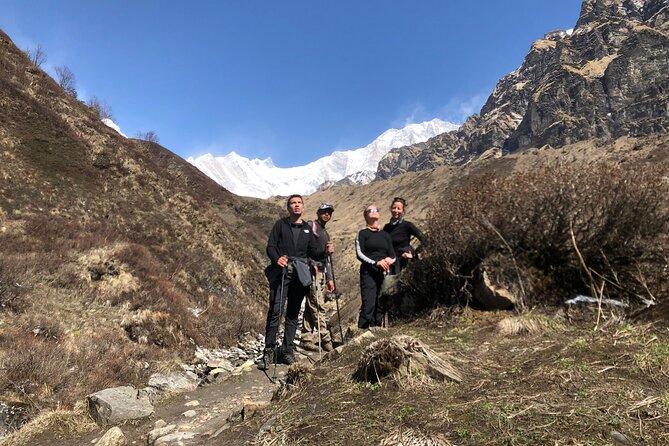
Lamjung Himal catches the morning light as you set out for Pisang. The route passes apple orchards, fir and pine forest, rocky slopes, and the narrow section of the valley near Bhratang.
After crossing bridges and following a high path, you continue toward Manang. The valley begins to feel drier and more open as the forest thins. The schedule lists about five hours of walking, though the changing elevation can make the day feel harder than the distance suggests.
Manang is one of the key stops on the circuit. It is not just a place to sleep. It is the base for acclimatization, mountain views, local walks, and practical preparation before Thorung La.
Day 5: Views of Annapurna III, Annapurna IV, and Braga
The trail climbs to a ridge with views over the Manang Valley and toward Tilicho Peak. You pass the airstrip at Humde before reaching broad plains where Annapurna III and Annapurna IV rise above the valley.
The route continues across the reduced Marsyangdi River toward Mungji and Braga. Braga is known for its striking monastery, which gives this section a strong cultural character as well as mountain scenery.
You finish in Manang after about five hours. The walking time looks manageable, but altitude is already a serious factor. Keep your pace slow, drink regularly, and tell your guide if you develop a headache or feel unwell.
Day 6: Acclimatization in Manang
This rest day is one of the most valuable parts of the schedule. You remain in Manang rather than pushing straight toward the pass. The options include walking toward an icefall, climbing above the village for wider views, visiting the Himalayan Rescue Association aid post, or going to Gangapurna Glacier Lake.
A rest day does not have to mean sitting indoors all morning. Short walks help you adjust, but the aim is not to tire yourself out. I would keep the day flexible and use it to check clothing, water, snacks, and footwear before the higher stages.
The presence of the rescue association aid post is useful context, but it does not replace travel insurance. Insurance is compulsory for the trek and should cover high-altitude trekking and emergency evacuation.
Day 7: Manang to Yak Kharka
The trail climbs gradually through Gunsang toward Yak Kharka. The route is listed at about four hours, yet this is where the thinner air begins to affect almost everyone.
The views are wide and open, with fewer trees and more exposed mountain slopes. You may find the walking distance easy on paper but slow in practice. Take short breaks, walk behind the guide at a comfortable pace, and avoid treating the day as a race.
Yak Kharka is a staging point before Thorung Phedi. The overnight stop helps divide the approach to the pass into more manageable sections.
Day 8: Yak Kharka to Thorung Phedi
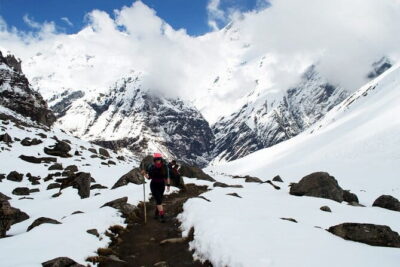
The trail reaches a ridge, descends toward the Marsyangdi headwaters, and crosses a covered wooden bridge. After a short climb, you follow a narrow path across an unstable scree slope before descending to Thorung Phedi.
This is a shorter day of about four hours, but the terrain deserves attention. A scree slope can be loose underfoot, and the final stop is high. Save energy for the pass crossing rather than using the day for extra wandering.
Thorung Phedi is your launch point for the early start on Day 9. A good night here depends partly on weather, fitness, and how your body is responding to altitude.
Day 9: Thorung La to Muktinath
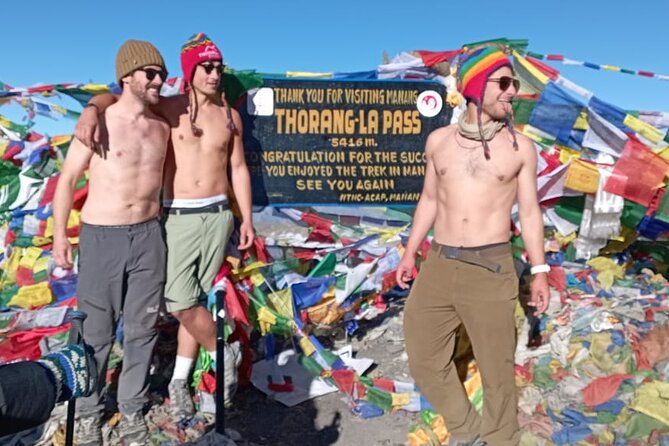
This is the hardest and most memorable day. You leave early and climb toward Thorung La, at 5,416 meters. The trail is well defined, but the altitude and steady uphill effort make the four-hour ascent demanding.
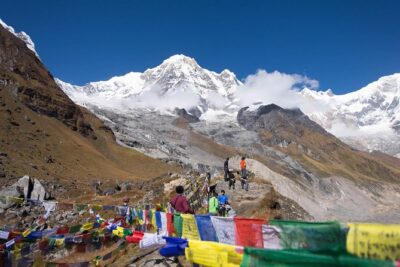
At the pass, prayer flags and a chorten mark the top. The views reach across snow-covered peaks toward the Kali Gandaki Valley and the brown and purple hills of Mustang. The setting changes sharply from the greener valleys below.
Then comes the long descent to Muktinath, dropping about 1,600 meters. The schedule gives the full day about eight hours. Your knees may feel the descent more than the climb, so trekking poles can be useful, although the package details do not state that they are provided.
This day is why you should not book the trip based only on the phrase all-levels hike. The route does not require climbing equipment, but it demands endurance, preparation, and sensible acclimatization.
Day 10: Muktinath to Tatopani by jeep
The morning begins with a visit to Muktinath, an important pilgrimage site. You return for breakfast, collect your bags, and take a jeep toward Tatopani along the Kali Gandaki River.
This is another major change in scenery and travel style. After the high pass and Muktinath’s dry mountain surroundings, the jeep ride carries you down the river corridor. It also saves time and reduces the amount of road walking on the lower section of the circuit.
The road can be rough, and local transport is part of the experience. If you prefer quiet trails with no vehicle sections, this itinerary may disappoint. If you value seeing more of Nepal in a limited number of days, the jeep transfer makes the 12-day plan possible.
Day 11: Tatopani to Ghorepani
The route returns to walking, first crossing flatter ground and then climbing steeply for at least an hour. The trail passes villages and farmland, with many local residents connected to the Gorkha and Indian regiments.
You continue through Phalate and Chitre toward Ghorepani. Rhododendron forest, oak, birds, and monkeys add variety to the seven-hour day. The route is greener here than around Muktinath, and the views open toward several mountain ranges.
This is a long day after the pass and jeep ride. Your legs may still be tired, so the uphill section can feel demanding. The reward is a comfortable position for the early walk to Poon Hill.
Day 12: Poon Hill sunrise and onward to Pokhara
You leave early for Poon Hill at 3,232 meters. The sunrise viewpoint looks toward Dhaulagiri, Tukuche Peak, Nilgiri, Annapurna I, Annapurna South, Annapurna III, Annapurna IV, Annapurna II, Machhapuchhre, Lamjung Himal, and other snow-covered summits.
After returning to the lodge for breakfast, you descend through rhododendron and oak forest toward Banthanti. The day is listed at about seven hours and ends with transport onward to Pokhara.
Poon Hill is a strong finish because it gives you one more mountain viewpoint after the main circuit. It is also an early morning climb, so do not expect a lazy final day. The route description is cut off before the final transport details, so confirm the exact Hile to Pokhara arrangement and arrival time.
Guides, porters, and group size
The company assigns a guide to handle route decisions, accommodation, and daily logistics. The stated ratio is one guide for up to 10 people, with two guides for groups of 11 to 14. The standard maximum for this activity is listed as 10 people.
The porter arrangement is one porter for every two trekkers, carrying about 20 kilograms total, or roughly 10 kilograms per person. You carry a day pack with water, sunscreen, a camera, a spare jacket, and similar essentials.
Several named guides receive especially warm praise in the supplied feedback, including Balaram Khadka, Jitu, Indra, Hom, Kapil, Rabi, Ram, and Amar. The common thread is attentive care, flexibility, help with small problems, and a strong focus on safety. That is important on a high route where a good guide does more than point out the trail.
Who should book this trek?
I would recommend it to you if you want a classic Nepal trek with organized support, tea house accommodation, cultural stops, and a major high pass. It suits people who accept early starts, local buses, jeep rides, basic lodges, and changing weather.
I would not choose it for a relaxed sightseeing holiday or for anyone expecting a gentle Sarangkot walk. The route reaches extreme altitude, includes long days, and requires compulsory travel insurance. The summary and detailed schedule also conflict, so confirm whether you are booking the Annapurna Circuit shown here or a separate Sarangkot and Dhampus program.
You can cancel for a full refund at least six full days before the start time. A 50 percent refund applies for cancellations made two to six full days before departure, while cancellations less than two full days before the start time are nonrefundable.
Should you book the Annapurna Circuit Trek?
Book it if the priorities are a high mountain pass, changing scenery, a small guided group, and a price that includes much of the basic trekking infrastructure. The combination of Manang acclimatization, Thorung La, Muktinath, and Poon Hill gives you a lot in 12 days.
Before booking, get written confirmation of the exact itinerary, city accommodation, pickup time, single supplement, porter arrangement, and transport from Ghorepani or Hile to Pokhara. If those details match your expectations, Outfitter Nepal offers a practical way to tackle a demanding and memorable section of the Himalayas.
FAQ
How long is the Annapurna Circuit Trek?
The scheduled experience lasts approximately 12 days, beginning with transport from Kathmandu and ending in Pokhara.
What is the highest point on the trek?
The highest point is Thorung La, which is listed at 5,416 meters.
Is a guide included?
Yes. An experienced guide is included, along with the guide’s salary, meals, accommodation, transportation, and insurance.
Are porters included?
The stated arrangement provides one porter for every two trekkers. A porter carries about 20 kilograms total, or approximately 10 kilograms from each trekker.
What accommodation is included?
Accommodation during the trek is in lodges or tea houses. The stated city accommodation is standard two or three-star lodging in Kathmandu and Pokhara, with upgrades available.
Are meals included?
The package includes 12 breakfasts, 12 lunches, and 11 dinners. Drinks, desserts, and city lunches and dinners are not included.
Is travel insurance required?
Yes. Your own travel insurance is compulsory, and the tour information specifically lists it as an excluded cost.
What is the cancellation policy?
A full refund is available if you cancel at least six full days before the start time. A 50 percent refund applies for cancellations made two to six full days before departure. Cancellations less than two full days before the start time are not refundable.
Recently added around Kathmandu
- Ghorepani Poon Hill Trek★ 5.0 · 16 reviews
- Private Manaslu Circuit Trek at Himalayas★ 5.0 · 3 reviews
- Amazing 1 Day Trekking Experience in Kathmandu Nepal★ 5.0 · 24 reviews
- Upper Mustang Trekking★ 5.0 · 2 reviews
- Ghorepani Poonhill Trek★ 5.0 · 5 reviews
- Upper Mustang Trekking★ 3.0 · 2 reviews
- Upper Mustang Trekking★ 5.0 · 4 reviews
- Upper Mustang Trek★ 5.0 · 5 reviews
Annapurna Base Camp Treks, compared.
Trekking in Annapurna/Langtang/Everest/Upper Mustang regions
Read our review →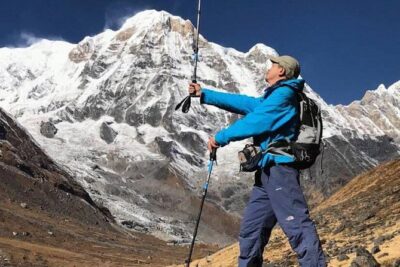
Kathmandu to Annapurna Base Camp (ABC) 5-Day Trek
Read our review →Browse the lists this tour appears in