
REVIEW · KATHMANDU
Annapurna Base Camp Trek
The mountains arrive one step at a time. This 13-day Annapurna Base Camp Trek combines Nepalese villages, rhododendron forests, hot springs, and a dramatic finish at Annapurna Base Camp, 4,130 meters above sea level. I like the way it mixes high mountain scenery with ordinary hill life, and I like the added sunrise walk to Poon Hill.
The route also has strong practical support. Airport transfers, permits, meals on most trekking days, a guide, and one porter for every two people are included. The main drawback is the physical demand: long stair climbs, steep descents, and altitude require real preparation, even though the trip is described as suitable for people with moderate fitness.
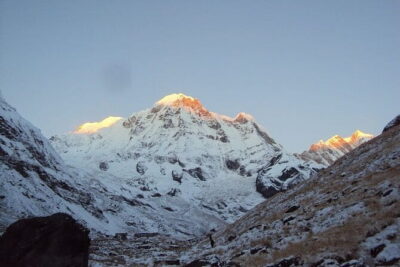
- Poon Hill sunrise: An early climb to 3,210 meters gives you a wide view of the Annapurna and Dhaulagiri ranges.
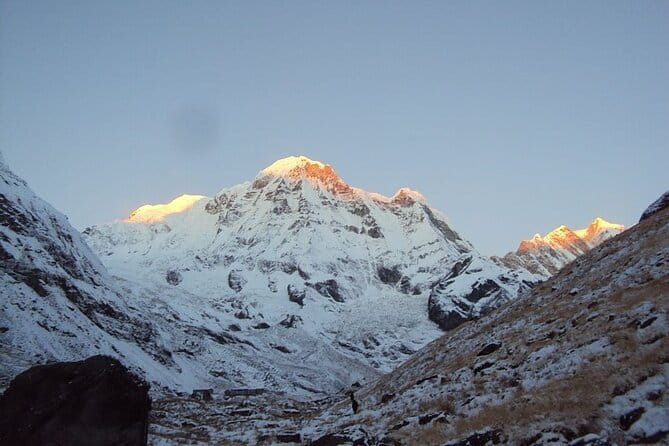
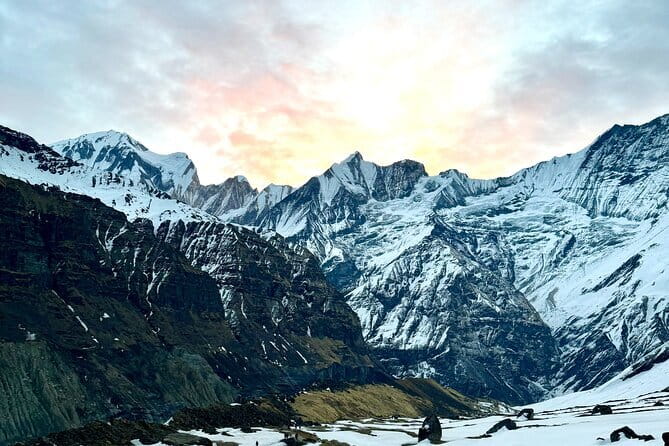
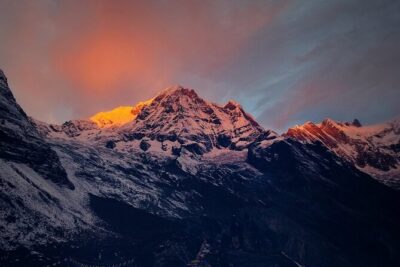
- Annapurna Sanctuary setting: Annapurna I, Annapurna South, Machapuchhre, and Hiunchuli surround the base camp.
- A changing route: You walk through low valleys, Magar and Gurung villages, bamboo, oak, pine, and rhododendron forests.
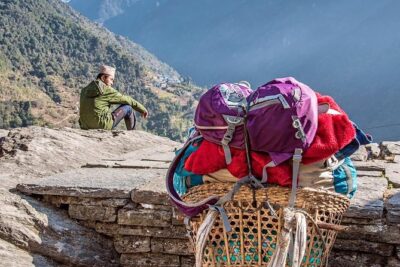
- Porter and guide support: One porter is assigned for every two clients, with English-speaking trekking leadership.
- A useful city-to-mountain plan: Kathmandu, Pokhara, the trek, and a farewell dinner fit into one organized trip.
- Strong customer record: The tour carries a 5 rating from 107 reviews, with 100 percent recommending it.
What the Annapurna Base Camp route feels like
This is not a quick walk to a viewpoint. You begin in Kathmandu, travel by road to Pokhara, then walk from Nayapul through villages and forest before reaching the high sanctuary. The route gains and loses height repeatedly, so the daily distance does not tell the whole story.
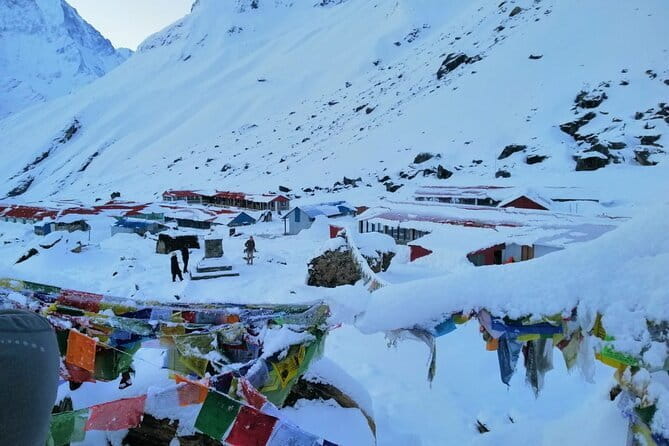
You will spend nights in guesthouses, often in twin-share or dormitory rooms. These are practical mountain lodgings rather than luxury hotels. Kathmandu and Pokhara include three-star hotel accommodation, while the eight trekking nights focus on shelter, food, and location close to the trail.
I find the route appealing because it gives you several different rewards. You get the classic Himalayan sunrise at Poon Hill, the cultural feel of Magar and Gurung settlements, and then the enclosed mountain amphitheater around Annapurna Base Camp. The scenery changes often enough that the walk does not feel like a single repetitive climb.
The route also has a clear physical rhythm. Day 3 is fairly gentle, Day 4 brings a serious stair climb to Ulleri, and the final approach to ABC puts you above 4,000 meters. You then retrace much of the trail, descend sharply, and finish with hot springs at Jhinu Danda.
Kathmandu arrival and the practical first day
Your trip begins at Tribhuvan International Airport, where an Ace the Himalaya representative meets you with a sign and transfers you to your hotel in a private tourist vehicle. That simple pickup matters after a long international flight, especially if Kathmandu is new to you.
A pre-trek meeting takes place on either Day 1 or Day 2. Bring your passport, three passport photos, and a readable copy of your travel insurance policy. You also need to settle any remaining balance and sign the trip forms.
The meeting is a useful checkpoint. You meet your guide, check the basic plan, and make sure your insurance covers emergency high-altitude rescue and evacuation. That insurance is not included in the $1,350 price, and it should be treated as essential rather than optional.
The company provides a duffel bag and sun hat. Pack lightly. One person who completed the trek offered the bluntest useful advice: do not bring more clothes than needed, since porters carry the load. The other practical tip was even clearer: train on stairs. You will meet plenty of them.
More Annapurna Treks in Kathmandu
- Annapurna Circuit Trek with Tilicho Lake
★ 5.0 · 368 reviews - Annapurna base camp trek 5 Days
★ 5.0 · 252 reviews - 14-Day Private Annapurna Base Camp Trek
★ 5.0 · 180 reviews
Kathmandu to Pokhara: a long road day
On Day 2, staff collect you from your hotel at 6:30 a.m. and take you to the tourist bus station. The bus leaves around 7:30 a.m. and takes you to Pokhara, a smaller and calmer base beside Phewa Lake.
This is a long transfer day, listed at about 12 hours. That is the price of going overland rather than flying. The road journey takes time, but it puts you directly into the gradual change from capital city to mountain town.
Pokhara is more than an overnight stop. You have views toward Annapurna and Machapuchare, the distinctive fish-tail peak, along with Dhaulagiri, Lamjung Himal, and Manaslu. The two included hotel nights in Pokhara also give you a little breathing room before and after the trek.
Nayapul to Tikhedhunga: an easy introduction
From Pokhara, a private vehicle takes you for about an hour to Nayapul, where the walking begins. The trail follows the Modi Khola for about 15 minutes before reaching Birethanti at 1,015 meters.
Birethanti is a substantial village with shops and tea houses. From there, the path follows the Bhurungdi Khola and climbs steadily through the valley to Hille at 1,495 meters, then to Tikhedhunga at 1,570 meters.
This first walking day is relatively short and easy. I like that design. You get your first feel for the trail without being thrown straight into the hardest ascent. It is also a good time to see if your boots, pack, and walking pace are working well.
Ulleri and Ghorepani: the stair test begins
Day 4 is a different matter. The trail rises steeply to Ulleri, a large Magar village at 2,070 meters. This is one of the route’s best-known stair sections, and it tests your legs early.
After Ulleri, the gradient eases as you walk through oak and rhododendron forest toward Banthanti at 2,250 meters. The path continues to Nangethanti at 2,460 meters, then reaches Ghorepani at 2,840 meters after about an hour more walking.
Ghorepani is important for two reasons. It is a mountain village and overnight stop, but it also sets up the next morning’s sunrise walk. The forest sections are attractive, yet the climb can feel hard if you have not trained for sustained steps.
Same trailhead, a longer or shorter day out:
- Everest Base Camp Trek – 14 Days
★ 5.0 · 1,499 reviews - Everest Base Camp Trek
★ 5.0 · 842 reviews - Everest Base Camp Trekking
★ 5.0 · 485 reviews - Everest Base Camp Trekking – 13 Day
★ 5.0 · 365 reviews
Poon Hill at sunrise and the trail to Tadapani
You leave very early on Day 5 for the one-hour climb to Poon Hill, at 3,210 meters. The goal is sunrise over the high Himalayas. You spend about an hour at the viewpoint before returning to Ghorepani for breakfast.
Poon Hill gives the trip an excellent early payoff. You do not need to wait until ABC for your first big mountain panorama. The morning climb is short, but darkness, cold, and altitude can make it feel more serious than the distance suggests.
After breakfast, the trail follows ridges and passes through pine and rhododendron forest toward Deurali at 2,960 meters. You descend to Banthanti, then turn toward Tadapani.
This day combines an early rise, a climb, a descent, and several hours of trail walking. Pace yourself at Poon Hill. The base camp is still ahead, and saving energy is smarter than treating the viewpoint like a race.
Tadapani to Chhomrong: forest, descent, and Gurung country
Day 6 begins with a steep descent through rhododendron forest. From Tadapani, the trail drops toward Gurjung, a village associated with the Gurung people, before an easier walk to Chhomrong at 2,140 meters.
Chhomrong is one of the key settlements on the route. It gives you a strong sense of the lived-in mountain trail, with village houses and tea houses rather than an empty wilderness. The descent can be tough on knees, so trekking poles may be useful, though personal equipment is not included.
The route loses height here before climbing again later. That pattern can be frustrating if you expect every day to move upward, but it is part of the Annapurna approach. The trail follows the contours of deep valleys rather than taking a simple straight line.
Chhomrong to Dovan: bamboo forest and a steep gorge
The next stage drops to the Chomrong Khola, then climbs toward Khuldighar at 2,380 meters. An Annapurna Conservation Area check post once operated here. Farther on, the route drops steeply down a rocky section and reaches the bottom of the gorge.
From there, you walk through bamboo and rhododendron forest along the west side of the river. The day continues toward the Himalayan Hotel area and Dovan.
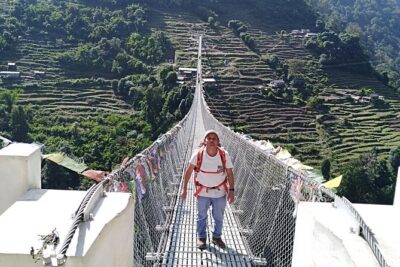
This part of the trek feels more enclosed than the open views around Poon Hill. Forest, river, and steep valley walls dominate. It is also a reminder that the Annapurna route is not just a parade of distant peaks. Much of the pleasure comes from walking through changing plant zones and small settlements.
Machapuchare Base Camp to Annapurna Base Camp
Day 8 brings the main goal. The trail passes Hinko Cave and Deurali before reaching Machapuchare Base Camp. The name can be misleading: Machapuchare Base Camp is not a climbing base camp because climbing Machapuchare is not permitted.
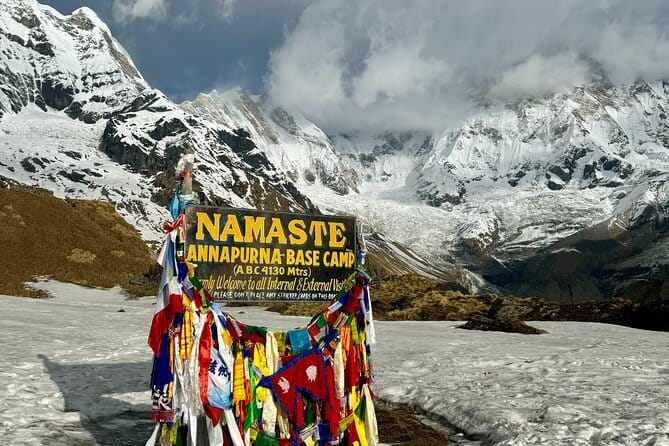
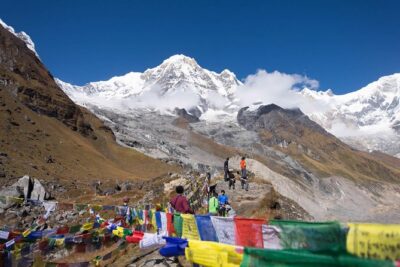
From Machapuchare Base Camp, it takes about two hours to reach Annapurna Base Camp at 4,130 meters. Here, Annapurna I rises to 8,091 meters, with Annapurna South, Machapuchhre, and Hiunchuli forming the surrounding mountain walls.
This is called the Annapurna Sanctuary because the peaks enclose the upper valley. The setting is unusually concentrated: you are not simply looking at one mountain across a wide valley. You are surrounded by major summits.
The altitude deserves respect. The itinerary calls for moderate fitness, but fitness alone does not prevent altitude problems. Your guide should control the pace, and you should report headaches, nausea, unusual fatigue, or other symptoms early.
The long descent to Bamboo
The following day retraces the trail. The route drops about 1,700 meters to the Modi Khola and continues to Bamboo at 2,345 meters, where tea houses and lodges are available.
Descending can seem easier than climbing, but it brings its own strain. The knees take repeated impact, especially after the high point of the trek. Keep your pace steady and avoid rushing simply because the trail points downhill.
The return also lets you notice details missed on the way up. The same bamboo corridors, waterfalls, bridges, and village sections feel different when the pressure of reaching base camp has passed.
Jhinu Danda and the natural hot springs
Day 10 follows the trail back toward Chomrong, then descends steeply to Jhinu Danda. The route passes through rhododendron and bamboo areas, with an experimental sheep farm near Khuldighar.
Jhinu is the trek’s recovery stop. Natural hot springs offer a chance to soak after several hard days on the trail. This is one of the itinerary’s smartest inclusions because it gives the return journey a distinct reward rather than making it only a retraced route.
The steep descent into Jhinu can still be demanding. Do not assume the hot springs make the whole day easy. They are a pleasant finish, not a substitute for careful footing.
Walking beside the Modi Khola and returning to Pokhara
On Day 11, you walk along the right side of the Modi Khola for about four and a half hours to Birethanti, then continue to Nayapul. The route is described as one of the most relaxing walks of the trek.
From Nayapul, a one-hour drive returns you to Pokhara. After checking into the hotel, you take a boat trip on Phewa Lake to Barahi Temple.
This day is a good contrast to the high mountain sections. The river walk lets you ease out of trekking mode, while the lake gives you a calm evening before the road trip back to Kathmandu.
Kathmandu return, farewell dinner, and airport departure
You drive back to Kathmandu on Day 12. The trip includes a farewell dinner at a traditional Nepalese restaurant with cultural performances.
The return day can also be used to extend your Nepal visit. Options listed include a Chitwan jungle safari, river rafting, a Kathmandu shopping tour, and mountain biking. Those extras are not part of the $1,350 package, so plan and budget for them separately.
On Day 13, an airport representative takes you to Tribhuvan International Airport. The activity begins and ends in Kathmandu, with airport transfers included.
What the $1,350 price includes
At $1,350 per person, the value depends on how much support you want. The cost covers two nights in a three-star hotel in Kathmandu, two nights in a three-star hotel in Pokhara, and eight trekking nights in twin-share or dormitory guesthouse rooms.
It also includes a licensed English-speaking guide, one porter for every two clients, trekking permits, the Kathmandu to Pokhara tourist bus, transport between Pokhara and Nayapul, and most meals during the trek. Breakfast is included for all 12 nights or mornings listed, while lunch and dinner are included on nine days.
You still pay for lunch and dinner in Kathmandu and Pokhara, drinks, alcohol, personal equipment, international airfare, Nepal entry visa, insurance, and tips. Tipping is expected for the trekking staff and driver, so include it in your planning.
The package is strongest for someone who wants the difficult logistics handled. You are not arranging permits, road transfers, porters, or daily trekking support on your own. If you prefer independent travel and already own the equipment, you may find a guided package less flexible. If you want a clear route with organized support, the cost is easier to justify.
Guide and porter support
The strongest pattern in the customer feedback is praise for the guides and porters. Names specifically associated with positive experiences include Raj, Mahesh, Ramesh Karki, Bhawishya KC, Maddy, Ganesh, Shyam, Dilip, Resham, Sunil, and Roonan.
The practical value of this support becomes clear on a hard day. Guides help with pacing and route decisions, while porters carry the main load. Past groups also praised the encouragement and good humor of porters such as Prakash, Bhagwan, Tenzing, Shantiraj, Ram Prasad, Tika Ram, and Lumbu Dai.
The group size can reach 15 people. That is small enough for a social trek but large enough that walking speeds may differ. Ask about the expected group composition and guide arrangement before departure if you want a quieter or more private outing.
Who should book this Annapurna trek?
I would recommend it to you if you want a classic Nepal trek with a defined schedule, mountain lodges, cultural contact, and professional support. It suits people who can handle repeated climbs and descents over nearly two weeks.
You should prepare with stair training, regular walking, and a light personal pack. The route is not technical climbing, but the altitude and repeated elevation changes make it more than a casual holiday.
I would be cautious about booking if you dislike shared rooms, long road transfers, early starts, or basic mountain accommodation. You also need insurance that covers high-altitude rescue and evacuation.
Cancellation is flexible up to three full days before the start for a full refund. Changes or cancellations inside that window are not refunded, and poor weather may lead to a new date or a full refund.
Should you book the Annapurna Base Camp Trek?
Book it if you want a well-supported route that delivers several major Nepal experiences in one trip: Poon Hill sunrise, Magar and Gurung villages, forest trails, Machapuchare, Annapurna Sanctuary, hot springs, and Pokhara.
The best reason to choose this package is the balance between organization and authentic trail time. You still walk through villages and forests under your own power, but the agency handles permits, transport, guides, porters, and most meals.
Skip it if you want a short, soft adventure or private hotel comfort throughout. For a fit walker willing to train for stairs and accept simple guesthouses, this is a strong-value route to one of Nepal’s most dramatic mountain settings.
FAQ
How long is the Annapurna Base Camp Trek?
The trip lasts approximately 13 days, including arrival and departure in Kathmandu, transfers to and from Pokhara, the trek, and the return journey.
What is the highest point on the trek?
Annapurna Base Camp is at 4,130 meters, or 13,549 feet. Poon Hill reaches 3,210 meters.
Is airport pickup included?
Yes. An airport representative meets you at Tribhuvan International Airport in Kathmandu and transfers you to your hotel. An airport drop-off is also included at the end.
Are meals included?
Breakfast is included for 12 days. Lunch and dinner are included for nine days. Lunch and dinner in Kathmandu and Pokhara, drinks, and alcoholic beverages are not included.
What accommodation is provided?
You receive twin-share or double rooms in three-star hotels for two nights in Kathmandu and two nights in Pokhara. During the trek, accommodation is in guesthouses with twin-share and dormitory rooms for eight nights.
Is travel insurance included?
No. You must arrange your own travel insurance, and it must cover emergency high-altitude rescue and evacuation.
What happens if bad weather cancels the trek?
If poor weather causes cancellation, you will be offered a different date or a full refund. For a standard cancellation, you must cancel at least three full days before the start time to receive a full refund.
Recently added around Kathmandu
- Ghorepani Poon Hill Trek★ 5.0 · 16 reviews
- Amazing 1 Day Trekking Experience in Kathmandu Nepal★ 5.0 · 24 reviews
- Private Manaslu Circuit Trek at Himalayas★ 5.0 · 3 reviews
- Ghorepani Poonhill Trek★ 5.0 · 5 reviews
- Upper Mustang Trekking★ 5.0 · 2 reviews
- Upper Mustang Trekking★ 3.0 · 2 reviews
- Upper Mustang Trekking★ 5.0 · 4 reviews
- Upper Mustang Trek★ 5.0 · 5 reviews
Annapurna Base Camp Treks, compared.
Trekking in Annapurna/Langtang/Everest/Upper Mustang regions
Read our review →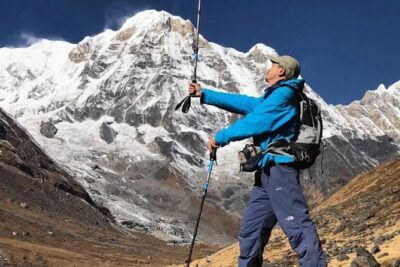
Kathmandu to Annapurna Base Camp (ABC) 5-Day Trek
Read our review →
Browse the lists this tour appears in