
REVIEW · KATHMANDU
Annapurna Tilicho Lake Trek
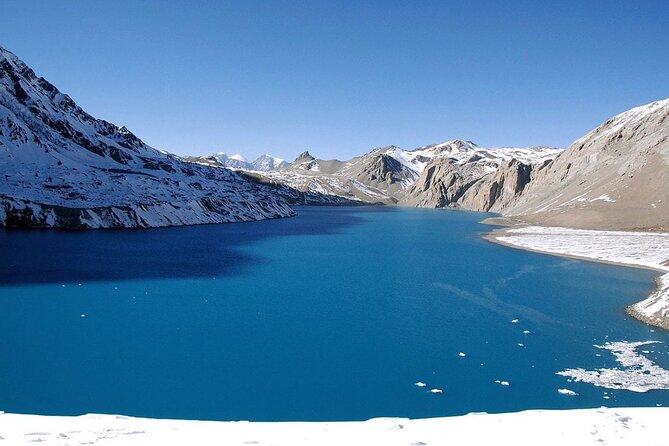
One lake, one pass, twenty days of mountain walking. The Annapurna Tilicho Lake Trek links forest trails, high Himalayan villages, the 5,416-meter Thorong La, and sunrise at Poon Hill. I like the route’s variety, and I like the sensible acclimatization day in Manang before the hardest walking. The main caution is the altitude: Tilicho Lake and Thorong La demand steady fitness, patience, and proper preparation.
The trip costs $1,430 per person, with a maximum group size of 12. That is a fair package price for permits, guides, porters, some city hotels, equipment, and transport, but meals during the trek, insurance, drinks, hot showers, and personal gear are extra. You should budget for those costs before booking.
Key points to know before you book
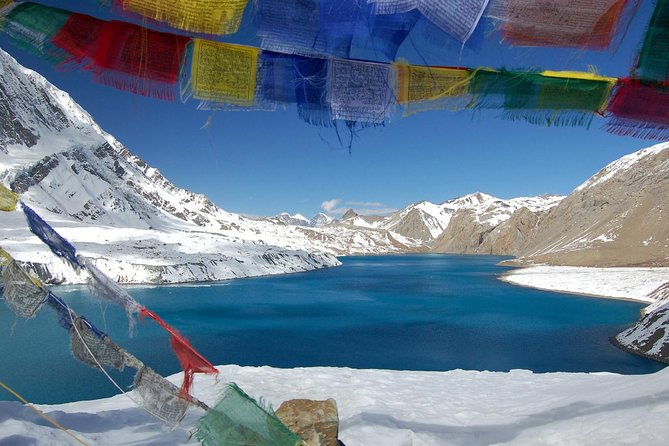
- Tilicho Lake reaches roughly 4,919 meters, with steep scree, loose rock, and a long high-altitude day from base camp.
- Thorong La rises to 5,416 meters, making Day 13 the toughest and most important day of the route.
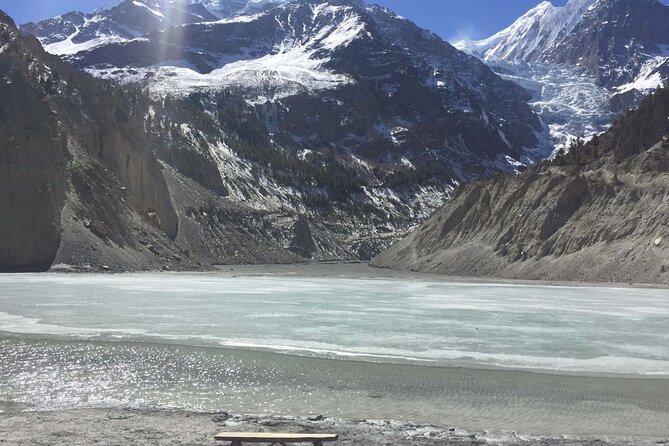
- Manang includes a full acclimatization day, with suggested walks to Bodzo Gompa and Gangapurna Lake.
- Poon Hill adds a sunrise finish, reached before breakfast from Ghorepani.
- The route changes dramatically, from river gorges and oak forest to dry Tibetan-style valleys and apple-growing villages.
- The package includes a guide, porters, permits, a sleeping bag, down jacket, and trekking bag, but not most meals or travel insurance.
What this 20-day Annapurna route really involves
This is not a short scenic walk with a few hard patches. It is a serious Himalayan trek with long days, rough roads, high passes, and two major altitude objectives. You follow the Annapurna Circuit from Syange to Manang, leave the main valley for Tilicho Lake, return toward the circuit, cross Thorong La, descend through Mustang, and finish with the Poon Hill route before returning to Kathmandu.
The daily walking times range from about three to eight hours. Those figures do not include every rest stop, meal, photo break, or delay. Road conditions also matter. The early transfer to Syange uses a private vehicle and then a local jeep on a bumpy, winding road, while the return from Nayapul to Pokhara uses private transport.
You should be comfortable walking uphill for several hours and descending on uneven ground. The tour calls for moderate physical fitness, but I would treat that as a minimum. The high points are demanding even for fit people because altitude changes the rules.
More Annapurna Treks in Kathmandu
- Annapurna Circuit Trek with Tilicho Lake
★ 5.0 · 368 reviews - Annapurna base camp trek 5 Days
★ 5.0 · 252 reviews - 14-Day Private Annapurna Base Camp Trek
★ 5.0 · 180 reviews
Arrival in Kathmandu and the long road to Syange
Your trip begins with an airport pickup in Kathmandu. A representative meets you at the airport, then takes you to your hotel by private vehicle. The arrival transfer is short, listed at about 30 minutes, and gives you a simple start after an international flight.
Day 2 is less about walking than getting into the mountains. You drive from Kathmandu along the Prithivi Highway beside the Trishuli River, then turn toward Besisahar and Lamjung. The road passes hillsides, small settlements, streams, and green valleys before the route changes to a local jeep for the final stretch to Syange.
Allow a full day for this transfer. The road is described as bumpy and winding, so this is not a polished coach ride. It is part of the experience, though you should not expect much sightseeing comfort. Syange itself is a small village with waterfalls nearby and serves as the practical starting point for the trek.
Syange to Manang, with forests and changing scenery
The walking begins on Day 3 with a rising and falling trail toward Chamje. You cross a suspension bridge, climb through oak forest, and enter a narrow gorge cut by the Marshyangdi River. Waterfalls become a regular feature, and the trail reaches Tal, a village at about 1,700 meters below a large waterfall.
From Tal onward, pay attention to local customs. At mani walls, walk on the left side. You cross the Marshyangdi several times on suspension bridges before reaching Dharapani after roughly six to seven hours.
Day 4 brings a gentler climb from Dharapani to Bagarchap, where Annapurna II comes into view. At Temang, you can look back toward the Manaslu Range. The vegetation shifts toward pine and fir, and apple orchards appear near Thanchok. The day ends around Chame after about six hours.
From Chame to Pisang on Day 5, the path follows the river through blue pine and fir forest. Brathang has a past connected with Tibetan resistance, though today it is known mainly for its apple orchard and tea houses. The route then clings to a cliff before crossing a bridge below the huge rock face of Mui Tscho, also called Paunde Danda.
Pisang marks a clear change in the trip. The valley opens, the air becomes drier, and the mountains feel closer. You have the option of upper and lower routes around the Marshyangdi on the next day.
The scenic northern route to Manang
Day 6 takes you toward Manang through the drier upper part of the district. The Annapurna Range blocks much of the monsoon, creating a noticeable contrast with the wetter forests below. People here herd yaks and grow crops during part of the year.
The northern route through upper Pisang, Ghyaru, and Ngawal involves more climbing than the southern route through Hongde, but it offers better mountain views. That choice matters. If your legs are fresh and the weather is clear, the higher route gives you a stronger sense of the old mountain villages and the broad valley. If you are tired, the lower route is less demanding.
You reach Manang after about five hours. The village is a major stopping point, with lodges, an airstrip at nearby Hongde, and the Himalayan Rescue Association. The presence of a medical post is reassuring, but it is not a reason to ignore symptoms. Altitude sickness can become serious quickly.
Day 7 is the trip’s dedicated acclimatization day. Keep walking, but keep it easy. Short hikes toward Bodzo Gompa or Gangapurna Lake help you spend time at altitude without adding a full trekking day. The next two days toward Tilicho Lake bring a faster rise, so this rest day is one of the route’s most valuable features.
Same trailhead, a longer or shorter day out:
- Everest Base Camp Trek – 14 Days
★ 5.0 · 1,499 reviews - Everest Base Camp Trek
★ 5.0 · 842 reviews - Everest Base Camp Trekking
★ 5.0 · 485 reviews - Everest Base Camp Trekking – 13 Day
★ 5.0 · 365 reviews
The hard side trip to Tilicho Lake
From Manang, you leave the main Annapurna Circuit and head west toward Khangsar. Day 8 involves a descent toward the river, a crossing, conifer forest, and a steep, exposed section of scree. You reach Khangsar after about five hours.
Day 9 is a longer seven-hour walk toward Tilicho Base Camp. The route passes a gompa and climbs toward a high ridge. A newer path avoids some of the steep scree on the old route, then descends by switchbacks into a side valley. Tilicho Base Camp sits beside a brook at the bottom.
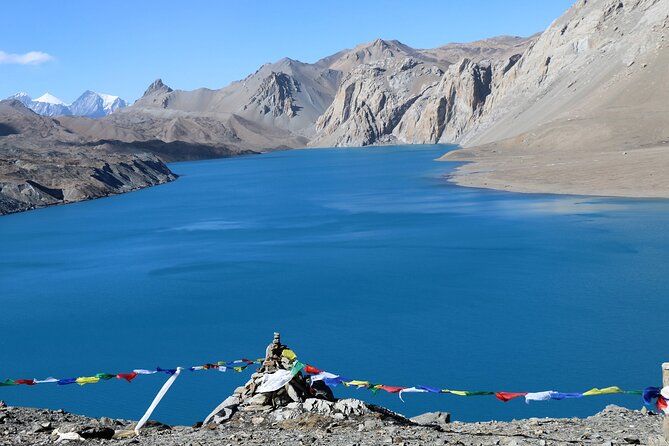
The lake day is the trek’s great test. From base camp, the path climbs over loose scree and boulders toward Tilicho Lake, described as the world’s highest lake. The route includes steep sections, faint tracks, a glacier without crevasses, and more than one saddle. Conditions can affect how clear or usable the path feels, so listen closely to your trek leader.
This is a seven-hour day, but that number should not make you casual. At high altitude, a moderate slope can feel like a wall. Walk slowly, drink regularly, and do not race to the lake for a photograph. The reward is a remote mountain basin and the feeling of reaching a place that requires real effort.
Returning to the circuit and preparing for Thorong La
After Tilicho Lake, you retrace part of the route toward Kangsar and continue to Yak Kharka. The path passes old mani walls, meadows, a small river, and a wooden bridge. The day takes about six hours.
The advice here is simple and sound: gain height gradually. Yak Kharka is not a glamorous stop, but it is an important one. You are positioning yourself for Thorong Phedi while giving your body another chance to adjust.
Day 12 is shorter, roughly three to four hours of walking to Thorong Phedi. The settlement is busy because it serves as the base for people crossing the pass. Some groups try to sleep at High Camp to shorten the next morning, but this program recommends staying at Thorong Phedi rather than sleeping higher.
That choice means a harder pass day, but it avoids spending the night at an even higher altitude. I prefer the conservative approach. A tough day in motion is usually a better plan than a poor night of sleep above 5,000 meters.
Thorong La at 5,416 meters
Day 13 is the physical centerpiece. You start early and climb from Thorong Phedi toward High Camp and then the pass. The path includes false summits, loose ground, and increasingly thin air before reaching Thorong La at 5,416 meters.
The scenery at the top is the payoff, with broad Himalayan views in every direction. Still, this is not a casual viewpoint walk. The route description itself advises a slow pace, and you should take that seriously. The pass crossing is strenuous and long, with the altitude making every step count.
After the pass, you descend toward Muktinath. The change from ascent to descent can be hard on knees, especially after several hours of effort. Trekking poles are useful, and you should resist the temptation to hurry simply because the trail is going downhill.
Muktinath, Marpha, and the Kali Gandaki Valley
Muktinath is a spiritual high point of the trip. You visit the temple in the morning, then descend toward Ekley Bhatti and Jomsom. The descent is steep in places, and careful footing matters.
Jomsom is known for strong afternoon winds. A full face mask and wind-stopper jacket are specifically recommended. This is also where the route begins to feel distinctly different, with dry valleys, wide riverbeds, and villages connected to the Mustang region.
Day 14 ends at Marpha after about seven hours. Marpha is known for apples, and the trip includes time to celebrate apple day. Local tea shops, apple brandy, tea, and coffee add character, but alcohol is not the best choice if you are dehydrated or still recovering from the pass.
From Marpha, you continue through Tukuche, Largung, and Kobang toward Kalopani. The walking is mostly flatter, with views toward Dhaulagiri and its icefall. There is also the possibility of an industrial visit to Tikuche Distillery, though the main attraction remains the valley and mountain views.
Day 16 descends more than 1,000 meters from Kalopani to Tatopani. You pass Dana and see the Kali Gandaki Gorge, described here as the deepest in the world. The route continues downhill for about three hours before reaching Tatopani, where a natural hot spring offers a welcome soak.
Tatopani to Poon Hill and Pokhara
The trip saves one of its biggest climbs for late in the route. From Tatopani at about 1,190 meters, you climb to Ghorepani at about 2,780 meters. The seven-hour day passes villages including Ghare, Shika, Phalate, and Chhitre, with Magar and Gurung communities along the way.
This is a good reminder that the trek is not simply a long descent after Thorong La. You still need strong legs for a major uphill day. Go to bed early in Ghorepani because the next morning begins before sunrise.
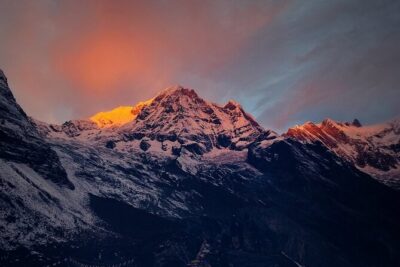
On Day 18, you hike for roughly 45 minutes to an hour toward Poon Hill. The viewpoint is famous for sunrise over the Annapurna and Dhaulagiri ranges. You return to Ghorepani for breakfast, then continue through Ulleri, Tikhedhunga, and Birethanti toward Nayapul.
The day can total about eight hours. After reaching Nayapul, private transport takes you to Pokhara. The combination of sunrise, a final long descent, and a road transfer makes this a full finish rather than a gentle farewell.
What the $1,430 price includes
The cost has real value for a supported high-altitude trek. Included services are:
- Airport pickup and selected ground transfers
- Trek permits, including ACAP and TIMS
- An English-speaking, government-licensed trek leader
- Assistant guide support at a ratio of one assistant for every four trekkers
- One porter for every two trekkers
- Staff wages, insurance, food, equipment, and accommodation
- Down jacket and sleeping bag, returned after the trip
- Trekking bag, T-shirt, and trekking map to keep
- Medical kit carried by the trek leader
- Two nights with breakfast at a deluxe Kathmandu Suite Home Hotel
- One night with breakfast at a deluxe Mount View hotel in Pokhara
- Welcome and farewell dinners
- Transfer from Pokhara to Kathmandu by tourist bus
- Private transport from Nayapul to Pokhara
The price does not cover international flights, travel insurance, Nepal’s entry visa, personal equipment, hot showers, Wi-Fi, cold drinks, staff tips, or meals during the trek. The meal information is worth checking carefully before payment because the package mentions breakfast inclusions, while breakfast, lunch, and dinner during the trek are listed as excluded.
There is also a small accommodation inconsistency in the details: selected Kathmandu and Pokhara nights are described as included, while separate wording says accommodation in Kathmandu and Pokhara is not included. Ask Accessible Adventure Pvt. Ltd. to confirm exactly which nights and hotels are covered.
Group size, support, and practical booking details
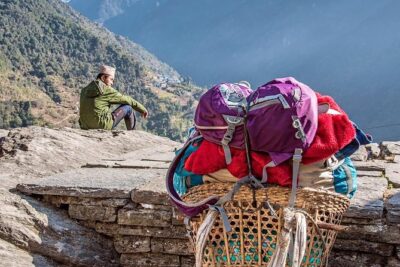
The maximum group size is 12, which is small enough for the guide to keep an eye on the group without promising a private trek. Porter support is especially useful here, since your daypack can stay lighter while you focus on altitude and footing.
The organizer is Accessible Adventure Pvt. Ltd. One past customer specifically praised the support and organization provided by a staff member named Himal during weather disruption. Another described the planning help as friendly and useful. The feedback is limited, but it points to a team that takes logistics seriously.
Pickup is offered, mobile tickets are available, and confirmation is provided at booking. The listed start time is 7:00 a.m. Free cancellation is available up to 24 hours before the local start time. After that point, the payment is not refunded, and late changes are not accepted.
Who should book this trek?
You should consider it if you want one trip to combine the Annapurna Circuit, Tilicho Lake, Thorong La, Mustang villages, hot springs, and Poon Hill. It suits someone who enjoys long walking days and accepts basic mountain lodging, rough transport, and changing weather.
It is less suitable if you want a relaxed holiday, dislike steep descents, or have no experience with extended physical activity. The word moderate in the fitness description should not be read as easy. You need enough endurance for repeated six to eight-hour days, plus the mental patience to move slowly at altitude.
FAQ
How long is the Annapurna Tilicho Lake Trek?
The scheduled trip lasts 20 days, including arrival and departure days, and is described as approximately 20 days.
What is the highest point on the trek?
Thorong La is the highest point, at 5,416 meters.
How high is Tilicho Lake?
The experience describes Tilicho Lake as the world’s highest lake. The route reaches it through Tilicho Base Camp and includes steep scree, boulders, saddles, and a glacier section.
Is there an acclimatization day?
Yes. Day 7 is a full acclimatization day in Manang, with short walks suggested toward Bodzo Gompa and Gangapurna Lake.
Are meals included?
Breakfast is included on selected hotel stays, and welcome and farewell dinners are included. Meals during the trek are listed as excluded, so you should budget separately for breakfast, lunch, and dinner on trekking days.
Is travel insurance included?
No. Travel insurance is excluded and must be arranged separately.
What happens if I need to cancel?
You can receive a full refund if you cancel at least 24 hours before the experience start time. Cancellations or changes made less than 24 hours before the start are not accepted for a refund.
Should you book it?
Book this trek if you want a demanding, well-supported mountain route with several different rewards instead of one single viewpoint. Tilicho Lake adds the remote high-altitude challenge, Thorong La supplies the big achievement, and Poon Hill provides a more accessible sunrise finale.
Before paying, confirm the Kathmandu and Pokhara accommodation details, clarify exactly which meals are covered, and price your insurance, drinks, showers, tips, and personal gear. If you accept those extras and prepare properly for altitude, the $1,430 package offers a strong amount of support for a 20-day journey through some of Nepal’s finest mountain country.
Recently added around Kathmandu
- Ghorepani Poon Hill Trek★ 5.0 · 16 reviews
- Private Manaslu Circuit Trek at Himalayas★ 5.0 · 3 reviews
- Amazing 1 Day Trekking Experience in Kathmandu Nepal★ 5.0 · 24 reviews
- Ghorepani Poonhill Trek★ 5.0 · 5 reviews
- Upper Mustang Trekking★ 5.0 · 2 reviews
- Upper Mustang Trek★ 5.0 · 5 reviews
- Upper Mustang Trekking★ 3.0 · 2 reviews
- Upper Mustang Trekking★ 5.0 · 4 reviews
Annapurna Base Camp Treks, compared.

Trekking in Annapurna/Langtang/Everest/Upper Mustang regions
Read our review →
Kathmandu to Annapurna Base Camp (ABC) 5-Day Trek
Read our review →Browse the lists this tour appears in