
REVIEW · KATHMANDU
Annapurna Circuit Trekking: 15 days
Thorong La is the great test. This 15-day route links Kathmandu sights, traditional mountain communities, high Himalayan views, and the 5,416-meter Thorong La Pass in one demanding trip. I like the mix of culture and scenery, especially the stop at Manang for altitude adjustment and the finish through Muktinath and Tatopani. I also like that private transport, guides, city hotels, and three daily meals are included in the main trekking plan.
The catch is simple: this is a serious high-altitude trek, not a gentle walking holiday. Several days run six to eight hours, and the crossing of Thorong La reaches 5,416 meters. The package is also not all-inclusive in the city, and drinks, insurance, visa fees, personal costs, and tips are extra.
Key points to know before booking
- Thorong La reaches 5,416 meters, making Day 13 the physical high point of the trip.
- Manang includes a rest day, a valuable pause before the route climbs above 4,000 meters.
- The trip combines private travel and a private trek, so only your own group participates.
- Kathmandu sightseeing covers four major sites: Pashupatinath, Boudhanath, Swayambhunath, and Kathmandu Durbar Square.
- The route ends with Muktinath, Tatopani, and Pokhara, giving you both mountain culture and a softer finish.
- Guides receive especially strong praise for care and support, with Ramhari Neupane, Ram, Dendi, Shiva, and porter Susan named in the supplied comments.
What you are really signing up for
The Annapurna Circuit is appealing because it changes character as you go. You begin with Kathmandu’s temples and crowded streets, then move by road into the foothills. From there, the route climbs through villages, river valleys, forested sections, and dry high country before crossing Thorong La.
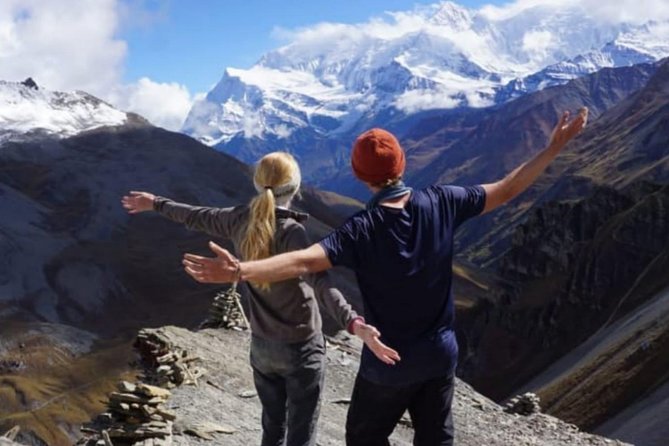
That variety is the main reason I like this trip. You are not simply walking toward one viewpoint and turning around. The route circles the Annapurna region and includes views of the Annapurna Massif, the Dhaulagiri Range, and other snow-covered peaks. It also passes through the Kali Gandaki area, known for the world’s deepest gorge.
The schedule is compact. Fifteen days gives you a clear route, but not much spare time if weather, road conditions, or altitude cause delays. You should arrive ready for long walking days and accept that the plan may need to change. One participant was unable to complete the circuit, but guide Shiva and manager Ram arranged an easier alternative that included Chitwan, Pokhara, and Gorkha.
That flexibility matters on a trek where the mountains have the final say.
More Annapurna Treks in Kathmandu
- Annapurna Circuit Trek with Tilicho Lake
★ 5.0 · 368 reviews - Annapurna base camp trek 5 Days
★ 5.0 · 252 reviews - 14-Day Private Annapurna Base Camp Trek
★ 5.0 · 180 reviews
Kathmandu begins with temples and practical preparation
Day 1 is straightforward. You arrive in Kathmandu at about 1,330 meters and transfer by private car to Hotel Dream City. Two nights in Kathmandu are included, giving you a fixed base at the start of the journey.
Day 2 is a seven-hour private-car sightseeing day with a professional guide. The route includes Pashupatinath, Boudhanath, Swayambhunath, and Kathmandu Durbar Square. These are not filler stops. Together, they give you a useful introduction to Nepal’s Hindu and Buddhist traditions, architecture, shrines, and daily religious life before you head into the mountain districts.
The private car is a practical plus. You are not tied to a large sightseeing group, and your guide can keep the day focused on the four listed places. Still, seven hours of sightseeing after an international arrival can feel full, especially if your flight lands late or you are dealing with jet lag.
The included city hotel helps control the cost, but meals in Kathmandu are not fully covered. The package specifically excludes lunch, dinner, and drinks in the city. Budget separately for meals, water, tea, coffee, beer, soft drinks, phone recharge, batteries, charging, hot water, showers, laundry, and other personal expenses.
The road to Khudi trades speed for access
Day 3 is an eight-hour drive to Khudi at about 800 meters. This is the least glamorous part of the route, but it gets you from Kathmandu into the trekking region without using domestic air travel.
An eight-hour road transfer can be tiring, so you should think of this as a transport day rather than a sightseeing day. Private transportation gives your group more control than a shared vehicle, but it does not make the road shorter. Pack water and keep essential items close, especially anything you need during the drive.
Khudi is low compared with the later stages. That helps the itinerary build altitude gradually rather than placing you high in the mountains immediately.
Sirung, Jagat, and Dharapani introduce the walking rhythm
Day 4 takes you to Sirung at about 2,200 meters, with around seven hours of trekking. This is your first substantial walking day, and it sets the tone for the rest of the trip. You should expect a full day on your feet, with the route moving from the low valleys toward higher villages.
Day 5 continues to Jagat at about 1,300 meters and takes six to seven hours. The altitude figure drops here, which means the route is not a simple straight climb. That is worth noting. The circuit rises and falls as it follows the terrain, and your legs may feel the repeated changes more than a neat altitude chart suggests.
Day 6 reaches Dharapani at 1,960 meters after seven to eight hours. This is one of the longer trekking days, so it deserves an early start and a realistic pace. I would not treat the stated times as guarantees. Stops, walking speed, weather, and trail conditions can all change the day.
The value of these early stages is cultural as much as physical. The route gives you time to see how mountain communities live rather than dropping you straight into the highest country. The supplied feedback also places strong emphasis on the care provided by the local team, especially Ramhari and the guides who supported trekkers when conditions became difficult.
Same trailhead, a longer or shorter day out:
- Everest Base Camp Trek – 14 Days
★ 5.0 · 1,499 reviews - Everest Base Camp Trek
★ 5.0 · 842 reviews - Everest Base Camp Trekking
★ 5.0 · 485 reviews - Everest Base Camp Trekking – 13 Day
★ 5.0 · 365 reviews
Chame and Pisang bring the peaks closer
Day 7 leads to Chame at about 2,710 meters and takes five to six hours. Compared with the previous day, this is a shorter walking schedule, which is welcome as the altitude increases.
Chame is an important transition point. You are now moving farther into the high mountain portion of the circuit, and the views of snow-covered peaks should become more prominent. The exact visibility depends on weather, but the appeal of this route is the changing mountain setting rather than one single guaranteed view.
Day 8 continues to Pisang at about 3,300 meters, again taking five to six hours. This is a significant climb from Chame, so you should watch how your body responds. Headaches, unusual fatigue, or other altitude concerns should be reported promptly to your guide.
The route’s private format can help here. Since only your group participates, the guide can pay closer attention to your pace and condition than a large mixed group might allow. The supplied comments repeatedly praise the team for safety, patience, and personal care. Ram was described as prepared and supportive, while guide Dendi was praised for adding small but meaningful touches to the trip.
Manang gives you a needed pause at 3,519 meters
Day 9 reaches Manang at 3,519 meters after six to seven hours. This is one of the most important stops in the entire plan. You are high enough that acclimatization is no longer an abstract concern, and the next stages climb above 4,000 meters.
Day 10 is a rest day in Manang. Do not be tempted to see this as wasted time. It gives you a chance to recover, adjust to the elevation, and prepare for the hardest part of the route. The schedule does not specify particular rest-day activities, so you should treat it as flexible time rather than expecting a fixed excursion.
Manang also marks a clear change in the feel of the trek. The lower sections are tied more closely to valleys and villages. Above Manang, the air gets thinner and the route becomes more focused on altitude and the pass ahead.
This is also where your guide’s judgment becomes especially useful. Several comments describe the team as careful and reassuring at high altitude. One trekker who had never walked as high as 5,416 meters said guide Ram and porter Susan provided strong support. That does not remove the physical risk, but it is a meaningful strength of the operation.
Yak Kharka and Thorong Phedi prepare you for the pass
Day 11 climbs to Yak Kharka at 4,110 meters in about four hours. The shorter walking time is helpful, but the altitude makes this a demanding day in a different way. You may walk fewer hours and still feel more tired than on a longer day at lower elevation.
Day 12 reaches Thorong Phedi at 4,600 meters after about four hours. This is the final staging point before the pass. The schedule is short on paper, but sleeping and moving at this height can be challenging.
The itinerary does not give detailed information about trail accommodation, room arrangements, or shower facilities in the mountain section. Ask the operator for those details before paying, especially if comfort, room sharing, or hot water matters to you. Hot water and showers are listed as personal extras, so you should not assume they are included.
The package includes breakfast, lunch, and dinner for the trekking portion, which is a real value at this altitude. Food costs can add up on a remote trek, and having the three main meals included makes budgeting easier. Drinks remain extra, including water, tea, coffee, beer, and soft drinks.
Thorong La is the hardest and most memorable day
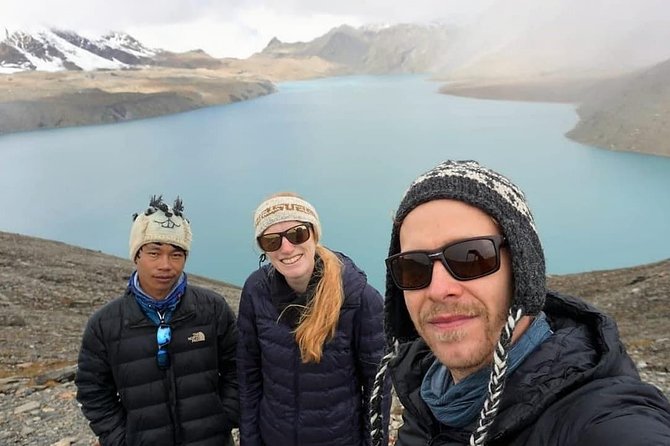
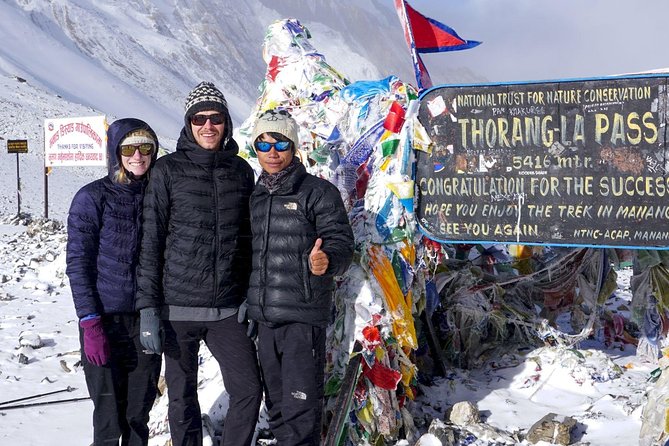
Day 13 crosses Thorong La at 5,416 meters and continues to Muktinath. The stated walking time is six to seven hours. This is the defining day of the circuit, and you should prepare for cold, thin air, a demanding ascent, and a long descent afterward.
The pass is not just a number on an itinerary. It is the moment when the whole trip’s gradual climb becomes real. You have moved from Kathmandu’s temples through low valleys and high villages to one of the highest points on the route.
Muktinath gives the day a strong cultural finish. The itinerary does not provide a detailed visit schedule, so I would not assume how much time is reserved for exploring the site. Still, arriving there after the pass gives the route a satisfying sense of change, from the Annapurna side toward the Mustang and Kali Gandaki side.
You should not book this crossing casually. The tour requires moderate physical fitness, but the altitude makes that description sound gentler than the pass itself may feel. Travel insurance is not included and should be arranged separately. It is especially important for a high-altitude trip with a fixed route and possible weather changes.
Tatopani and Pokhara soften the final two days
Day 14 is a drive to Tatopani at about 1,200 meters. After the high pass, this drop in elevation is welcome. The day also changes the rhythm from walking to road travel, giving your body a break.
Day 15 continues from Tatopani to Pokhara. Two hotel nights in Pokhara at Crystal Palace Hotel are included, although the listed itinerary describes the transfer on Day 15. Confirm whether the second night is used after arrival or is part of an adjusted schedule.
Pokhara is a sensible finish. After the altitude and long walking days, you have a city base rather than another remote mountain night. Meals and drinks in the city are not included, so plan for those costs separately.
What the $1,300 price covers
At $1,300 per person, the package offers good value if you want a guided private trek with transport and city arrangements handled. The price includes private transportation, all listed fees and taxes, a professional guide, two nights at Hotel Dream City in Kathmandu, two hotel nights at Crystal Palace Hotel in Pokhara, and three daily meals.
That is a useful bundle. You are not only paying for the walking route. You are also paying for airport transfer, Kathmandu sightseeing, road transport, a guide, and support through a route where plans may need to change.
The price does not cover everything. Set aside money for:
- Nepal visa fees
- International and domestic flights
- Travel insurance
- Drinks and bottled water
- Lunch, dinner, and drinks in the cities
- Tips for guides, porters, and other staff
- Extra nights and activities
- Charging, batteries, phone recharge, hot water, showers, and laundry
- Extra porters
The listing says group discounts are available, but it does not state the discount amount. Ask for the exact rate before booking. Pickup is offered, and the stated start time is 6:15 a.m., so confirm the pickup location and timing with the operator.
The guide team is a major strength
The strongest theme in the supplied feedback is personal care. Ramhari Neupane is connected with the company, and Ram is praised for being prepared, reliable, friendly, and attentive. Dendi is also named as a guide who helped create a well-managed trip.
Shiva handled an alternative itinerary for one person who could not complete the circuit. Porter Susan is praised for helping at high altitude. These details matter because a trek like this depends on judgment, not just route knowledge.
The company is also described as a family business connected with Hotel Dream City in Kathmandu. That can make the start and end of the trip feel more connected, though you should still ask clear questions about trail lodging, porter arrangements, daily distances, and emergency procedures.
Who should book this Annapurna Circuit trip?
I would recommend it to you if you want a private, guided Himalayan trek with a strong mix of culture, high mountain views, and changing terrain. It suits people who can manage repeated six to eight-hour walking days and who are prepared for the physical demands of 5,416 meters.
It is less suitable if you want a relaxed holiday, dislike long road transfers, or need fixed comfort standards in mountain accommodation. It is also not ideal if you have no experience with strenuous walking and have not discussed altitude concerns with a medical professional.
The most important booking questions are practical: What accommodation is used on the trail? What exactly is covered by the three meals? How are delays handled? What happens if you cannot cross Thorong La? The company has shown flexibility in arranging alternatives, but the exact backup plan should be clear before departure.
Should you book it?
You should book this trip if the full Annapurna Circuit matters more to you than polished comfort. The route delivers remarkable variety, a serious high pass, useful acclimatization time in Manang, and support from a team repeatedly praised for care and safety.
You should pause if the price leaves no room for insurance, drinks, tips, and extra costs, or if the six to eight-hour days sound daunting. For a prepared walker who wants a private Nepal experience at a reasonable package price, this is a strong choice. The five-star score from nine supplied ratings supports the positive picture, but the altitude and compact schedule still deserve respect.
FAQ
How long is the Annapurna Circuit Trek?
The trip lasts approximately 15 days, beginning with arrival in Kathmandu and ending with the transfer from Tatopani to Pokhara.
What is the highest point on the trek?
The highest point is Thorong La Pass at 5,416 meters.
Is transportation included?
Yes. Private transportation is included, including the airport transfer, Kathmandu sightseeing transport, the drive to Khudi, and the scheduled road journeys later in the trip.
Are meals included?
Breakfast, lunch, and dinner are included as part of the package. Drinks such as water, tea, coffee, beer, and soft drinks are not included. Lunch, dinner, and drinks in the cities are also excluded.
Is there a rest day?
Yes. Day 10 is a rest day in Manang at approximately 3,519 meters.
Is this a private or group tour?
It is a private activity, meaning only your group participates. Group discounts are available, but the amount is not specified.
What is the cancellation policy?
You can cancel at least 24 hours before the experience begins for a full refund. Cancellations or changes made less than 24 hours before the start time are not refunded or accepted. If poor weather causes the operator to cancel, you will be offered another date or a full refund.
Recently added around Kathmandu
- Ghorepani Poon Hill Trek★ 5.0 · 16 reviews
- Private Manaslu Circuit Trek at Himalayas★ 5.0 · 3 reviews
- Amazing 1 Day Trekking Experience in Kathmandu Nepal★ 5.0 · 24 reviews
- Ghorepani Poonhill Trek★ 5.0 · 5 reviews
- Upper Mustang Trekking★ 5.0 · 2 reviews
- Upper Mustang Trekking★ 3.0 · 2 reviews
- Upper Mustang Trekking★ 5.0 · 4 reviews
- Upper Mustang Trek★ 5.0 · 5 reviews
Annapurna Base Camp Treks, compared.

Trekking in Annapurna/Langtang/Everest/Upper Mustang regions
Read our review →
Kathmandu to Annapurna Base Camp (ABC) 5-Day Trek
Read our review →Browse the lists this tour appears in