
REVIEW · KATHMANDU
Annapurna Circuit Trek
The high pass is only part of the story. This 22-day Annapurna Circuit journey combines classic Himalayan trekking with Kathmandu temples, Pokhara sightseeing, village stays, and a welcome soak in Tatopani’s hot springs. I especially like the slow acclimatization plan and the mix of mountain scenery, Hindu and Buddhist sites, and everyday Nepalese life.
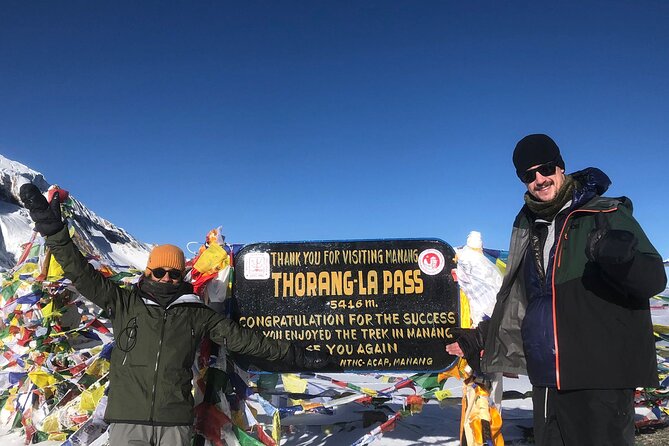
I also like that the $2,240 price includes the hard-to-arrange pieces: airport transfers, permits, a licensed guide, porter support, transport, accommodation, sightseeing, and most meals. The main concern is the physical demand. You will walk for many hours on several days, reach 5,416 meters at Thorong La, and face basic guesthouse conditions along the route.
The small group is limited to 15 people, and the experience has a perfect recommendation record with 67 five-star ratings supplied. Guides including Ganesh, Nimesh, Madan, Ram, and Janardan, known as Janu, receive repeated praise for care, encouragement, and help with acclimatization. That personal support matters when the air gets thin.
Key things to know before booking
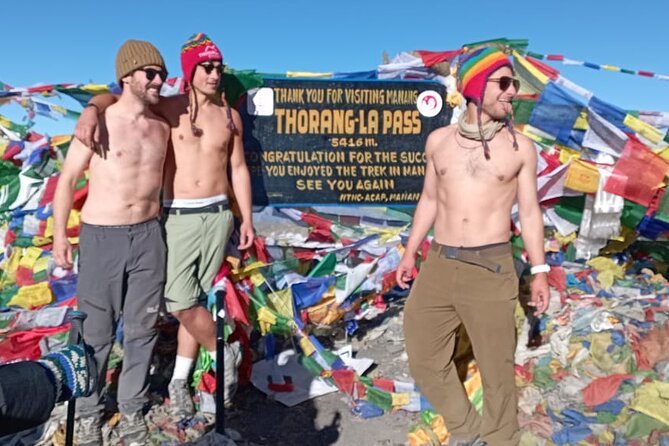
- Thorong La is the major test: The pass reaches 5,416 meters, with a pre-dawn start and possible snow or strong wind.
- Manang provides a real acclimatization day: You visit a monastery and Gangapurna Glacier Lake before climbing higher.
- The route changes dramatically: Expect green river valleys, pine and rhododendron forest, high dry country, and the Kali Gandaki Valley.
- Tatopani breaks up the hard walking: A full rest day lets you use the natural hot springs after the high pass.
- The package is unusually complete: Permits, guide, porter, hotels, tea houses, transfers, sightseeing, and most meals are included.
- The road reduces some walking: Public buses and shared four-wheel-drive vehicles cover sections at both ends of the trek.
What the $2,240 price really covers
At first glance, $2,240 is a serious sum. Look closer, and it covers 22 days, including three hotel nights in Kathmandu, two nights in Pokhara, 16 nights in guesthouses during the trek, airport transfers, transport, permits, guided sightseeing, and a farewell dinner with cultural performances.
You also receive breakfast on 21 days, dinner on 17 days, and lunch on 16 days. Lunch and dinner in Kathmandu and Pokhara are not included, nor are drinks, international flights, the Nepal entry visa, travel insurance, personal equipment, or tips. You should budget separately for those costs.
The guide and porter arrangement is practical: one porter is provided for every two clients. A sleeping bag, down jacket, duffel bag, and sun hat are supplied, but you still need suitable trekking clothing and footwear. Most important, your insurance must cover emergency high-altitude rescue and evacuation. That is not a minor box to tick on a mountain trip.
For this length of journey, the price offers good value if you want one company handling the moving parts. Independent trekking can cost less, but you would need to arrange transport, permits, rooms, porters, guides, and contingency plans yourself. Here, the benefit is less paperwork and more support when plans meet mountain weather.
More Annapurna Treks in Kathmandu
- Annapurna Circuit Trek with Tilicho Lake
★ 5.0 · 368 reviews - Annapurna base camp trek 5 Days
★ 5.0 · 252 reviews - 14-Day Private Annapurna Base Camp Trek
★ 5.0 · 180 reviews
Kathmandu begins with temples and practical preparation
Your airport pickup starts the trip on a sensible note. An Ace the Himalaya representative meets you outside Tribhuvan International Airport with a sign and takes you to your hotel in a private tourist vehicle.
A pre-trek meeting takes place on the first or second day. Bring your passport, three passport photographs, and a readable copy of your travel insurance policy. You will also meet your guide, sign the required trip documents, and settle any remaining balance.
Day two is a compact introduction to Kathmandu Valley culture. At Pashupatinath Temple, you view one of the world’s most important Hindu temples dedicated to Shiva from the eastern bank of the Bagmati River. Non-Hindus cannot enter the temple itself, but the riverfront setting and religious activity still make the visit worthwhile.
At Boudhanath Stupa, you can watch Buddhist pilgrims walk around the great white dome while turning prayer wheels. The stupa’s four pairs of Buddha eyes face the cardinal directions, giving the place a watchful, focused character.
Bhaktapur Durbar Square adds old royal architecture, including the five-story Nyatapola Temple, Batsala Temple, Bhairavnath Temple, Dattatraya Temple, Pujari Muth, and the Palace of 55 Windows. The stops are fairly short, so you get a useful first look without spending the entire day on temple sightseeing.
Days three through six follow the Marsyangdi River
Day three is a long transport day. A public bus takes you from Kathmandu to Besisahar in about six hours, followed by a shared four-wheel-drive vehicle to Syange, taking roughly two more hours. You pass rivers, waterfalls, and rural scenery, but do not expect a quiet luxury transfer.
From Syange, the walking begins. The route follows the Marsyangdi River toward Tal, with a gradual climb and waterfalls along the way. The itinerary lists unusually long stop durations, such as 18 hours, which should not be read as 18 hours of walking. They are itinerary timing labels. The actual walking descriptions indicate several hours on foot, with the guide setting the daily pace.
The next day brings views of Annapurna II and Pisang Peak, along with old villages and a stronger sense of high-country life. At Danakyu, you are already moving away from the lower river environment and toward the mountains that give the circuit its fame.
Chame, the Manang district headquarters, arrives after about four hours of walking. It is described as an easier day and offers more facilities than the smaller places before it. That makes Chame a useful point to rest, charge devices if possible, and check your clothing before the route climbs higher.
Pisang and Ngawal bring the first great mountain views
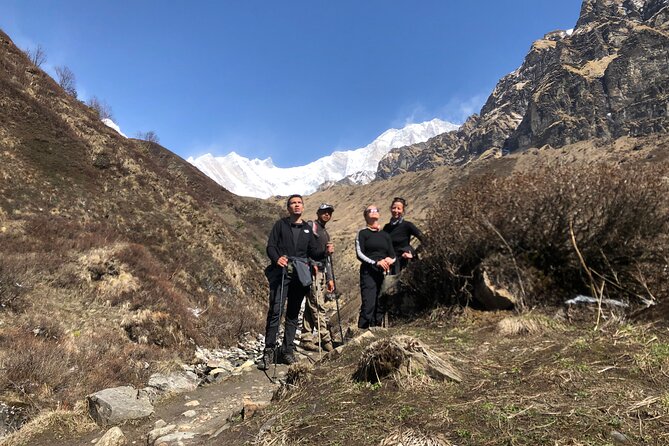
From Chame to Upper Pisang, the route passes through forest, beside the Marsyangdi River, and toward the curved Paungda Dada rock face. The six-hour walk ends with views of Annapurna II, which rises prominently to the south.
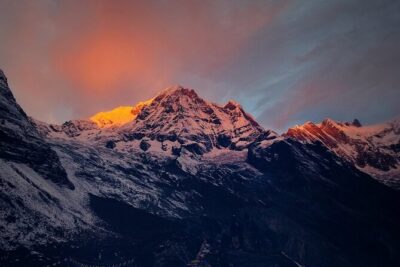
Upper Pisang gives you a higher and more scenic overnight stop than the lower route. The next morning begins early so you can see sunlight reach Annapurna II. From there, you climb toward Ngawal on a trail about 400 meters higher than the lower alternative.
That extra height brings a reward: wider views of Annapurna II and III, Pisang Peak, gorges, and high-altitude plants and animals. It also adds effort, so you should not treat this as a casual village stroll. The route is steadily teaching your body to work above the tree line.
From Ngawal to Manang, expect about six hours of walking through hills, forest, and wetlands. Along the way are stupas and a lama school. Manang is one of the more active settlements on the route, with more places to eat, rest, and prepare for the difficult days ahead.
Same trailhead, a longer or shorter day out:
- Everest Base Camp Trek – 14 Days
★ 5.0 · 1,499 reviews - Everest Base Camp Trek
★ 5.0 · 842 reviews - Everest Base Camp Trekking
★ 5.0 · 485 reviews - Everest Base Camp Trekking – 13 Day
★ 5.0 · 365 reviews
Manang is where you protect your health
The dedicated acclimatization day in Manang is one of the strongest parts of the plan. Instead of pushing onward immediately, you take shorter walks around the village, visit a monastery, and walk to Gangapurna Glacier Lake.
That day is not wasted time. It helps your body adjust before you climb toward 4,000 meters and beyond. Your guide’s judgment matters here, and the supplied feedback repeatedly praises guides such as Ganesh and Nimesh for paying close attention to acclimatization and keeping people safe on the pass.
After Manang, the route climbs through Tenki Manang and leaves the Marsyangdi Valley. You reach Yak Kharka at about 4,000 meters, where vegetation becomes sparse and yak herds become a familiar sight. The climb is about 500 meters, and the thin air can make an otherwise manageable walk feel slow.
The following day brings Thorong Phedi. After an initial ascent, you descend to cross the river at about 4,310 meters, then climb again to the guesthouses at 4,450 meters. This up-and-down profile can be frustrating, but it prepares you for the pass crossing.
Thorong La demands an early start and steady nerves
The pass day begins around 4 a.m. You climb in the dark, aiming to reach Thorong La between 9 and 10 a.m., before strong winds usually become a bigger problem. The route is easy to follow in normal conditions, but altitude, snow, and weather can make the crossing much harder.
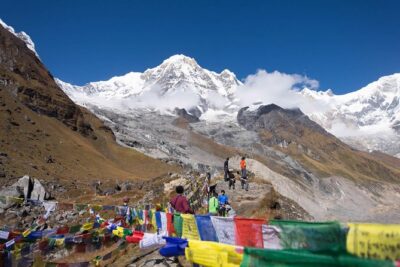
After roughly four hours of climbing, prayer flags and chortens mark the pass at 5,416 meters. The views from the top are the payoff, but this is not a moment to rush. You should walk at the guide’s pace, keep warm, drink regularly, and tell the guide quickly if you feel unwell.
The descent to Muktinath takes about another four hours. Muktinath means place of nirvana and is an important religious site, making the end of the pass day more than just a place to sleep. Still, this is the most demanding day of the trek, and you should book only if you are comfortable with long mountain days and a high-altitude crossing.
Mustang and Tatopani change the mood
After Thorong La, the scenery becomes much drier, almost desert-like in places. You follow the Kali Gandaki River toward Jomsom, passing stupas, traditional houses, and settlements shaped by Mustang’s distinctive culture.
Jomsom is a substantial town and the administrative center of Mustang district. It offers more facilities than the high villages, which is welcome after the pass. From there, the route continues down the Kali Gandaki Valley toward Tatopani.
Along the way, you pass Kopchepani, described here as the world’s deepest gorge. The route then reaches Tatopani, famous for its natural hot springs. This is a smart rest point after several difficult days, and the full second day lets you shower, soak, have drinks, and eat local food without worrying about the next climb.
The hot springs are more than a sightseeing stop. They give your legs a break and create a welcome change from cold mornings, dusty paths, and basic mountain rooms.
The climb to Ghorepani is short but steep
Do not assume the lower elevation makes the next section easy. The walk from Tatopani to Ghorepani takes about seven hours and climbs roughly 1,620 meters. That is a serious ascent, especially after the long pass crossing.
The route passes through Magar and Gurung villages, offering another look at Nepalese mountain communities. From Ghorepani, you can see Annapurna South, Hiunchuli, and Tukuche Himal.
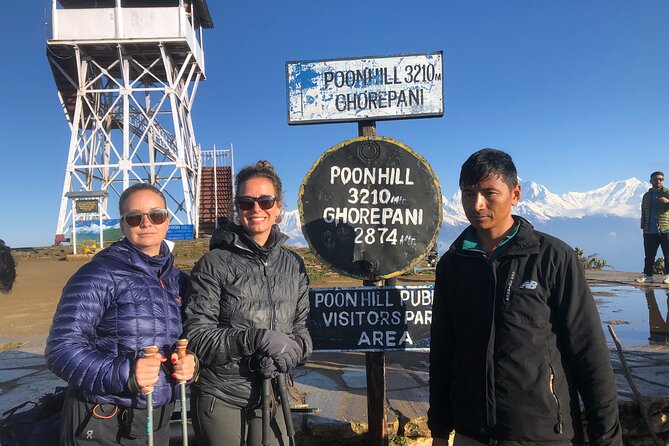
The next morning starts before sunrise with an hour-long climb to Poon Hill at 3,210 meters. From the viewpoint, you have a chance to see sunrise over the high Himalaya, weather permitting. You spend about an hour there before returning to Ghorepani for a hot breakfast.
After breakfast, the path descends toward Tikhedhunga through ridges and rhododendron forest. The day combines a memorable viewpoint with a long downhill walk, so trekking poles could be useful, though personal equipment is not supplied beyond the listed jacket and sleeping bag.
Pokhara brings a softer finish
From Tikhedhunga, a final light walking section leads to Nayapul. A vehicle then takes you to Pokhara, where the pace changes from mountain trekking to city sightseeing.
The following day includes Bindhyabasini Temple, dedicated to the goddess Bhagwati, and Devi’s Fall, where water from Phewa Lake drops into a deep gorge. Gupteshwor Mahadev Cave sits opposite the waterfall and includes narrow passages, large chambers, and a Shiva shrine.
You also visit the Seti River Gorge, cut by the fast-flowing Seti Gandaki River, and the Tashi Ling Tibetan Refugee Camp. The camp is known for wool carpets and handicrafts, and its history reaches back to Tibetan settlers who arrived in Nepal during the 1950s.
These stops are brief, but together they give Pokhara more substance than a simple overnight transfer. You see religious sites, natural features, and a working handicraft community before returning to Kathmandu.
The final day includes a long road trip
Day 21 uses a tourist bus from Pokhara to Kathmandu. The drive takes most of the morning and can feel tiring after three weeks on foot, but it avoids another flight and keeps the package straightforward.
That evening ends with a farewell dinner in a traditional Nepalese restaurant and cultural performances. If you have extra time in Nepal, the operator lists options including Chitwan jungle safari, river rafting, shopping, and mountain biking.
Your airport transfer takes place on day 22. The trip ends back at Tribhuvan International Airport.
Guide support is one of the biggest strengths
The strongest personal praise centers on the guides and porters. Ganesh Khanal is repeatedly described as careful and well organized, particularly during acclimatization and the Thorong La crossing. Nimesh is praised for looking after people during the hardest sections, while Madan, Ram, and Janu are credited with patience, encouragement, flexibility, and good humor.
That matters because the route is not only scenic. It includes changing weather, high altitude, long descents, basic rooms, and transport that can be tiring. A good guide helps turn those problems into manageable parts of the day.
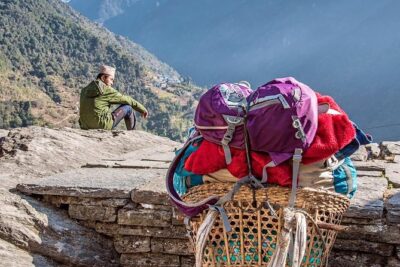
Porters including Ajeet, Amish, Kalish, Ramesh, Sumon, and others are also praised for being helpful and cheerful. Tipping is expected, so include it in your budget and ask the company for current guidance before departure.
Who should book this trek?
I would recommend it to you if you want the full Annapurna Circuit in one organized package and have enough time for proper acclimatization. It suits people who enjoy mountain scenery, village life, cultural sites, and a demanding but supported walking holiday.
I would not choose it for a casual vacation, a first-time fitness experiment, or anyone unwilling to sleep in simple guesthouses. The moderate fitness requirement should be taken seriously. The itinerary includes a 5,416-meter pass, a 1,620-meter climb to Ghorepani, and several days described as roughly six to seven hours of walking.
You can cancel up to three full days before the start for a full refund. If poor weather cancels the experience, you are offered another date or a full refund. The group maximum of 15 keeps the trip small enough for guide contact without promising a private trek.
Should you book the Annapurna Circuit Trek?
Book it if you value organized support over independent flexibility and want more than a mountain trail. The Kathmandu temples, Manang acclimatization day, Thorong La crossing, Tatopani hot springs, Poon Hill sunrise, and Pokhara sightseeing create a well-rounded Nepal journey.
The price is fair for what is included, especially with permits, transport, guide, porter, meals, and accommodation covered. Just arrive prepared for altitude, long walking days, modest guesthouses, weather changes, and extra costs for insurance, drinks, visas, personal gear, and tips.
FAQ
How long is the Annapurna Circuit Trek?
The experience lasts approximately 22 days, beginning with airport pickup in Kathmandu and ending with airport drop-off in Kathmandu.
What is the highest point on the route?
Thorong La Pass reaches 5,416 meters. The crossing begins around 4 a.m. and usually takes about four hours to climb to the pass.
Is a guide included?
Yes. The package includes a licensed English-speaking trekking guide.
Is a porter included?
Yes. One porter is included for every two clients.
How many people can join the group?
The maximum group size is 15 people.
Are meals included?
Breakfast is included on 21 days, dinner on 17 days, and lunch on 16 days. Lunch and dinner in Kathmandu and Pokhara are not included.
Is travel insurance included?
No. You must arrange your own travel insurance, and it must cover emergency high-altitude rescue and evacuation.
What accommodation is included?
You receive twin-share or double rooms in three-star hotels for three nights in Kathmandu and two nights in Pokhara. During the trek, accommodation is in guesthouses with twin-share and dormitory rooms for 16 nights.
Recently added around Kathmandu
- Ghorepani Poon Hill Trek★ 5.0 · 16 reviews
- Private Manaslu Circuit Trek at Himalayas★ 5.0 · 3 reviews
- Amazing 1 Day Trekking Experience in Kathmandu Nepal★ 5.0 · 24 reviews
- Upper Mustang Trekking★ 5.0 · 2 reviews
- Ghorepani Poonhill Trek★ 5.0 · 5 reviews
- Upper Mustang Trekking★ 3.0 · 2 reviews
- Upper Mustang Trekking★ 5.0 · 4 reviews
- Upper Mustang Trek★ 5.0 · 5 reviews
Annapurna Base Camp Treks, compared.
Trekking in Annapurna/Langtang/Everest/Upper Mustang regions
Read our review →
Kathmandu to Annapurna Base Camp (ABC) 5-Day Trek
Read our review →Browse the lists this tour appears in