
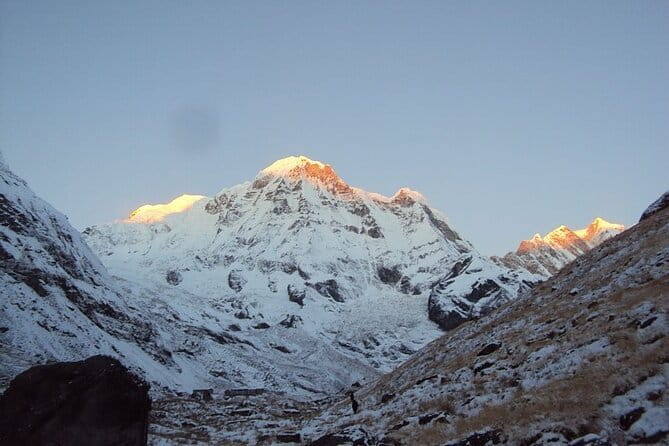
REVIEW · KATHMANDU
Annapurna Base Camp Trek
Mountain mornings do not get better than this. The Annapurna Base Camp Trek combines a classic Himalayan route with Poon Hill sunrise views and the chance to sleep beneath some of Nepal’s highest peaks. I like the smart progression from Kathmandu’s temples to Pokhara’s lakeside setting, then into rhododendron forests, stone stairways, river valleys, and the high sanctuary around Annapurna Base Camp.
I also like the private-group format and the strong guide support reported by past participants, especially from guides such as Pradeep, Bikas, Santos, Birendra, Lal, and Aashman. The main caution is simple: this is a serious 15-day mountain trip, not a gentle sightseeing holiday. Long climbs, steep steps, basic lodge stays, and cold conditions require moderate physical fitness and a willingness to accept changing plans.
Five things to know before you book
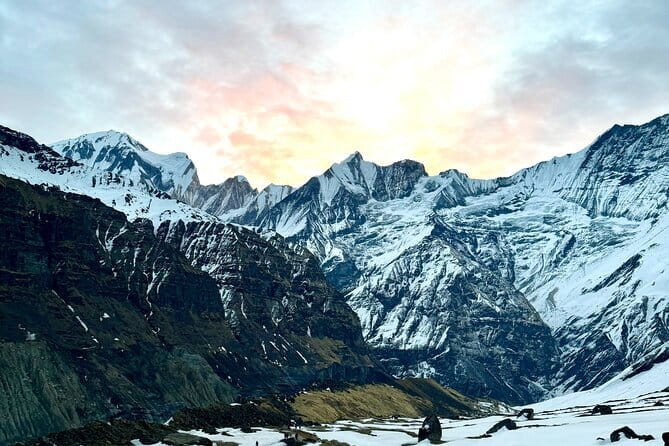
- Poon Hill adds a spectacular sunrise: You reach the viewpoint before breakfast, with views toward the Annapurna and Dhaulagiri ranges.
- The route changes constantly: Expect city temples, a long bus ride, waterfalls, forests, terraced fields, suspension bridges, and high alpine scenery.
- Annapurna Base Camp is reached on foot: The final approach passes Machapuchare Base Camp before entering the mountain-ringed sanctuary.
- Guide care is a major strength: Feedback repeatedly praises Pradeep, Bikas, Santos, Birendra, Lal, and Aashman for motivation, flexibility, and personal attention.
- The $995 price covers important basics: Permits, listed entrance fees, 14 breakfasts, 10 lunches, and 10 dinners are included, but drinks, insurance, tips, and personal costs are not.
- This is a private activity: Only your own group participates, though group discounts are offered.
Kathmandu temples set the tone on days one and two
Your first day is intentionally easy. A representative meets you at the airport, transfers you by private car, and gives you time to settle into your Kathmandu hotel. The welcome dinner includes Nepalese food, a cultural restaurant setting, and a Nepali dance show.
That dinner is useful for more than entertainment. You receive a fuller explanation of the route and can ask last-minute questions before leaving the city. I would use this evening to check footwear, layers, medication, and any items you may need during the walking days.
Day two is a full introduction to Kathmandu Valley. You visit Pashupatinath Temple, Boudhha, Swayambhunath, and Kathmandu Durbar Square. The sites represent important Hindu and Buddhist traditions, and together they give you a better sense of Nepal before you head into mountain villages.
Pashupatinath is close to the airport and is a major Hindu pilgrimage site. Boudhha, with its large Buddhist stupa, is nearby, making the two stops easy to combine. Swayambhunath, often called the Monkey Temple, adds hilltop views and another important Buddhist setting. Kathmandu Durbar Square brings royal architecture and a central old-city atmosphere close to Thamel.
The day lasts about six hours, followed by a trek briefing, an introduction to the guide, and an equipment check. That equipment check matters. This is the best moment to raise concerns about boots, bags, clothing, or fitness before you are far from Kathmandu.
More Annapurna Treks in Kathmandu
- Annapurna Circuit Trek with Tilicho Lake
★ 5.0 · 368 reviews - Annapurna base camp trek 5 Days
★ 5.0 · 252 reviews - 14-Day Private Annapurna Base Camp Trek
★ 5.0 · 180 reviews
The long road to Pokhara is part of the adventure
Day three uses a tourist bus for the journey from Kathmandu to Pokhara. The trip takes about seven to eight hours, with hills and the Trishuli River providing much of the scenery. A lunch stop near Malekhu and Ghansikuwa breaks up the ride.
This is not a quick transfer. You should expect a full travel day, and road conditions may make the journey feel longer. The reward is Pokhara, Nepal’s famous lakeside gateway to the Annapurna region. Your hotel is near Fewa Lake, giving you time to eat at local cafes, walk around, and recover before the first mountain climb.
The Pokhara stop is well placed. It gives you a softer transition from city sightseeing to trekking, though you should not expect much free time if the bus arrives around mid-afternoon and you need to prepare for the next morning.
Ulleri’s 3,400 steps are the first real test
On day four, a drive takes you to Nayapul, the traditional starting point for this section of the walk. From there, you follow a forested valley, cross the Bhurungdi Khola River, and reach Tikhedhunga before facing the famous stair climb to Ulleri.
The route includes about 3,400 steps and boulders. This is where the trip becomes physically real. The distance may look manageable on paper, but repeated stone stairs test your knees and breathing. Take the climb at a steady pace rather than trying to match someone else’s speed.
Ulleri is your overnight stop. The six-hour day is a useful warning about what follows: this trek is built around walking for several hours daily, often on uneven surfaces. A guide who watches your pace and keeps morale high can make a large difference here.
Poon Hill gives you the classic Himalayan view
Day five takes you toward Ghorepani through waterfalls, small villages, and forest. You may catch views of Annapurna South along the way. Upper Ghorepani provides broad mountain views, including Annapurna South and Nilgiri.
The next morning begins before breakfast with the climb to Poon Hill. This is one of the most memorable parts of the route because the viewpoint gives a wide look toward the Annapurna and Dhaulagiri ranges. A hot coffee at sunrise is a small comfort, but it becomes a welcome one after the early climb.
After returning to Ghorepani for breakfast, you continue through rhododendron forest and past waterfalls to Tadapani. The day lasts about seven hours, so the sunrise comes with a cost: an early start followed by a long walking day.
Still, I consider Poon Hill one of the route’s best design choices. It gives you a major mountain view early in the trip, before the trail turns deeper into the Annapurna Sanctuary.
Same trailhead, a longer or shorter day out:
- Everest Base Camp Trek – 14 Days
★ 5.0 · 1,499 reviews - Everest Base Camp Trek
★ 5.0 · 842 reviews - Everest Base Camp Trekking
★ 5.0 · 485 reviews - Everest Base Camp Trekking – 13 Day
★ 5.0 · 365 reviews
Chhomrong brings terraces, bridges, and a mountain village
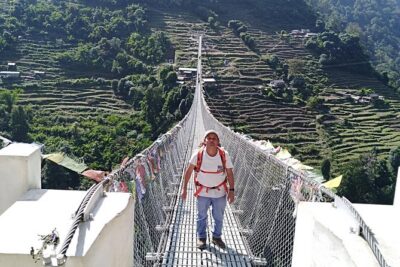
The walk to Chhomrong takes about six hours. You pass through broad rhododendron forest, then reach terraced fields as the trees thin out. The route includes waterfalls, varied surfaces, and a suspension bridge before the final approach to the village.
Chhomrong sits below the Annapurna peaks and acts as an important point on the route. It also gives you a good feeling for the villages that support mountain trekking in this region. You are no longer simply walking through scenery. You are moving through working farmland and settlements connected by footpaths.
The route includes an uphill section of roughly five kilometers. That detail is worth noting because the trail can feel demanding even when the daily walking time seems moderate.
Bamboo and Deurali lead you into colder country
Day eight descends from Chhomrong on many stone steps to the Chhomrong Khola River. After crossing a swinging bridge, you climb toward Sinuwa, pass through forest near Kuldihar, and descend again to Bamboo.
This repeated pattern of going down and then back up is common on Himalayan routes. It can be harder on the legs than a steady climb, particularly for anyone with knee trouble. One participant specifically praised guide Bikas for helping with knee pain and providing motivation, which suggests that clear communication about physical problems is important.
The next day brings a cooler forest and a steeper climb toward Himalaya Hotel. The trail opens near the glacial river, then becomes drier as you approach Hinku Cave. You descend to a river and climb again to Deurali.
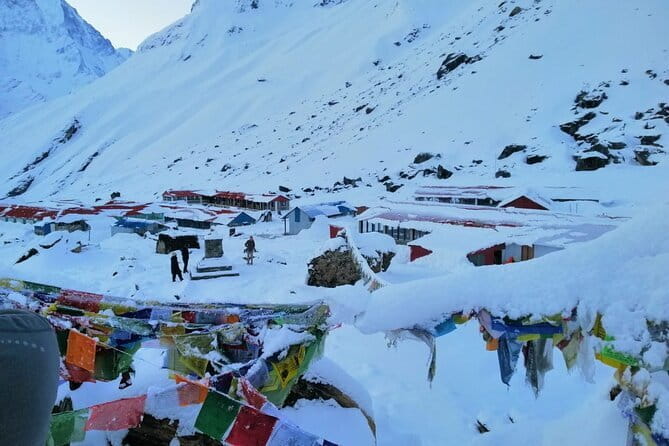
Deurali is where the setting begins to change sharply. Dense greenery gives way to exposed views of cliffs, waterfalls, river valleys, and distant mountains including Dhaulagiri. The five-hour walking day is shorter than some others, but the high, steep terrain can make it feel demanding.
Annapurna Base Camp is the payoff on day ten
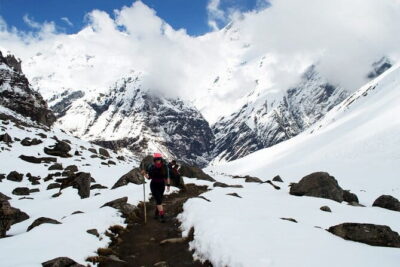
The approach to Annapurna Base Camp follows a valley trail with rocky cliffs and steep sections. Some flatter walking gives your legs a break before the climb to Machapuchare Base Camp.
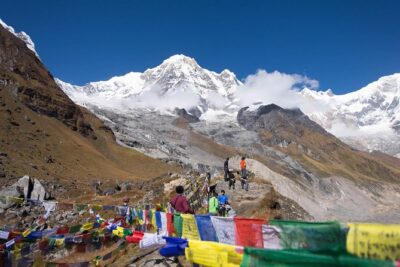
From Machapuchare Base Camp, the views open toward Hiunchuli, Annapurna South, Annapurna I, Annapurna III, Gandharvachuli, and Gangapurna. This is a powerful part of the route because the mountains feel close and enclosed around you.
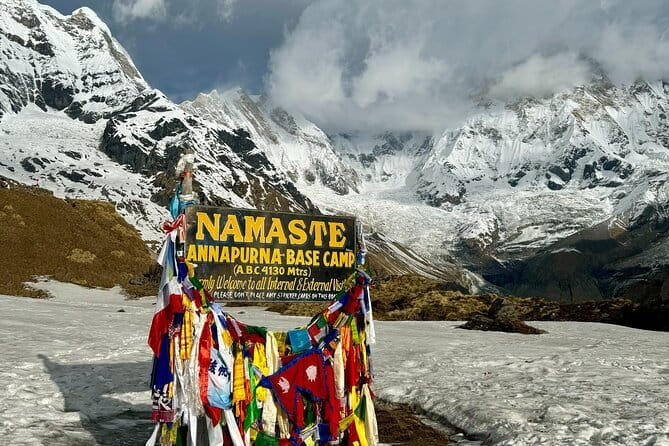
The final walk to Annapurna Base Camp takes about six hours for the day. The route enters through the gorge you have been following, and the base camp sits inside a dramatic mountain basin. You spend the night there, which is far more meaningful than simply arriving for a photograph and leaving immediately.
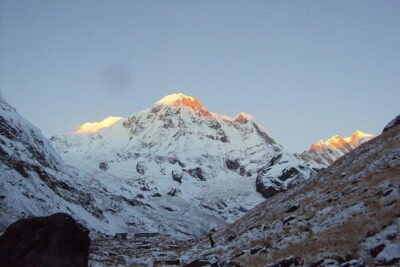
The overnight stay also means you can see the setting in changing light. Sunrise the next morning is described as the high point of the base camp experience, so keep your warmest layers close by.
The return route is easier, but not effortless
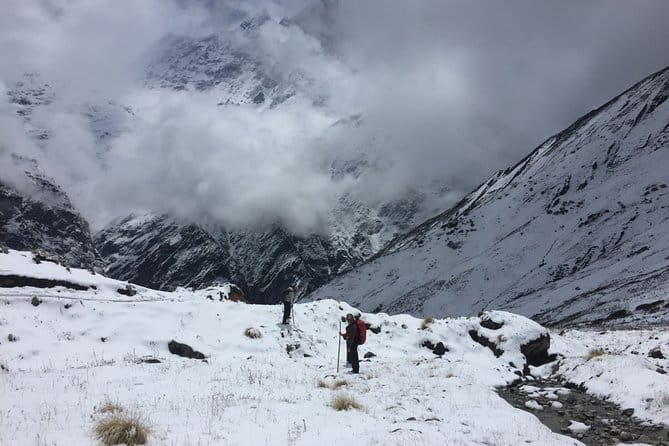
Day eleven starts early for sunrise at base camp. After breakfast, you descend to Machapuchare Base Camp, Deurali, Himalaya Hotel, and then Bamboo. The downhill route is generally easier than the climb up, but steep descents can be tough on knees and toes.
Day twelve continues toward Chhomrong, where you stop for lunch before tackling more stone steps and descending to Jhinu Danda. The route passes farmland and rainforest. Jhinu Danda is a pleasant change after the colder upper sections, although the six-hour day still demands energy.
Day thirteen completes the walking portion. You leave Jhinu Danda after breakfast, follow the hills toward Nayapul, stop for lunch, and drive back to Pokhara. The eight-hour day combines walking and road travel, so it is not simply a rest day after the base camp descent.
What the $995 price really covers
At $995 per person, this trip offers solid value if you want a guided, organized trek with city services before and after the mountains. The price includes all listed fees and taxes, required permits, entrance fees on the route, 14 breakfasts, 10 lunches, and 10 dinners.
It does not cover personal expenses, alcoholic drinks or other beverage bills, travel insurance, or tips. The meal count also means you should read the inclusions carefully rather than assume every meal for all 15 days is covered.
The private-group setup is another value point. You are not placed into an unknown large group, and feedback gives repeated credit to guides and porters for being attentive, cheerful, and flexible. Families may appreciate that flexibility. One parent described the guide team adjusting the plan when an eight-year-old struggled in snow, though the listed fitness requirement remains moderate and you should not treat the trip as an easy family walk.
The return from Pokhara to Kathmandu may be by flight or road. Since the exact option is not fixed in the information provided, ask about this before paying. The final day includes hotel transfer to the airport, with a representative accompanying you about three hours before departure.
Guides and porters are central to the experience
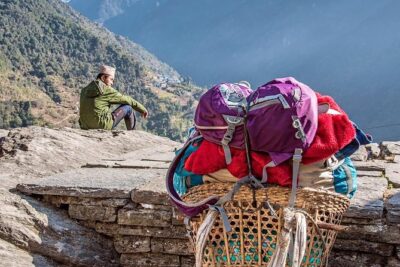
The strongest practical theme in the feedback is the quality of personal care. Pradeep is praised for planning meals and looking after the whole group. Bikas is described as responsible, encouraging, and able to communicate in English. Santos and the porter team also receive repeated credit for making the walk more comfortable.
Other named guides include Birendra, Lal, and Aashman. Aashman is praised for explaining local culture and helping people stay comfortable. Birendra receives credit for handling arrangements and solving problems. These details matter because a base camp trek brings small problems every day: tired legs, changing weather, meal timing, unfamiliar terrain, and the need to adjust the pace.
You should still tell the company about medical issues, knee pain, or family concerns before departure. Good support works best when the guide knows what is going on.
Who should book this Annapurna trek?
I would recommend this experience to you if you want a full Nepal trip rather than a short mountain walk. It suits people who value local guides, organized transfers, cultural visits, and a gradual route through changing mountain environments.
It is also a good fit if Poon Hill and Annapurna Base Camp are both on your wish list. You get the famous sunrise viewpoint and the deeper sanctuary walk in one trip.
I would hesitate if you dislike basic mountain lodging, long bus journeys, steep stairs, or early starts. The tour requires moderate fitness, and the six-hour walking days are only part of the challenge. Uneven stone trails, altitude, cold mornings, and repeated climbs demand preparation.
Confirmation is provided when you book, and the experience is listed daily from December 20, 2023 through June 6, 2026. Service animals are allowed, and the route is near public transport in its city sections. You can cancel for a full refund up to three full days before the local start time. After that point, changes and refunds are not accepted.
Should you book it?
Book this trek if you want a carefully structured Annapurna journey with strong guide and porter support, cultural stops in Kathmandu, and enough time to reach base camp without rushing the mountain section.
Do not book it simply because the price looks attractive. First confirm the return transport from Pokhara, understand which meals are included, arrange travel insurance, and be honest about your knees and fitness. If you can handle the stairs and long walking days, the combination of Poon Hill sunrise, high mountain lodges, and an overnight stay at Annapurna Base Camp makes this a very rewarding choice.
FAQ
How long is the Annapurna Base Camp Trek?
The experience lasts approximately 15 days, including arrival and departure days in Kathmandu, the journey to Pokhara, the trek, and the return to Kathmandu.
What is included in the price?
The price includes all fees and taxes, required permits, entrance fees listed in the program, 14 breakfasts, 10 lunches, and 10 dinners.
What is not included?
Personal expenses, bar and beverage bills, travel insurance, and tipping are not included. Items not specifically mentioned in the program are also excluded.
Is this a private tour?
Yes. Only your own group participates in the activity. Group discounts are offered.
What level of fitness is required?
The experience is intended for people with a moderate level of physical fitness. The route includes long walking days, steep climbs, many stone steps, uneven trails, and early morning starts.
Does the tour include airport pickup?
Yes. A representative meets you at the airport in Kathmandu and transfers you to your hotel by private car. Airport transportation is also arranged at the end of the trip.
Can I cancel for a full refund?
Yes. You must cancel at least three full days before the experience start time, based on local time. Cancellations or changes made less than three full days before the start are not accepted for a refund.
Recently added around Kathmandu
- Ghorepani Poon Hill Trek★ 5.0 · 16 reviews
- Amazing 1 Day Trekking Experience in Kathmandu Nepal★ 5.0 · 24 reviews
- Private Manaslu Circuit Trek at Himalayas★ 5.0 · 3 reviews
- Ghorepani Poonhill Trek★ 5.0 · 5 reviews
- Upper Mustang Trekking★ 5.0 · 2 reviews
- Upper Mustang Trekking★ 3.0 · 2 reviews
- Upper Mustang Trekking★ 5.0 · 4 reviews
- Upper Mustang Trek★ 5.0 · 5 reviews
Annapurna Base Camp Treks, compared.

Trekking in Annapurna/Langtang/Everest/Upper Mustang regions
Read our review →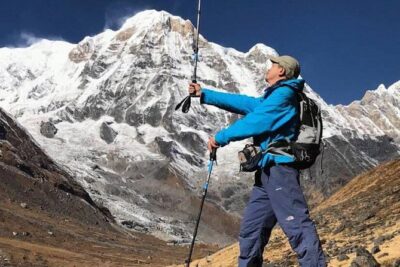
Kathmandu to Annapurna Base Camp (ABC) 5-Day Trek
Read our review →Browse the lists this tour appears in