
REVIEW · KATHMANDU
Everest Base Camp Trek
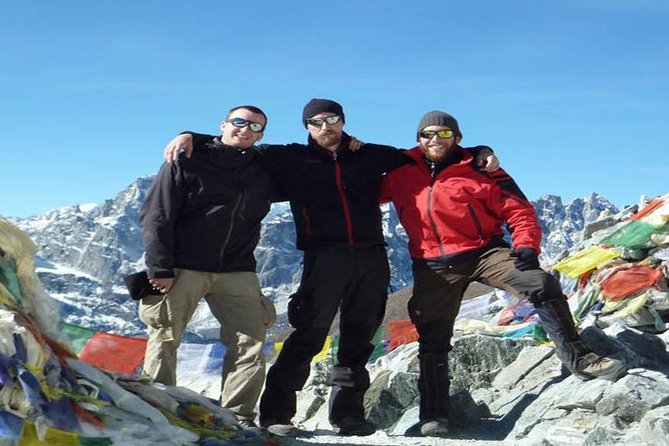
The Himalaya demands patience. This 15-day Everest Base Camp Trek takes you from Kathmandu to Lukla, then along the classic route through Sherpa villages, monasteries, and Sagarmatha National Park toward the foot of Mt. Everest. I like the combination of local guides and porters with included flights, lodges, meals, and ground transfers. I also like that the route gives you more than mountain views: you spend time in highland communities where Sherpa life remains part of the journey.
The main drawback is Lukla. Flights can be delayed or canceled for a day or several days, even during the best trekking seasons. You need a flexible schedule, travel insurance, and enough physical strength for long days at high altitude. At $2,500 per person, the package is not cheap, but it covers many costly pieces of a Himalayan trip and offers the comfort of a private group.
Key details before you book
- Lukla flights set the rhythm: Kathmandu to Lukla and back are included, but bad weather can disrupt the plan.
- Altitude is the real challenge: The trek reaches some of the highest walking routes on Earth, so moderate fitness is essential.
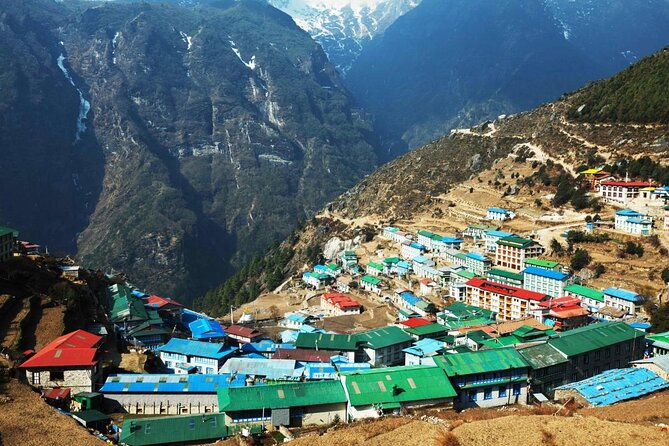
- Sherpa villages add meaning: Namche and other settlements bring monasteries, local culture, and daily mountain life into the trip.
- Simple lodging is part of the deal: You sleep in local lodges with standard rooms and shared bathrooms.
- Meals are covered on trek: Breakfast, lunch, dinner, and hot drinks are included, while Kathmandu lunches and dinners are not.
- The package is private: Only your group takes part, with an English-speaking local guide and porters.
Kathmandu begins the story
The trip starts at Tribhuvan International Airport in Kathmandu, where pickup is offered. Three nights at a three-star hotel with breakfast are included, giving you time to recover from the journey and explore Nepal’s capital before and after the trek.
That extra Kathmandu time matters. You are not rushed straight from an international flight into the mountains. The city portion is described as a day of exploration, and it provides a useful contrast to the quiet villages ahead. Kathmandu is the place to sort out last details, meet your guide, and get ready for a route where shops, roads, and reliable services quickly become scarce.
Lunch and dinner in Kathmandu are not included. That gives you freedom to choose your own restaurants, but it also means the advertised price is not a fully all-inclusive holiday. Keep some money aside for meals, drinks, snacks, and personal purchases in the capital.
The operator has received especially warm praise for planning and airport support. Names that appear in the feedback include Anuj, Bal, Sabin, Raju, and Gelu. That does not guarantee which guide you will receive, but it does suggest that guide selection and personal attention are major parts of the company’s service.
More Everest Base Camp Treks in Kathmandu:
- Everest Base Camp Trek – 14 Days
★ 5.0 · 1,499 reviews - Everest Base Camp Trek
★ 5.0 · 842 reviews - Everest Base Camp Trekking
★ 5.0 · 485 reviews
The flight to Lukla is part of the adventure
The flight from Kathmandu to Tenzing-Hillary Airport in Lukla is included in the price. Lukla sits at roughly 2,845 to 2,860 meters, and its airport is the normal gateway for the Everest Base Camp route.
Flights operate in the morning to reduce the risk of poor weather. Still, mountain weather can change quickly. A delay or cancellation may affect the beginning of your trek, the return to Kathmandu, or both.
This is the most important practical warning in the entire package. Do not schedule an international flight immediately after the planned return from Lukla. The operator advises adding buffer days, and that is sound advice. If you have a fixed flight home, a delayed Lukla service can turn a fine itinerary into an expensive scramble.
If flights remain canceled for a longer period, the company may offer a helicopter transfer for an extra charge. The helicopter cost is not included, and availability and pricing are handled at the time. Alternative trekking areas such as Annapurna, Langtang, or Upper Mustang may also be offered because they are easier to reach by road.
You should treat the Lukla flight as a real part of the experience, not a minor transfer. It saves days of road travel and places you directly at the mountain trailhead, but it also means the whole schedule depends on conditions beyond anyone’s control.
From Lukla into Sagarmatha National Park
From Lukla, the trail enters the Everest region and continues through Sagarmatha National Park. The route is known for its mix of forests, mountain scenery, bridges, villages, and high-altitude walking.
The early part of the trek gradually changes your surroundings. You move away from the busy capital and into settlements shaped by mountain trade, farming, tourism, and Buddhist traditions. The package includes an English-speaking local guide and porters, so you can walk with a lighter day bag while the support team carries the main load.
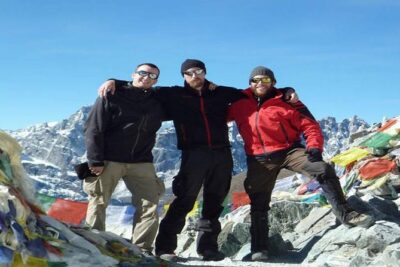
That support is more than a convenience. At altitude, even an ordinary bag can feel heavy, and tired legs make every uphill section longer. Several accounts describe guides helping slower members of a group, while porters carried extra day bags when someone was injured or struggling. One guide, Bal, was praised for his calm manner, and another, Raju, was singled out for giving extra support to older walkers.
The trek is private, so only your own group participates. That gives you more room to set a sensible pace than you would have in a large mixed group. It does not make the route easy. You still need to walk day after day, often over uneven ground, while your body adjusts to thinner air.
Namche and the Sherpa heart of the route
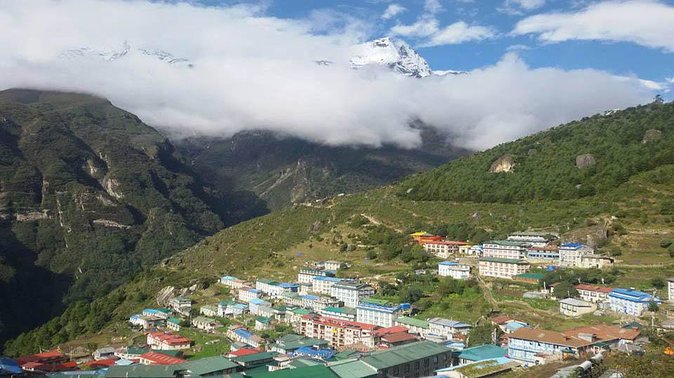
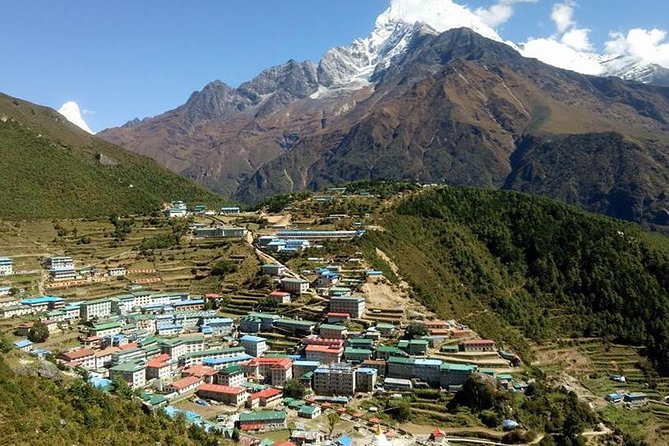
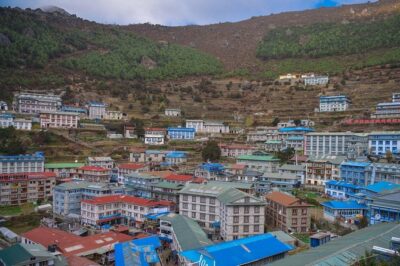
Namche Bazaar is one of the best-known stops in the Everest region, and the route passes through this important Sherpa settlement. It is described as an iconic place in the trek, and its role is practical as well as scenic.
Namche gives you a stronger sense of highland life before the trail pushes farther upward. You see how Sherpa communities serve both local residents and people heading into the mountains. The wider route also includes monasteries and villages where Buddhist culture is part of the setting rather than a separate sightseeing stop.
The cultural side of this trek deserves attention. You are not simply walking toward a famous mountain. You are passing through communities with their own religious sites, family life, work, and traditions. The guide can help explain what you are seeing, which is one reason the local guide is worth more than a printed route map.
The higher you go, the more basic the facilities become. Lodges are described as standard local accommodations with shared bathrooms. They provide shelter and meals, not hotel-style comfort. If you need a private bathroom, strong heating, or a quiet room each night, this trip may test your patience.
A few more treks around Kathmandu worth a look
- Annapurna Circuit Trek with Tilicho Lake
★ 5.0 · 368 reviews - Everest Base Camp Trekking – 13 Day
★ 5.0 · 365 reviews - Everest Base Camp Trek
★ 5.0 · 350 reviews - Everest Base Camp Trek -14 Days
★ 5.0 · 321 reviews
The mountain views are the reward for the effort
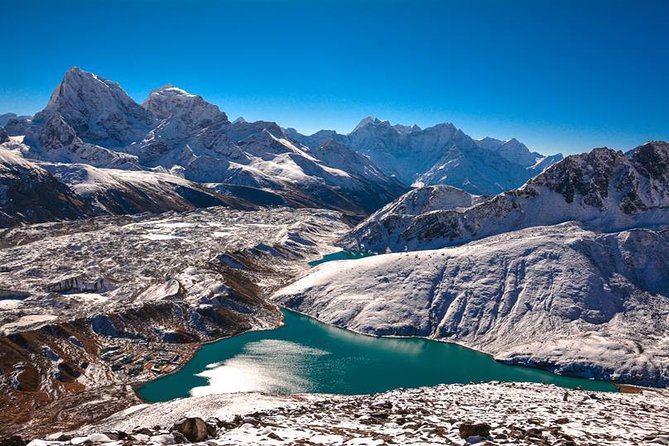
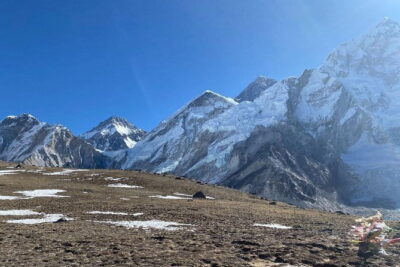
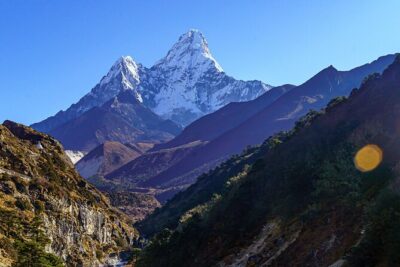
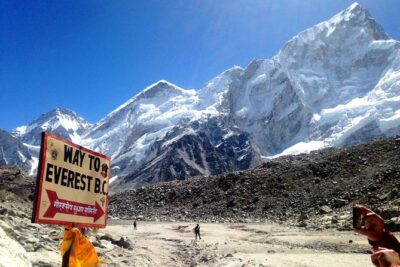
The route brings views of Mt. Everest, Lhotse, Cho Oyu, Ama Dablam, and Makalu. Everest reaches 8,848 meters, Lhotse 8,586 meters, Cho Oyu 8,188 meters, and Ama Dablam 6,812 meters.
Those figures help explain the scale of the surroundings, but the daily experience is less about collecting mountain names and more about how quickly the view changes as you climb. You may see enormous peaks rising above villages, ridgelines, and open valleys, then watch them disappear behind cloud or weather.
That uncertainty is part of the mountain experience. The route promises access to the Everest region, not perfect visibility every hour. Your guide’s judgment and the pace of the group matter more than a rigid timetable.
The route is also physically demanding. The supplied information calls for moderate physical fitness, and that should be taken seriously. You do not need to be an elite athlete, but you should be comfortable with sustained walking and prepared for high-altitude conditions. A person who finds ordinary long walks difficult will need careful preparation before booking.
Reaching Everest Base Camp
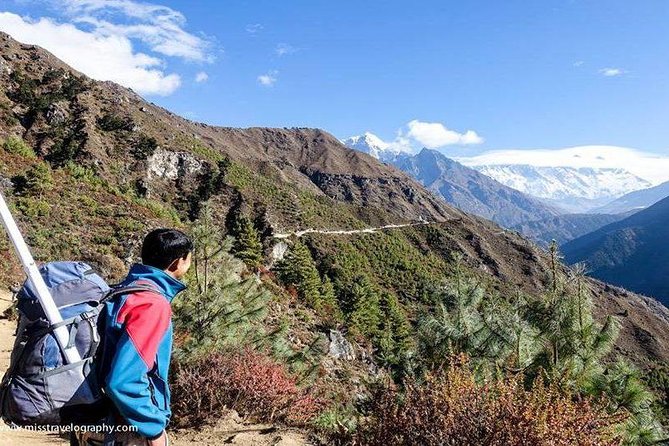
The goal is Everest Base Camp, reached through the exceptional setting of the Everest region. The route brings you close to the base of the world’s highest mountain, though it does not take you to the summit or turn you into a mountaineer.
That distinction is important. Base Camp is a trekking destination, not a climbing expedition. You experience the route, the altitude, the mountain communities, and the sight of the peaks without attempting Everest itself.
Some Everest itineraries connected with this operator also include Kala Patthar, a high viewpoint used for broad mountain views. You should confirm whether it is included in your exact departure plan, since the supplied trip description focuses on Base Camp and does not list Kala Patthar as a separate included stop.
The final approach is likely to feel significant because the entire route has been building toward it. Still, the best memories may not come from one arrival point. The walk through Sherpa villages, the changing mountain views, and the encouragement from your guide and porters are central to the experience.
Food, lodges, and the cost of comfort
Three daily meals are included during the trek, along with hot drinks. The food is served through local lodges, and the arrangement keeps the trip simple and practical. You are not paying for a luxury Himalayan retreat, but you are not expected to organize every meal yourself either.
The lodges use shared bathrooms. This is normal for the route and helps keep the price from climbing higher. You should expect basic rooms and modest facilities rather than polished hotel service.
At $2,500 per person, the value comes from the bundle. The price includes:
- Three nights at a three-star Kathmandu hotel with breakfast
- Kathmandu to Lukla and return airfare
- Local lodge accommodation during the trek
- Breakfast, lunch, dinner, and hot drinks while trekking
- An English-speaking local guide
- Porters
- Trekkers’ Information Management System fees
- Surface transfers listed in the itinerary
You still pay for a Nepal visa, Kathmandu lunches and dinners, snacks while walking, table drinks, medical expenses, insurance, and emergency evacuation. If a roadblock or emergency creates extra costs, those are also excluded.
For a private trek with flights, a guide, porters, food, accommodation, and transfers, the package offers solid value. The price makes less sense if you already have your own guide, porter arrangements, and Lukla flights. Its strength is convenience and local support, not luxury.
The strongest part of the service is the human support
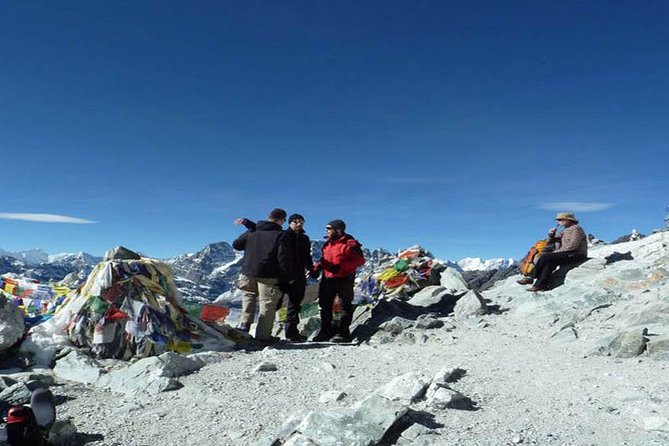
The most consistent praise is aimed at the staff. Guides are described as patient, calm, supportive, and able to handle difficult moments. Porters receive special recognition for carrying loads, encouraging tired walkers, and helping when someone had a leg injury.
This matters on a route where plans can change quickly. Weather may delay a flight. A group member may need to slow down. Someone may feel unwell at altitude. A local team that knows the route can help you make sensible choices, though no guide can remove the risks of high-altitude trekking.
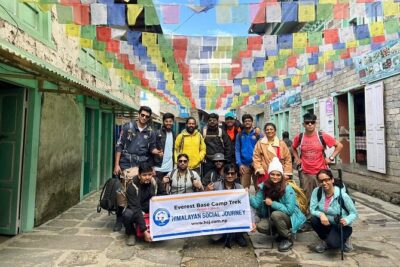
The company has also handled groups with a wide range of ages. One account describes two 69-year-old women reaching Base Camp with extra attention, while another describes a 78-year-old grandfather completing the trek with his grandsons. These examples do not mean age is irrelevant or that the trek is easy. They show the value of pacing, preparation, and a capable support team.
Who should book this trek?
I would recommend this trip to you if you want the classic Everest route with logistics arranged in advance. It suits people who value local guides, porters, included meals, and a private group more than luxury rooms or a tightly fixed schedule.
It is also a good fit if you want cultural contact along with mountain views. The Sherpa villages and monasteries give the trek more substance than a simple point-to-point walk.
I would be cautious if you have little experience with long walks, dislike shared bathrooms, or cannot tolerate schedule changes. The Lukla flight is unpredictable, and emergency evacuation and medical costs are not included. You need proper insurance and a few spare days.
The free cancellation policy allows cancellation at least 24 hours before the local start time for a full refund. Changes or cancellations inside that window are not accepted, so check your plans carefully before the deadline.
Should you book the Everest Base Camp Trek?
Book it if Base Camp is a serious personal goal and you want a Nepal-based company to handle the main logistics. The included flights, meals, lodges, guide, porters, and Kathmandu hotel cover the expensive and complicated parts of the trip.
Do not book it as a casual holiday. You need moderate fitness, patience with basic accommodation, and flexibility for weather delays. Add buffer days after the trek, buy suitable insurance, and ask in advance whether your plan includes Kala Patthar.
For the right person, this is a strong package: demanding, practical, culturally grounded, and supported by a team that has earned a 5/5 rating from 87 published ratings, with 100 percent recommending the experience.
FAQ
Where does the Everest Base Camp Trek start?
The activity starts at Tribhuvan International Airport in Kathmandu, Nepal.
Where does the trek end?
The activity ends back at the meeting point in Kathmandu.
How long does the trek take?
The tour lasts approximately 15 days.
Is pickup included?
Pickup is offered, and surface transfers are included as listed in the itinerary.
Is the Kathmandu to Lukla flight included?
Yes. The package includes Kathmandu to Lukla and return airfare.
Can the Lukla flight be delayed or canceled?
Yes. Weather can delay or cancel flights for one or several days, even during the best trekking season.
Are helicopter transfers included if the Lukla flight is canceled?
No. A helicopter can be arranged if available, but it requires an additional charge.
What accommodation is included during the trek?
The trek uses local lodges with standard rooms and shared bathrooms. Three nights in a three-star Kathmandu hotel with breakfast are also included.
Are meals included?
Breakfast, lunch, dinner, and hot drinks are included during the trek. Lunch and dinner in Kathmandu are not included.
What fitness level is required?
A moderate level of physical fitness is required.
Is travel insurance included?
No. Insurance and medical expenses are not included. Emergency evacuation costs are also excluded.
Is this a private tour?
Yes. Only your group participates in the activity.
Do I need a Nepal visa?
Yes. The listed requirement is a multiple-entry 30-day Nepal visa costing USD 40.
What is the cancellation policy?
You can cancel at least 24 hours before the local start time for a full refund. Cancellations or changes made less than 24 hours before the start time are not accepted.
Recently added around Kathmandu
- Ghorepani Poon Hill Trek★ 5.0 · 16 reviews
- Amazing 1 Day Trekking Experience in Kathmandu Nepal★ 5.0 · 24 reviews
- Private Manaslu Circuit Trek at Himalayas★ 5.0 · 3 reviews
- Ghorepani Poonhill Trek★ 5.0 · 5 reviews
- Upper Mustang Trekking★ 5.0 · 2 reviews
- Upper Mustang Trekking★ 3.0 · 2 reviews
- Upper Mustang Trekking★ 5.0 · 4 reviews
- Upper Mustang Trek★ 5.0 · 5 reviews
Everest Base Camp Treks, compared.
Browse the lists this tour appears in