
REVIEW · KATHMANDU
Gokyo Valley Trek
Gokyo Ri earns its sunrise. This 15-day trek from Kathmandu takes you through Sherpa villages, Buddhist monasteries, glacial valleys, and the high blue lakes of Gokyo. I especially like the chance to see Everest, Lhotse, Makalu, Cho Oyu, and Gyachung Kang from one viewpoint, and I like that the route includes a proper acclimatization day in Namche Bazaar.
The main tradeoff is effort. You reach 5,483 meters at Gokyo Ri, sleep in simple mountain lodges, and depend on weather for the small aircraft between Kathmandu and Lukla. The itinerary is well supported, but this is still a serious high-altitude trek, not a sightseeing holiday with a few walks added on.
Key points at a glance
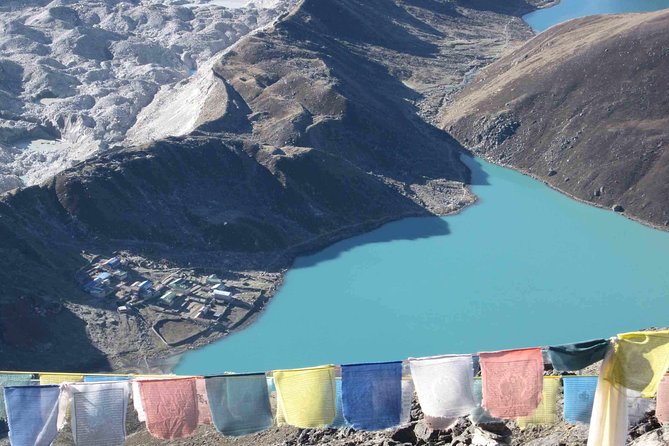
- Gokyo Ri at 5,483 meters: The summit gives you a wide view of Everest, Lhotse, Nuptse, Makalu, Cho Oyu, Gyachung Kang, Gokyo Valley, and the Ngozumpa Glacier.
- The Ngozumpa Glacier: You trek beside Nepal’s largest glacier, with ice and moraine forming one of the route’s most striking sights.
- A useful Namche acclimatization day: The hike toward Syangboche and the Everest View Hotel gives your body time to adjust before higher ground.
- Sherpa villages and local lodges: Phakding, Namche, Phortse, Machhermo, Gokyo, Dole, and Khumjung offer a closer look at daily life in the Khumbu.
- A small group format: The maximum group size is 15, with one porter for every two clients.
- A package with practical support: Flights, permits, guides, porters, meals, lodging, airport transfers, sightseeing, a sleeping bag, and down jacket are included.
What the $1,514.67 price really covers
The price looks reasonable for a 15-day Himalayan trip because it covers many of the costly moving parts. You receive airport transfers, four nights in a three-star Kathmandu hotel, 10 nights in guesthouses, a licensed English-speaking guide, porters, trekking permits, Kathmandu to Lukla flights, return airfare, and guided sightseeing in the Kathmandu Valley.
The food arrangement is also useful. Breakfast is included for 14 days, lunch for 10 days, and dinner for 11 days. Meals in Kathmandu are not included, as are drinks, international flights, the Nepal entry visa, travel insurance, personal equipment, and tips.
I would look closely at the insurance requirement before booking. Your policy must cover emergency high-altitude rescue and evacuation. That is not a minor detail in the Himalayas, and it should be arranged before departure.
You also receive a duffel bag, sun hat, down jacket, and sleeping bag for the trek. The jacket and sleeping bag are loaned equipment and must be returned. You still need personal trekking clothing and equipment, but this package reduces the amount of bulky gear you need to bring from home.
The cost is strongest for someone who wants an organized trip rather than a do-it-yourself route. Guides and porters handle much of the practical work, while airport transfers and permits remove several tasks that can be awkward to arrange on your own.
More Everest Base Camp Treks in Kathmandu:
- Everest Base Camp Trek – 14 Days
★ 5.0 · 1,499 reviews - Everest Base Camp Trek
★ 5.0 · 842 reviews - Everest Base Camp Trekking
★ 5.0 · 485 reviews
Kathmandu begins with temples, paperwork, and a useful briefing
Your airport pickup starts the trip in a straightforward way. An Ace the Himalaya representative meets you outside Tribhuvan International Airport with a signboard and takes you to your hotel in a private tourist vehicle.
A pre-trek meeting takes place on the first or second day. Bring your passport, three passport photos, and a readable copy of your travel insurance policy. You also clear any remaining balance, meet the trek leader, and complete the required trip forms.
Day two gives you a compact introduction to Kathmandu’s religious and artistic heart. At Pashupatinath Temple, you cannot enter the main temple because it is reserved for Hindus, but you can view the temple and riverside activity from the eastern bank of the Bagmati River.
Boudhanath Stupa offers a different atmosphere. Buddhist pilgrims walk around the stupa, turning prayer wheels beneath the painted eyes of the Buddha. This is one of the best places on the itinerary to notice how Tibetan Buddhist traditions remain part of everyday life in Kathmandu.
Bhaktapur Durbar Square adds old royal buildings, pagoda temples, and carved woodwork. The visit includes Nyatapola, Batsala Temple, Bhairavnath Temple, Dattatraya Temple, Pujari Muth, and the Palace of 55 Windows.
These stops are not filler. They give you cultural context before the mountain walk begins, although the day may feel full if you are still recovering from a long international flight.
Lukla to Phakding: the trek gets moving quickly
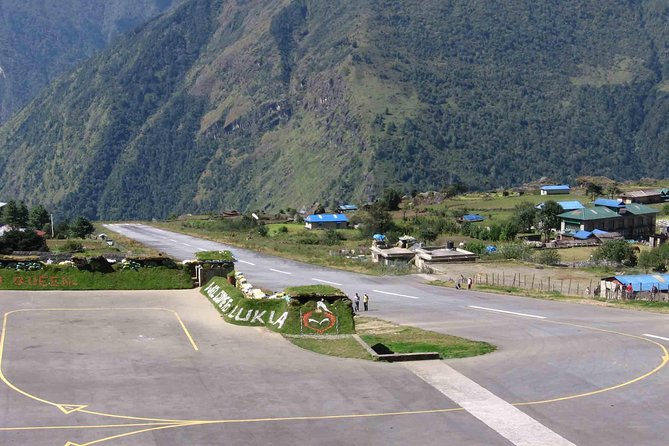
The flight from Kathmandu to Lukla takes about 35 minutes and lands at Tenzing and Hillary Airport at 2,804 meters. The mountain setting begins almost at once, but the flight is also one of the less predictable parts of the trip because the itinerary depends on suitable weather.
At Lukla, your guide introduces the porters while equipment is sorted and loaded. The first walk descends toward the Dudh Kosi River, then follows the main trail toward Namche Bazaar.
The route through Ghat and on to Phakding is comparatively gentle. You stay at about 2,550 meters in Ghat before reaching Phakding, where the pace remains manageable. This first walking day matters because it lets you begin adjusting without forcing an immediate high-altitude push.
The supplied schedule lists unusually long time blocks for several walking days, but you should understand the trip as a multi-hour trekking program with stops, meals, and changes in pace. Your guide will set the actual rhythm according to the group and conditions.
Namche Bazaar brings the first serious climb
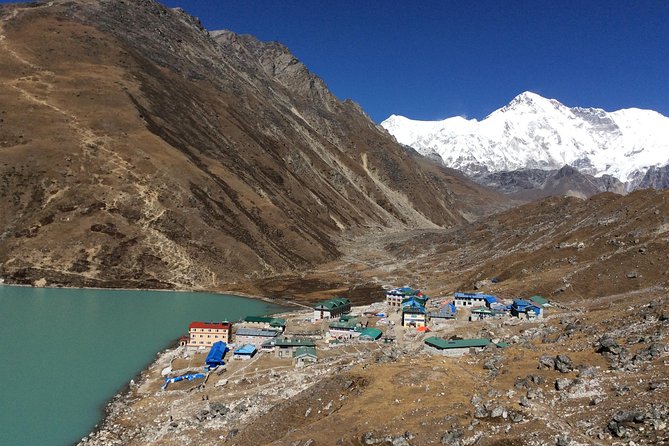
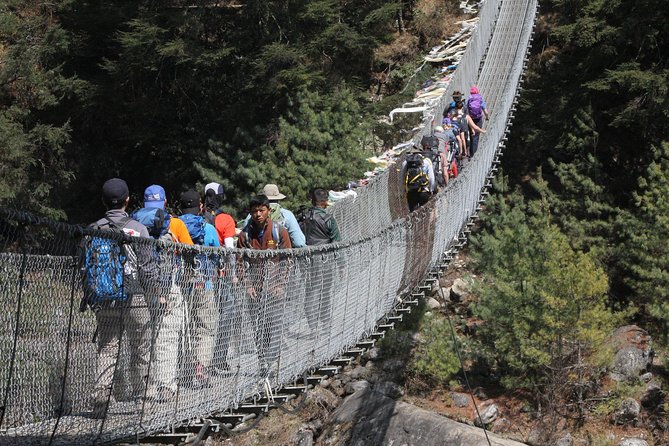
The trail follows the Dudh Kosi and crosses suspension bridges decorated with prayer flags. After entering Sagarmatha National Park, the path climbs more sharply toward Namche Bazaar, the main trading town on the Everest route.
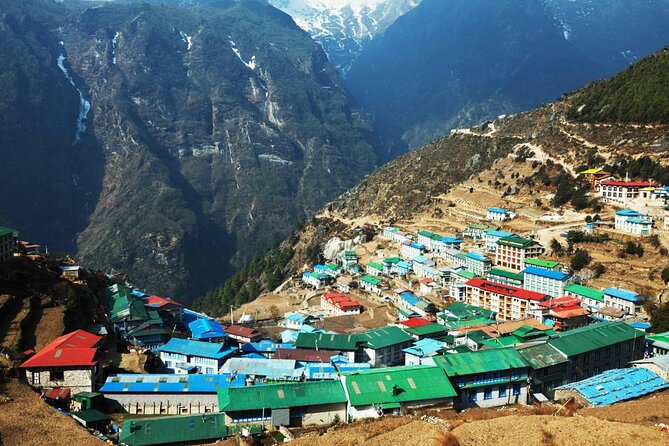
Namche is more developed than the smaller settlements ahead. You may find restaurants, bakeries, lodges, hotels, shops, money exchange services, and internet cafes. That makes it a useful place to rest and adjust, but it is still a mountain town reached by foot, not a comfortable city base.
The acclimatization day is one of the itinerary’s strongest choices. You make a short hike to a museum focused on Sherpa customs, then continue toward Syangboche Airport and the Everest View Hotel. From there, the route offers broad views of the Khumbu peaks, especially at sunrise and sunset.
Do not treat this as a wasted rest day. The short hike helps your body adjust, and the high point gives you an early look at the mountains you will approach over the next week.
A few more treks around Kathmandu worth a look
- Annapurna Circuit Trek with Tilicho Lake
★ 5.0 · 368 reviews - Everest Base Camp Trekking – 13 Day
★ 5.0 · 365 reviews - Everest Base Camp Trek
★ 5.0 · 350 reviews - Everest Base Camp Trek -14 Days
★ 5.0 · 321 reviews
Phortse and Machhermo show the route’s quieter side
Leaving Namche, the trail climbs through rhododendron, juniper, and conifer forest. In spring, the flowering rhododendrons add color to the walk, while the higher sections become more open and spare.
You pass yak pastures and seasonal settlements on the way to Phortse. Views of Khumbi La and Tawache accompany the day, and the smaller village setting gives you a quieter contrast to Namche.
The route then moves toward Machhermo. A ridge provides views back down the valley toward Kengtega and upward toward Cho Oyu. After descending to a river, you climb again toward the terminal moraine of the Ngozumpa Glacier.
Machhermo sits at a serious altitude, and this is where the trek begins to feel properly high. You should keep your pace steady, drink as directed by your guide, and pay attention to how you feel. The schedule allows only one night here before Gokyo, so your guide’s judgment matters.
Gokyo Valley and the Ngozumpa Glacier
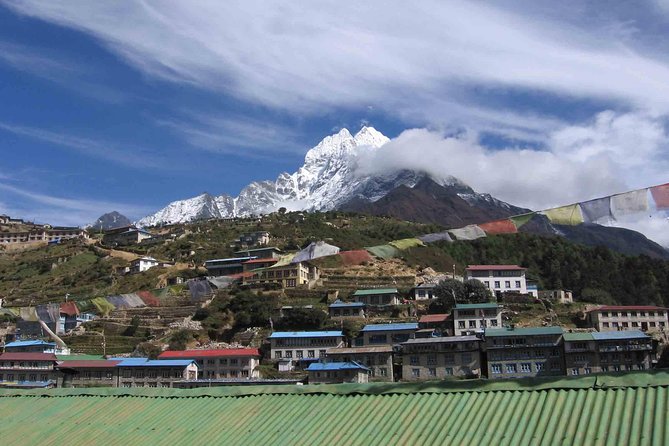
The approach to Gokyo is the visual centerpiece of the route. Gokyo sits at about 4,790 meters beside its famous lakes, with the Ngozumpa Glacier nearby.
You spend two nights here, which gives you time for more than a quick arrival and departure. The glacier, high peaks, and lakes create a setting that feels very different from the forested lower trail.
Gokyo also works well as a base for the main climb. Rather than reaching the village late and immediately attempting Gokyo Ri, you have time to rest before the early morning ascent.
This is also the point where simple accommodation becomes more noticeable. Guesthouses are part of the package, but they are not hotel rooms in the usual sense. You should expect basic mountain lodging and shared or twin-share arrangements, including dormitory-style rooms at some points.
Gokyo Ri is the payoff, but not an easy one
The climb to Gokyo Ri begins early and rises steeply to 5,483 meters. The effort is real, especially in thin air, but the reward is one of the broadest mountain views in the Khumbu.
From the top, you can look over Gokyo Valley and the massive Ngozumpa Glacier. Everest, Lhotse, Nuptse, Makalu, Cho Oyu, and Gyachung Kang are visible in the panorama when conditions are clear.
The view also includes the great ice ridge between Cho Oyu and Gyachung Kang, a feature that gives this route its own identity. You are not simply looking at Everest from another angle. You are seeing a collection of major Himalayan peaks around a high glacial basin.
The summit visit is listed as a short stop, but the climb itself is the important part. Weather can affect visibility, so there is no guarantee that every peak will be clear. That is one reason the extra night at Gokyo is valuable.
The return through Dole and Khumjung feels different
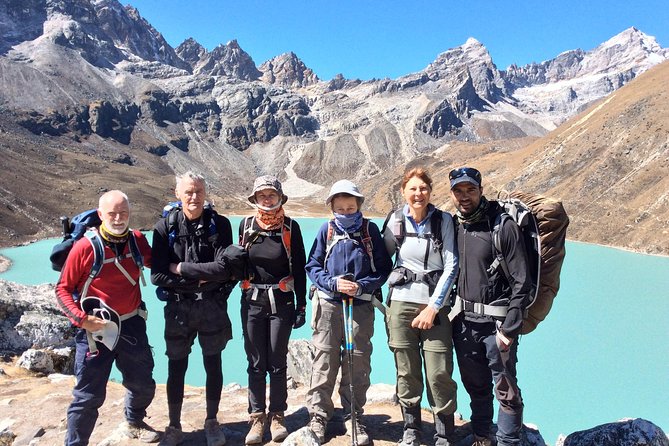
After Gokyo Ri, the route descends to Dole. Downhill walking is easier on your breathing, but it can be tiring on knees and legs after the high climb.
The return to Namche passes through Khumjung, a typical Sherpa village. By this stage, the trail will feel familiar in reverse, but the lower altitude changes your energy and your view of the route.
You then continue to Lukla, where the group has time to reflect on the trek and explore the town. This final night is useful because the next day’s flight can be affected by weather, and it is better to reach Lukla before your scheduled departure rather than trying to rush there from the trail.
The flight back to Kathmandu offers one last look at the mountains. Once in the capital, you are transferred to your hotel for a spare day before departure.
The final Kathmandu day adds breathing room
Day 14 is deliberately open. You can rest, shop, or arrange an additional activity such as a Chitwan safari, rafting, a Kathmandu Valley tour, a scenic Everest flight, or mountain biking.
The included farewell dinner takes place at a traditional Nepalese restaurant with cultural performances. It gives the group a clear ending after the trek, while the spare day also provides some protection if the mountain flight schedule shifts.
The trip ends with an airport transfer to Tribhuvan International Airport. Pickup and drop-off are included, which is helpful after a long trek and makes the final morning simple.
Guides, porters, and group size
The maximum group size is 15, and one porter is assigned for every two clients. That is a useful balance: you receive logistical help without necessarily being part of a huge walking group.
The strongest praise has focused on individual staff members. Guides including Nimesh, Ramesh Karki, Aamod Nepal, Milan, Bishnu, and Ngima are specifically singled out for care, flexibility, encouragement, and route knowledge. Porters such as Bal Krishna Niagiar, Bishal, Gopal, Lochan, and Auishe Rai are also named for their support.
That pattern matters. High-altitude trekking is not just about scenery. A calm guide who notices changing conditions, adjusts the route, and keeps the group moving safely can make a major difference.
There are also reports of guides adapting plans after flight delays, landslides, or moderate weather problems. You should not assume every disruption can be solved, but flexibility is a valuable quality on a route that depends on mountain weather.
Who should book this trek?
I would choose this trek if you want major Himalayan views but prefer Gokyo’s glacier and lakes to the more familiar Everest Base Camp route. It suits people with moderate physical fitness who can handle repeated walking days, steep climbs, basic lodges, and high altitude.
It is less suitable if you want comfortable hotels throughout, guaranteed flight times, or a gentle walking holiday. The itinerary is organized, but it cannot remove the physical demands or the uncertainty of Lukla weather.
Cancellation terms are strict close to departure. You receive a full refund if you cancel at least six full days before the start time, a 50 percent refund when canceling two to six full days ahead, and no refund within two days. If poor weather cancels the experience, you are offered another date or a full refund.
Should you book the Gokyo Valley Trek?
Book it if the view from Gokyo Ri, the Ngozumpa Glacier, and time among Sherpa villages matter more to you than luxury. The package offers solid value because flights, permits, meals, guides, porters, gear loans, accommodation, sightseeing, and transfers are bundled together.
I would book only after confirming your insurance, fitness, personal equipment, and flexibility around Lukla flights. If those pieces are in place, this is a strong choice for a supported Himalayan trek with an excellent mountain viewpoint and a more distinctive route than simply following the busiest Everest corridor.
FAQ
How long is the Gokyo Valley Trek?
The full program lasts approximately 15 days, including Kathmandu sightseeing, the trek, flights between Kathmandu and Lukla, and the final airport transfer.
Where does the trek start and finish?
The experience starts at Tribhuvan International Airport in Kathmandu. It ends back at the same meeting point after the return to Kathmandu.
What is the highest point reached?
The highest point is Gokyo Ri, at an elevation of 5,483 meters.
Is airport pickup included?
Yes. Airport transfers in Kathmandu are included at arrival and departure, along with the transfer between Lukla Airport and the trekking route.
Are Kathmandu sightseeing visits included?
Yes. Guided sightseeing includes Pashupatinath Temple, Boudhanath Stupa, and Bhaktapur Durbar Square. Entrance fees during the guided sightseeing are included.
Are flights to Lukla included?
Yes. Kathmandu to Lukla and Lukla to Kathmandu airfare is included in the package.
Is accommodation included?
Yes. The package includes four nights in a twin-share or double room at a three-star hotel in Kathmandu and 10 nights in guesthouses during the trek. Trekking accommodation may use twin-share and dormitory rooms.
Are meals included?
Breakfast is included for 14 days, lunch for 10 days, and dinner for 11 days. Lunch and dinner in Kathmandu are not included, and drinks are also excluded.
Is trekking equipment provided?
A down jacket and sleeping bag are provided for the trek and must be returned afterward. You must bring or arrange your own personal trekking equipment.
Is travel insurance included?
No. You must arrange your own insurance, and it must cover emergency high-altitude rescue and evacuation.
What happens if bad weather cancels the trip?
If poor weather causes the experience to be canceled, you are offered a different date or a full refund. The Lukla flights and mountain conditions can be affected by weather.
What is the cancellation policy?
Cancel at least six full days before the start time for a full refund. Cancel two to six full days ahead for a 50 percent refund. Cancellations less than two full days before departure are not refunded.
Recently added around Kathmandu
- Ghorepani Poon Hill Trek★ 5.0 · 16 reviews
- Private Manaslu Circuit Trek at Himalayas★ 5.0 · 3 reviews
- Amazing 1 Day Trekking Experience in Kathmandu Nepal★ 5.0 · 24 reviews
- Ghorepani Poonhill Trek★ 5.0 · 5 reviews
- Upper Mustang Trekking★ 5.0 · 2 reviews
- Upper Mustang Trekking★ 3.0 · 2 reviews
- Upper Mustang Trekking★ 5.0 · 4 reviews
- Upper Mustang Trek★ 5.0 · 5 reviews
Everest Base Camp Treks, compared.






Browse the lists this tour appears in