
REVIEW · KATHMANDU
14-Day Everest Base Camp Trek
Everest starts with a tiny mountain runway. This 14-day trek combines the classic Khumbu route with Namche Bazaar, Tengboche Monastery, Everest Base Camp, and the sunrise climb to Kala Patthar. I like the two built-in acclimatization days, and I like that the $1,600 price includes flights, permits, meals, guides, porters, and mountain lodging. The main catch is simple: this is a serious high-altitude trek, not a sightseeing holiday with a little walking added.
You should also plan for weather delays, basic teahouse rooms, long uphill days, and changing flight arrangements. The strongest praise goes to the guiding team, especially KP, Dil Man, Pemba Sherpa, Narayan, and Saugat, who are repeatedly credited with careful support and flexible planning. The small maximum group of eight is another plus.
Key things to know before booking
- Lukla is the dramatic gateway: The trek begins with a flight to 2,860-meter Lukla, followed by a three to four-hour walk to Phakding.
- Acclimatization is built in: Rest days in Namche and Dingboche give your body time to adjust before the highest section.
- The hardest day is not necessarily Base Camp day: The rocky route from Gorakshep to Everest Base Camp and back takes six to seven hours.
- Kala Patthar provides the big view: The pre-dawn climb offers one of the finest close views of Everest without climbing the mountain.
- The package covers most major costs: Domestic flights, permits, three meals a day during the trek, guides, porters, and 11 teahouse nights are included.
- Weather can change the plan: Flights may use Ramechhap instead of Kathmandu, adding a long road transfer before or after the mountain section.
What the $1,600 package really gives you
At $1,600 per person, this is a strong-value guided trek if you want the major logistics handled for you. The price includes Kathmandu to Lukla and back, airport transfers, Sagarmatha National Park and local entry permits, a guide for 12 days, a porter for 11 days, two Kathmandu hotel nights, and 11 nights in mountain teahouses.
Food is also covered during the trekking portion: 12 breakfasts, 12 lunches, and 12 dinners. You pay for lunch and dinner in Kathmandu, personal expenses, and travel insurance separately.
That list matters in Nepal. The flight, permits, mountain rooms, staff transport, and support team can be awkward to arrange alone. You are not simply paying for a walking route. You are paying for local coordination in a place where weather, road conditions, and mountain logistics can alter the day.
The package does not include evacuation cover or medical costs. Buy travel insurance that specifically covers high-altitude trekking and possible evacuation. This is not a minor detail. At altitude, a sensible insurance policy is part of your equipment.
The group limit is eight people, which should make walking pace, meal stops, and safety decisions easier than on a large commercial departure. The company also has a record of adapting plans, including compressed treks, medical situations, and helicopter finishes on some customized trips. Those extras are not part of this standard package, but they suggest that flexibility is possible when conditions require it.
More Everest Base Camp Treks in Kathmandu:
- Everest Base Camp Trek – 14 Days
★ 5.0 · 1,499 reviews - Everest Base Camp Trek
★ 5.0 · 842 reviews - Everest Base Camp Trekking
★ 5.0 · 485 reviews
Kathmandu arrival and the flight to Lukla
Day one is deliberately easy. A guide or office representative meets you at Tribhuvan Airport and transfers you to a Kathmandu hotel, listed as Bodhi Boutique or a similar property. You have time to settle in before the mountain section begins.
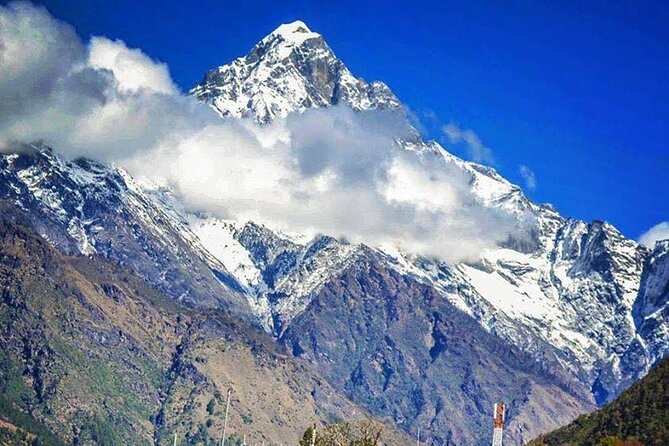
Day two brings the famous flight to Lukla. The airstrip sits at 2,860 meters, so you arrive in cool mountain air almost at once. Your guide and porter meet you there, and the walk to Phakding takes about three to four hours.
The route descends toward Dudh Koshi Ghat before following the river. It is a gentle introduction by Everest region standards, but do not treat it as a throwaway day. You are already at altitude, and your legs are adjusting to a trail rather than pavement.
There is an important flight note. At certain times, flights leave from Ramechhap instead of Kathmandu because of work at Kathmandu Airport. Ramechhap is about a four-hour drive from Kathmandu, and the departure may require a 2 a.m. start. The return road trip can take four to six hours, depending on traffic.
That change can make the first and final days tiring. It is worth asking about the current flight airport before you arrive, then keeping your schedule loose after the trek.
Phakding to Namche Bazaar, your first real climb
From Phakding, you cross the Dudh Koshi several times on suspension bridges and walk through pine forest. At the entrance to Sagarmatha National Park, permits are checked before the trail drops toward Jorsale for lunch.
Then comes the uphill to Namche Bazaar. The Hillary Suspension Bridge marks part of this climb, and the path becomes a clear test of your fitness. The itinerary gives this day a long schedule, but actual walking time can vary with pace, stops, and trail conditions.
Namche is not just a place to sleep. It is the main Sherpa trading center on this route and the staging point for many Everest expeditions. Shops, lodges, and small markets make it a useful place to rest and organize your gear.
You also get your first sight of Mount Everest on the way in, though the view is not yet the grand panorama you may have imagined. The real value of Namche is that it gives you a comfortable base for altitude adjustment.
Namche acclimatization and the Everest View Point
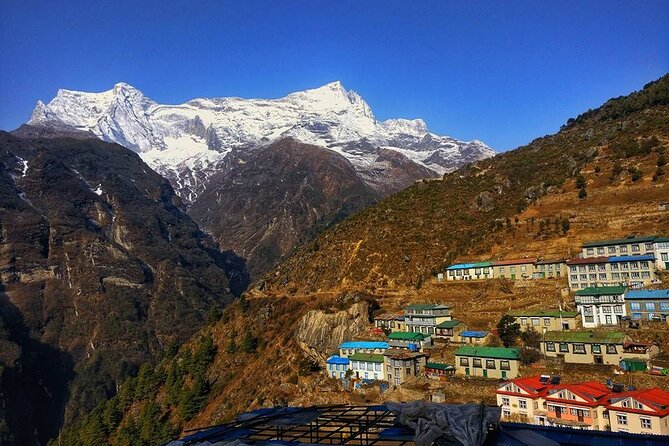
Day four is an acclimatization day. You can explore Namche or take a roughly two-hour hike to the Everest View Point.
The point of this day is not only sightseeing. You climb higher during the day, then return to sleep at the same altitude. That pattern helps your body adjust before the route rises farther into the Khumbu.
Namche also offers a Sherpa museum. If your visit falls on Saturday, you may find a small outdoor market. This is a useful day to walk slowly, drink plenty of water, check your layers, and avoid spending all your energy on side trips.
The itinerary lists only a short duration for this stop, but the hike itself is about two hours. Treat it as a walking day with a rest purpose, not as a completely idle day.
A few more treks around Kathmandu worth a look
- Annapurna Circuit Trek with Tilicho Lake
★ 5.0 · 368 reviews - Everest Base Camp Trekking – 13 Day
★ 5.0 · 365 reviews - Everest Base Camp Trek
★ 5.0 · 350 reviews - Everest Base Camp Trek -14 Days
★ 5.0 · 321 reviews
Tengboche Monastery and the changing high country
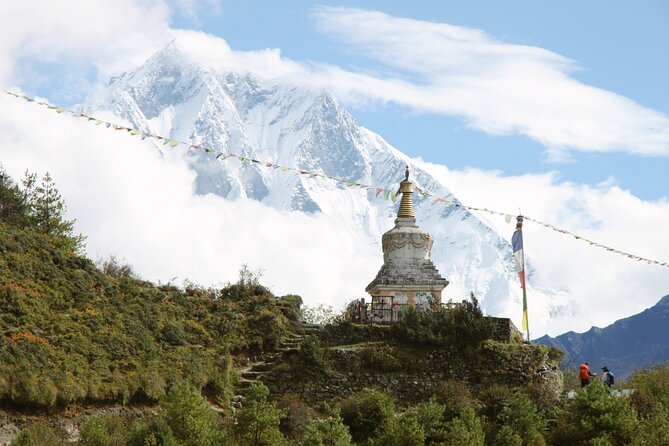
The route to Tengboche moves through forest and open mountain country. Tengboche is famous for its monastery, described as the largest in the Khumbu region, and the visit gives the trek a cultural center beyond the mountain views.
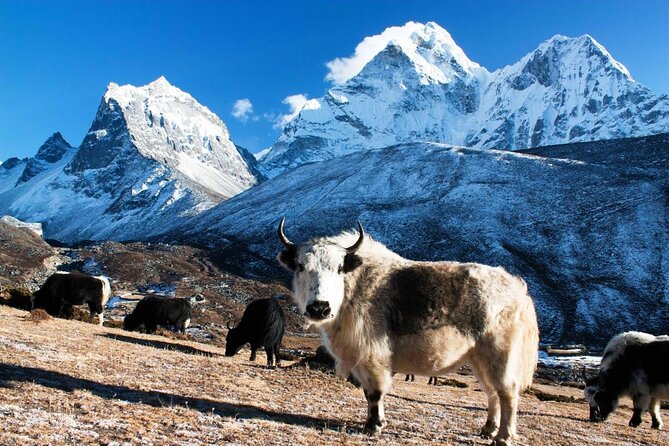
You have the chance to receive blessings at the monastery. Around Tengboche, the views include Ama Dablam, Thamserku, and Khumbila, mountains regarded as sacred by the Sherpa people.
The path can feel demanding because the itinerary contains long scheduled days, and some sections include descents followed by climbs. Your guide will set the pace, but you should still expect a full day outside. Keep snacks and water within reach rather than waiting for the next meal stop.
From Tengboche toward Dingboche, the vegetation begins to change. You pass villages and walk through the Khumbila Khola Valley before climbing toward a ridgeline with views of Taboche, Nuptse, and Cholatse. Trees become less common, shrubs replace much of the forest, and the air feels thinner.
Dingboche, the second essential rest day
Dingboche is where the trek begins to feel properly high and exposed. The route passes through alpine country and reaches a village surrounded by broad valleys and large peaks.
Day seven is another acclimatization day. You can rest in Dingboche or explore the Chhukung and Imja Valleys. Imja connects toward Island Peak and Makalu Barun National Park, though this itinerary does not include those routes.
This rest day is one of the best features of the program. The schedule could be shortened, but doing so would make the altitude adjustment harder. You need time here before moving toward Lobuche, Gorakshep, and Base Camp.
The company requires a strong fitness level, and that is fair. You do not need climbing experience for this itinerary, but you do need to manage repeated long walking days at increasing altitude.
Lobuche and the memorials on the trail
The route to Lobuche is slower and tougher as the air thins. You climb steeply to a hill with memorial stupas honoring people who died on Everest.
This is a quiet, serious part of the trek. It gives the mountain a human scale. Everest is not only a spectacular backdrop. It is also a place that has demanded a high price from climbers and their support teams.
Beyond the memorials, the trail continues over rough mountain ground toward Lobuche. Views include Lobuche, Pumori, and Nuptse. The scenery becomes less about trees and more about rock, snow, ice, and wide open slopes.
Lobuche accommodation is in a mountain teahouse. Rooms are simple, and you should expect fewer comforts than in Kathmandu. The value is having a warm place to eat and sleep close to the next day’s route.
Gorakshep and the long walk to Everest Base Camp
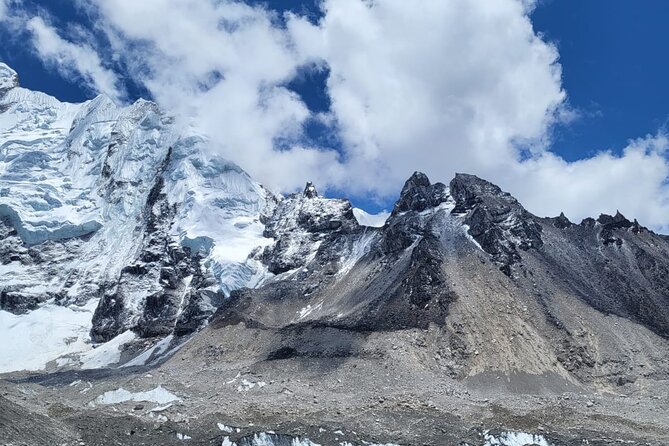
From Lobuche, the path to Gorakshep may begin gently, but the going soon becomes rougher. The trail crosses dunes, moraine, and rocky ground formed by glacier debris.
From Gorakshep, the route to Everest Base Camp and back takes around six to seven hours. This is a serious walking day, even if the mileage does not look extreme on a map. The uneven surface slows you down, and the altitude makes every rise feel larger.
At Base Camp, you see the Khumbu Glacier and the Khumbu Icefall. During the main climbing season, you may see climbers and expedition activity, though the exact scene depends on timing and conditions.
Base Camp itself is not the best place for a wide Everest view. Nuptse and other peaks dominate much of the sightline. The emotional reward comes from reaching the point used by expeditions attempting Everest, after walking through the Khumbu’s stark upper country.
You return to Gorakshep for the night. Keep this day focused. Take photographs, but do not let the camera turn a demanding return walk into a rushed finish.
Kala Patthar sunrise and the long descent
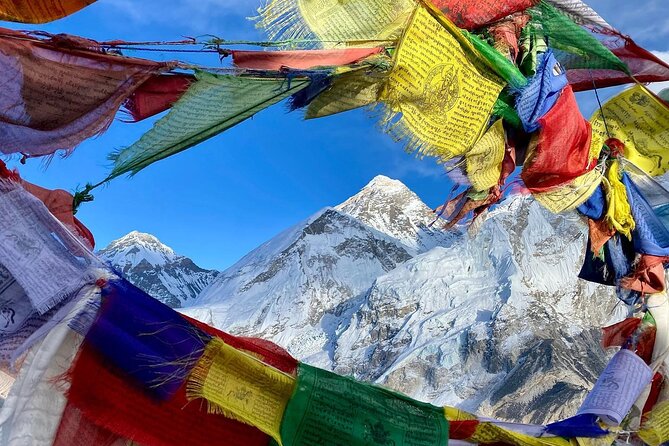
Day ten begins before dawn with the climb to Kala Patthar. The early start is designed to catch sunrise as the first light reaches Everest, Nuptse, Changtse, and Lhotse.
Kala Patthar is the view day. From the summit, you get a close and commanding look toward Everest without climbing the peak itself. Cold, wind, and darkness can make the climb uncomfortable, but the timing is part of its appeal.
Afterward, you return to Gorakshep for breakfast and descend toward Pheriche. If the group has enough energy, the route may continue toward Panboche for the night. That possibility should be confirmed with your guide, since it depends on pace, conditions, and how the group is feeling.
The descent is easier on breathing but not always easy on knees. Trekking poles can help, especially after several days on rocky ground.
Returning through Namche and Lukla
From Pheriche, the route runs mainly downhill toward Tengboche and Namche Bazaar. You pass familiar places from the outward walk, but the return direction gives the trail a different rhythm.
Day twelve continues toward Lukla, including another crossing of the Hillary Suspension Bridge. In Lukla, the group has a traditional farewell party. It is a fitting end to the walking portion, though you should still keep some energy for the next morning’s flight.
Day thirteen is set aside for the early flight from Lukla. The destination may be Kathmandu or Ramechhap. If you land at Ramechhap, the road transfer to Kathmandu can take four to six hours.
Day fourteen is your onward departure day. The program includes your departure transfer, but your own international arrangements should allow room for flight disruption. Mountain weather does not follow your airline schedule.
Guides, porters, and the human side of the trek
The most praised part of this operation is its staff. KP is repeatedly singled out for calm care, positive energy, and thoughtful attention. Dil Man and Jay are praised for planning and support, while Pemba Sherpa and Narayan are credited with looking after individual trekkers closely.
Saugat is noted for handling last-minute changes, including a compressed itinerary. There are also accounts of Pradeep, the company owner, giving clear advice before departure and helping shape flexible plans.
That matters more than polished paperwork. On a high-altitude trek, you want a guide who notices when you are struggling, adjusts the pace, and takes safety seriously. One account describes the team responding quickly when a group member showed signs of acute mountain sickness. You should still understand that no guide can remove all mountain risk.
The porter is included for 11 days, and staff insurance and necessary ground transport are covered. Pack with the porter arrangement in mind, but ask the company directly about luggage weight limits before departure because that detail is not specified here.
Who should book this Everest Base Camp trek?
I would recommend it to a fit first-time Himalayan trekker who wants the standard Everest route with a guide, porter, permits, flights, meals, and teahouse nights arranged in one package.
It also suits small groups that value personal support. The maximum of eight people is large enough for company but small enough for the guide to keep track of individual needs.
I would not choose it if you dislike basic accommodation, early starts, long walking days, uncertain flights, or cold conditions. I would also be cautious if you have limited fitness or no time to recover from a delayed return.
The published rating is 5 out of 5 from 20 ratings, and every recorded rating recommends the experience. That is encouraging, especially because the praise focuses on real points: careful guides, strong planning, flexible support, and good teahouse arrangements. Still, your own success depends on preparation, pacing, insurance, and respect for altitude.
At $1,600, the trek offers good value for a supported 14-day route. Book it if you want Everest Base Camp without managing each permit, flight, meal, porter, and lodge yourself. Before paying, confirm the current flight airport, baggage rules, insurance requirements, and what happens if weather interrupts the Lukla flights.
FAQ
How long is the Everest Base Camp trek?
The experience lasts approximately 14 days, including arrival and departure days in Kathmandu, the mountain trek, and the flights between Kathmandu or Ramechhap and Lukla.
Where does the trek begin?
The program begins with airport pickup at Tribhuvan Airport in Kathmandu. The mountain walking begins after the flight to Lukla at 2,860 meters.
Is the Lukla flight included?
Yes. The package includes the Kathmandu to Lukla and Lukla to Kathmandu flight arrangement, though flights may operate through Ramechhap instead of Kathmandu during airport upgrades.
How long is the walk from Lukla to Phakding?
The first walking day takes approximately three to four hours from Lukla to Phakding.
Are meals included?
Breakfast, lunch, and dinner are included during the trekking portion, with 12 breakfasts, 12 lunches, and 12 dinners provided. Lunch and dinner in Kathmandu are not included.
Are accommodation and permits included?
Yes. The package includes two nights in Kathmandu, 11 nights in mountain teahouses, Sagarmatha National Park entry, and local entry permits.
Is the trek suitable for beginners?
The trek does not require stated climbing experience, but it does require a strong fitness level. You should be ready for daily walking of about five hours, with some days lasting seven to eight hours.
Can I cancel for a full refund?
You can cancel at least 24 hours before the experience start time for a full refund. Poor weather or failure to meet the minimum number of participants may result in a different date or a full refund.
Recently added around Kathmandu
- Ghorepani Poon Hill Trek★ 5.0 · 16 reviews
- Private Manaslu Circuit Trek at Himalayas★ 5.0 · 3 reviews
- Amazing 1 Day Trekking Experience in Kathmandu Nepal★ 5.0 · 24 reviews
- Ghorepani Poonhill Trek★ 5.0 · 5 reviews
- Upper Mustang Trekking★ 5.0 · 2 reviews
- Upper Mustang Trekking★ 3.0 · 2 reviews
- Upper Mustang Trekking★ 5.0 · 4 reviews
- Upper Mustang Trek★ 5.0 · 5 reviews
Everest Base Camp Treks, compared.




Browse the lists this tour appears in