REVIEW · KATHMANDU
Kanchenjunga Circuit Trek
High mountains, few footprints. The 21-day Kanchenjunga Circuit Trek takes you into one of Nepal’s most remote trekking regions, from warm forest and Rai and Limbu villages to the icy Pangpema base camp at 5,143 meters. I like the carefully paced acclimatization day at Cheram and the chance to reach both Yalung Base Camp and the north side of Kanchenjunga. I also like that guides such as Nima Sherpa and Pasang have been praised for their care, local knowledge, and friendly manner.
The trade-off is the route’s difficulty. You spend several days above 4,000 meters, cross high passes, and walk through remote country where comfort and services are basic. A moderate fitness level is required, but I would treat that as a minimum rather than a full description of the challenge.
Key points at a glance
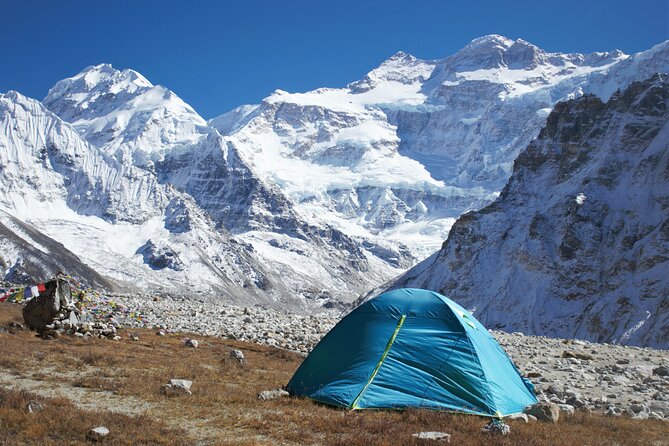
- Pangpema reaches 5,143 meters: The high point is the north Kanchenjunga base camp, with a serious altitude test before the return to Lhonak.
- The route changes constantly: Expect oak and rhododendron forest, steep valley trails, high passes, glaciers, and stark mountain country.
- Two base-camp outings add variety: Yalung Base Camp is reached from Cheram, while Pangpema is the main overnight destination in the north.
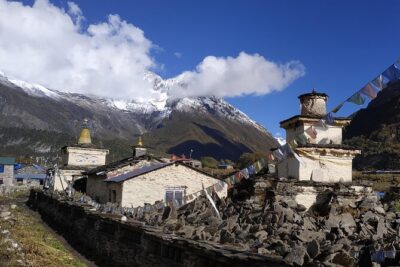
- Local culture is part of the route: Rai and Limbu communities live along the lower sections, giving the trek a stronger local character than a simple mountain walk.
- Nima Sherpa and Pasang are named guides: Their inclusion in past trips is useful reassurance for anyone concerned about guiding quality.
- The $3,000 price covers major trek costs: Permits, conservation fees, meals, guide service, airport transfers, Kathmandu hotel breakfasts, and trekking equipment are included, but insurance, porters, drinks, and several personal costs are extra.
Why Kanchenjunga feels different from Nepal’s famous treks
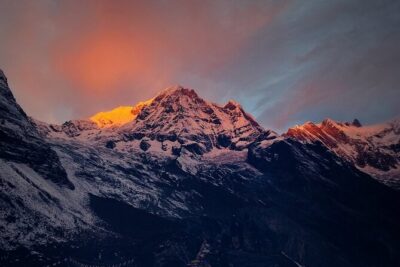
Kanchenjunga sits in Nepal’s far northeast and rises to 8,586 meters, making it the world’s third-highest mountain. The circuit is not a quick viewpoint walk or a busy teahouse route. It is a long journey through a protected mountain region where the trail, villages, and weather carry more importance than tourist infrastructure.
I like this trek for its sense of progression. You begin near Suketar at 2,420 meters, pass through forested hills and small settlements, and gradually enter a colder, more severe world. By the time you reach Lhonak and Pangpema, the scenery has changed completely.
The lower trail introduces Rai and Limbu communities, while the upper sections focus on glaciers, ridges, high passes, and huge peaks. You may see Kanchenjunga’s central, south, and north faces, along with Yalungkang and Mount Jannu. From the Sele La area, the views can extend toward Makalu, Chamlang, Lhotse, and Everest.
The route is also noted for oak and rhododendron forests, birds, mask deer, and the possibility of snow leopard sightings. Wildlife is never guaranteed, so I would treat it as a bonus rather than a reason to book the trek.
A few more treks around Kathmandu worth a look
- Everest Base Camp Trek – 14 Days
★ 5.0 · 1,499 reviews - Everest Base Camp Trek
★ 5.0 · 842 reviews - Everest Base Camp Trekking
★ 5.0 · 485 reviews
Day 1 to Day 4: Suketar, forest trails, and village country
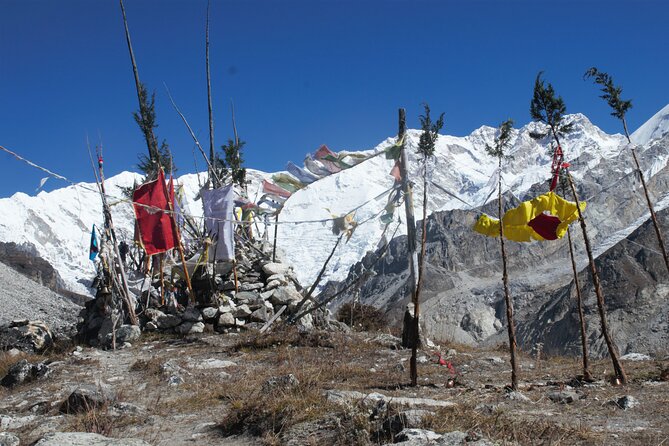
The trip begins with a flight from Kathmandu to Suketar, followed by a trek to Lalikha. The meeting point is Tribhuvan Airport, with a stated start time of 7:15 a.m. Airport pickup and private vehicle transfers are included, which makes the first morning easier, especially if you are handling trekking bags and unfamiliar airport routines.
The itinerary then moves from Lalikharka to Khesewa at 2,120 meters. This is still a lower-elevation section, but the walking is not necessarily easy. The route gains and loses height through wooded terrain, and early trekking days can feel demanding because your body is still adjusting to the schedule.
From Khesewa, you continue to Mamankhe at 1,785 meters, followed by Mamankhe to Yamphudin at 2,080 meters. These stops bring you deeper into rural Nepal, where local communities are more central to the experience than mountain views alone.
This is one of the route’s strengths. You do not rush straight toward the famous peaks. Instead, the trek gives you time to see how the setting changes from populated hills to increasingly wild country.
Day 5 to Day 7: climbing toward Cheram
Yamphudin to Tortong is the first major push upward, reaching 2,995 meters. The next day takes you to Cheram at 3,870 meters, a notable jump that marks the beginning of the high-altitude portion of the trek.
At this point, the itinerary wisely includes a full rest and acclimatization day at Cheram. That pause is not wasted time. It gives you a chance to recover, check how your body is responding, and prepare for the still higher sections ahead.
Cheram is also an important base for the Yalung side of Kanchenjunga. The route around here shifts from forest and village paths toward more open mountain terrain. You should expect colder conditions, thinner air, and fewer everyday comforts.
I would use the rest day carefully. The tour does not specify a separate activity program, so you should not assume a guided sightseeing schedule. The main value is recovery and acclimatization before the next high-altitude walks.
Day 8 and Day 9: Ramche and Yalung Base Camp
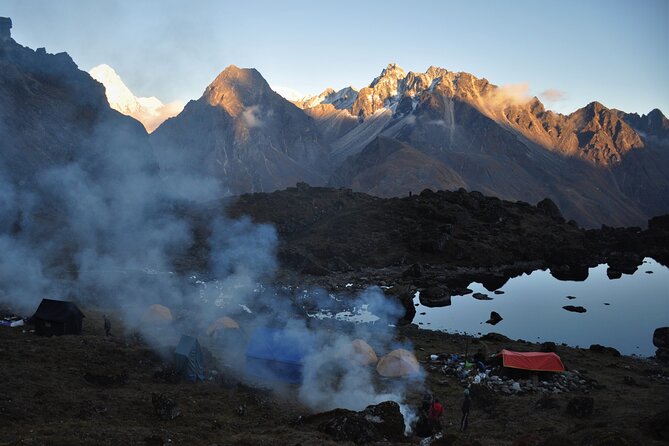
From Cheram, the route climbs to Ramchaur, also called Ramche, at 4,580 meters. The altitude becomes a serious factor here, and even a moderate walking pace can feel slow. Good pacing matters more than speed.
The following day takes you from Ramche to Yalung Base Camp at about 4,500 meters, then back to Cheram. This is a long out-and-back mountain day, but it gives you an important look at Kanchenjunga from the south side.
The return to Cheram is helpful because you sleep lower than the day’s highest point. Still, you should expect fatigue. This is one of the sections where you will appreciate having three meals a day, a guide, and a planned route rather than making decisions on the trail while tired.
The itinerary’s base-camp highlights need a little clarification. The route directly includes Yalung Base Camp and Pangpema Base Camp. Makalu and Everest are described as distant mountain views near the high-pass section, not as destinations reached on this itinerary.
Same trailhead, a longer or shorter day out:
- Annapurna Circuit Trek with Tilicho Lake
★ 5.0 · 368 reviews - Everest Base Camp Trekking – 13 Day
★ 5.0 · 365 reviews - Everest Base Camp Trek
★ 5.0 · 350 reviews - Everest Base Camp Trek -14 Days
★ 5.0 · 321 reviews
Day 10 and Day 11: Sele La and the crossing into Ghunsa
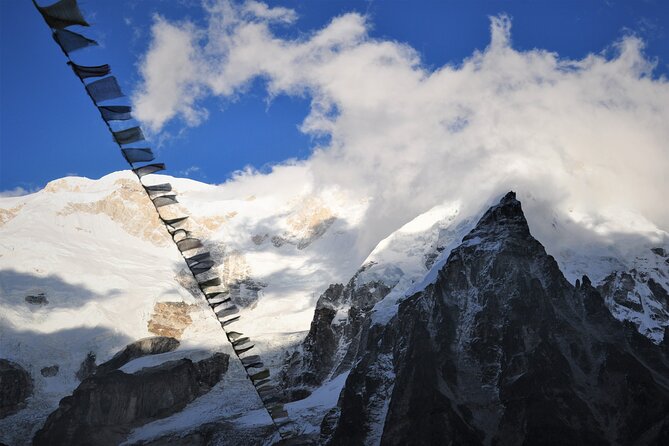
The trek leaves Cheram for Sele La at 4,290 meters. The route also refers to crossing Mirgin La at 4,725 meters, a demanding high-pass section with wide views toward Makalu, Chamlang, and Everest.
Pass crossings are among the most memorable parts of a Himalayan trek, but they are also exposed to changing weather and tiring climbs. You should be ready for a slow day, uneven ground, and fewer signs of settlement.
After Sele La, the trail descends to Ghunsa at roughly 3,595 meters, with one itinerary figure also giving 3,475 meters for the return section later in the trip. Ghunsa is an important stop because it brings you back below the highest pass and prepares you for the north-side valley.
This transition gives the circuit its shape. You are not simply walking to one base camp and retracing the same route. You cross from the southern side toward the northern approach, seeing a different angle of the mountain region.
Day 12 to Day 15: Kambachen, Lhonak, and Pangpema
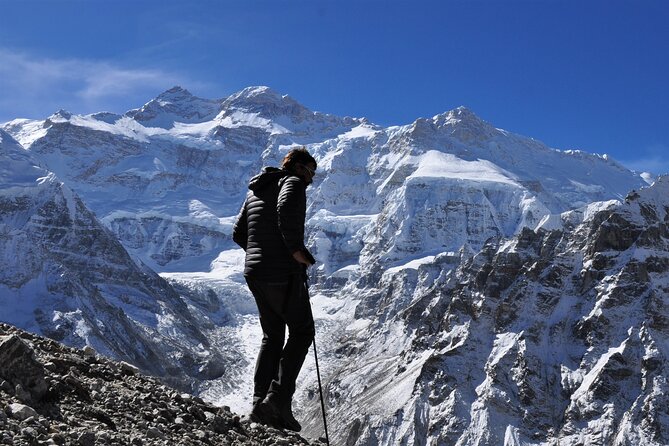
Ghunsa to Kambachen reaches 4,050 meters. From there, you continue to Lhonak at 4,780 meters, one of the highest sleeping points of the trek.
At this altitude, the schedule becomes serious. The itinerary does not offer the same kind of full rest day used at Cheram, so you need to pay attention to your health and tell your guide promptly if you feel unwell. The presence of a first aid kit is useful, but it does not replace travel insurance or emergency evacuation cover.
The main goal comes on Day 14, when you walk to Kanchenjunga Base Camp and stay overnight at Pangpema at 5,143 meters. This is the highest and most demanding part of the route, as well as the point that will matter most to many trekkers.
Pangpema offers the north-side base-camp experience and the strongest sense of being among the great peaks. The overnight stay makes the visit more than a brief photo stop, but it also means sleeping at a very high elevation. You should choose this trek only if you are comfortable with that level of physical and altitude challenge.
Day 15 retraces the route from Pangpema to Lhonak. The return may feel easier because you know the terrain, but accumulated fatigue can make a descent surprisingly hard. Trekking poles and careful footing would be sensible, although specific personal equipment is not included in the tour description.
Day 16 to Day 21: the long return to Suketar
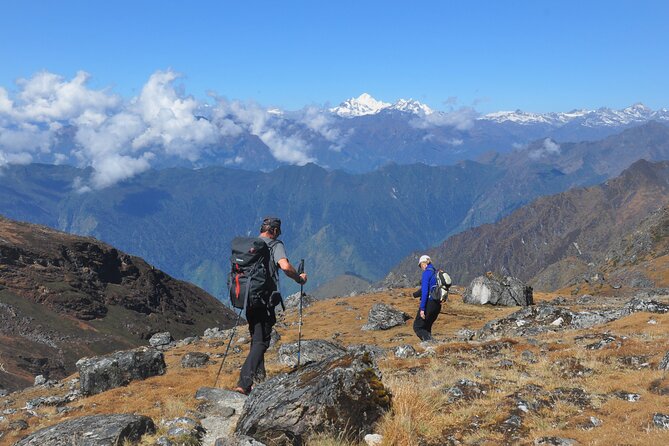
From Lhonak, you return to Ghunsa, listed at about 3,475 meters. This is a substantial descent and should offer some relief from the thin air around Pangpema.
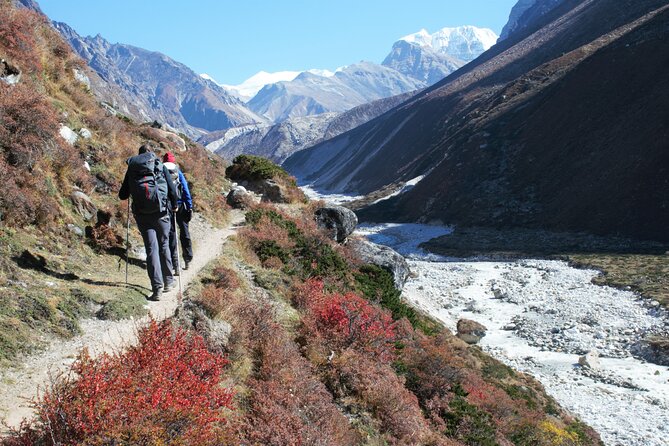
The next stages run from Ghunsa to Amjilosa at 2,308 meters, then Amjilosa to Chirwa at 1,270 meters. The trail returns to warmer, greener country, and the lower elevations can feel almost startling after the high valleys.
Chirwa to Phurumbu at 1,549 meters is followed by Phurumbu to Suketar. These final walking days still require energy. A long descent is not automatically easy, especially after a high-altitude circuit.
On Day 21, you fly back to Kathmandu. The trip includes Kathmandu hotels with breakfast, but meals and accommodation in Kathmandu are not included in the trek price in every situation, including early returns or late departures. That detail matters if weather or fatigue changes your schedule.
What the $3,000 price really covers
At $3,000 per person, this is an expensive trek, but the price includes many of the costs that can quietly add up in Nepal. You receive a licensed English-speaking guide, three meals a day during the trek, government taxes, a trekking map, the Kanchenjunga permit, and the conservation fee.
Airport and hotel transfers by private vehicle are also included. Kathmandu hotel accommodation with breakfast is included as stated, though you should clarify exactly how many nights before booking, particularly if your flights do not match the 21-day plan.
The package also includes seasonal fresh fruit during the trek, a first aid kit, and a down jacket and sleeping equipment on a refundable basis. Confirm the deposit and return arrangements for that equipment before departure, since the wording does not give the exact amount.
The main extras are international flights, a Nepal visa, two passport photographs, travel and medical insurance, and emergency evacuation. You also pay for drinks, bottled or other drinking water, hot showers, telephone, internet, laundry, desserts, snacks, and bar bills.
A porter is available for an additional fee. That is worth considering. The high altitude and long duration make carrying a heavy personal pack a poor way to save money, though the exact porter cost is not stated.
Food, guiding, and the practical human side
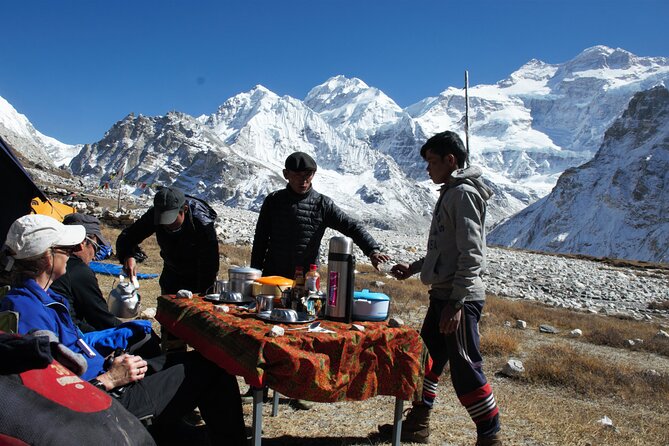
Three meals are provided during the trek, and seasonal fresh fruit is included. One person who followed a vegan diet reported having no trouble eating during the trek, which is encouraging, but you should still tell the operator about dietary needs before departure.
The guide can make a major difference on a route this remote. Nima Sherpa is named as a local guide from the area, and Pasang is praised for being friendly and well spoken. Pasang also handled an airport welcome and hotel transfer on one trip, a useful touch after a long flight.
The tour is private, so only your own group participates. That gives you more control over walking pace and daily conversation than a large group departure, though the description does not state the maximum group size.
Who should book this trek?
You should consider this route if you want solitude, high mountain views, and a long trip with a strong sense of distance from ordinary tourism. It suits fit hikers who are willing to spend several nights in basic mountain accommodation and who understand that high altitude cannot be treated casually.
It is also a good choice if you value cultural contact along with scenery. Rai and Limbu communities, changing vegetation, wildlife possibilities, and remote villages give the route more substance than a peak-focused itinerary.
I would hesitate to recommend it if you have little multi-day trekking experience, dislike cold conditions, or want reliable internet, hot showers, and easy transport. A moderate fitness rating understates the demands of 5,143 meters, high passes, and a three-week schedule.
The cancellation policy is generous if your plans change early: cancel at least 24 hours before the local start time for a full refund. Changes or cancellations inside that window are not accepted for a refund.
Should you book the Kanchenjunga Circuit Trek?
Book it if your priority is a remote Himalayan route with two base-camp outings, major mountain views, local communities, and a patient 21-day schedule. The included permits, meals, guide, transfers, and conservation fees give the $3,000 price reasonable value, especially for a private trip.
Before paying, confirm the Kathmandu hotel nights, the refundable amount for the down jacket and sleeping equipment, porter pricing, and how emergency support is handled through your insurance. If you prepare for the altitude and accept basic conditions, this is the kind of trek that rewards patience more than speed.
FAQ
How long is the Kanchenjunga Circuit Trek?
The stated duration is approximately 21 days, beginning with a flight from Kathmandu to Suketar and ending with a flight back to Kathmandu.
Where does the trek start?
The meeting point is Tribhuvan Airport in Kathmandu, Nepal. The stated start time is 7:15 a.m., followed by a flight to Suketar.
What is the highest point on the itinerary?
The highest listed destination is Pangpema at 5,143 meters, where you stay overnight after reaching Kanchenjunga Base Camp.
Is an acclimatization day included?
Yes. Day 7 is scheduled as an acclimatization and rest day at Cheram.
Are meals included during the trek?
Yes. Three meals a day are included during the trekking portion, along with seasonal fresh fruit.
Is a guide included?
Yes. The package includes a government-licensed, English-speaking guide with experience in the region.
Are permits and conservation fees included?
Yes. The Kanchenjunga permit and conservation fee are included, along with government taxes and one trekking map per person.
Is travel insurance included?
No. International airfare, Nepal visa fees, travel and medical insurance, and emergency evacuation are not included.
Recently added around Kathmandu
- Ghorepani Poon Hill Trek★ 5.0 · 16 reviews
- Private Manaslu Circuit Trek at Himalayas★ 5.0 · 3 reviews
- Amazing 1 Day Trekking Experience in Kathmandu Nepal★ 5.0 · 24 reviews
- Ghorepani Poonhill Trek★ 5.0 · 5 reviews
- Upper Mustang Trekking★ 5.0 · 2 reviews
- Upper Mustang Trekking★ 3.0 · 2 reviews
- Upper Mustang Trekking★ 5.0 · 4 reviews
- Upper Mustang Trek★ 5.0 · 5 reviews
Kathmandu Trekking Tours, compared.