REVIEW · KATHMANDU
Upper Mustang Trek 14 Days
Mustang keeps its best stories behind high passes. This 14-day journey takes you from Kathmandu to the old kingdom of Upper Mustang, with Tibetan-style villages, cliff caves, monasteries, and the walled town of Lo Manthang. I like the careful route planning and the chance to travel with a licensed English-speaking guide, especially on a trek where local context matters.
I also like the balance between adventure and basic comfort. The package includes airport transfers, two Kathmandu hotel nights, permits, transport, a duffel bag, map, first-aid kit, and a company T-shirt. The main drawback is the fine print: trek accommodation, porters, drinks, and meals are not included, apart from dinner listed in the inclusions.
The trip is private, so your group travels together rather than joining a large departure. Devaraj is named as a guide associated with the company, and the strongest praise focuses on his organization, communication, and guidance. Still, you should be ready for long trekking days, simple arrangements, and a moderate level of fitness.
What makes this Upper Mustang trek worth considering
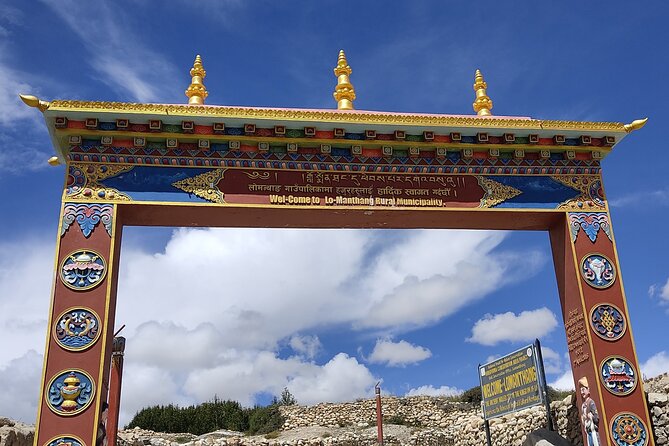
- The route reaches Lo Manthang, the walled capital of Upper Mustang, after passing through Kagbeni, Chele, Ghami, Tsarang, and other remote settlements.
- Chhoser Cave and Thubchen Gompa give the trip more purpose than a mountain walk focused only on scenery.
- The Upper Mustang Restricted Area Permit and Annapurna Conservation Area Permit are included, reducing two major planning tasks.
- Flights between Pokhara and Jomsom save time, while the road journeys connect Kathmandu and Pokhara.
- A private format gives your group more control, though the price is still based on a fairly basic trekking setup.
- The price is $1,212 per person, a reasonable starting point for the permits, guide, transfers, and Kathmandu lodging, but not an all-inclusive trekking budget.
Why Upper Mustang feels different from a standard Nepal trek
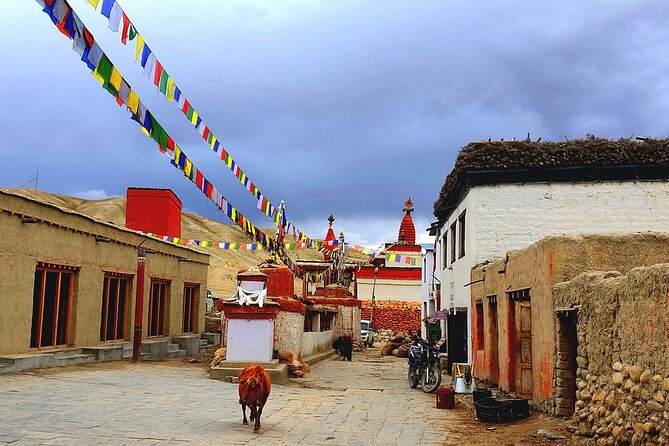
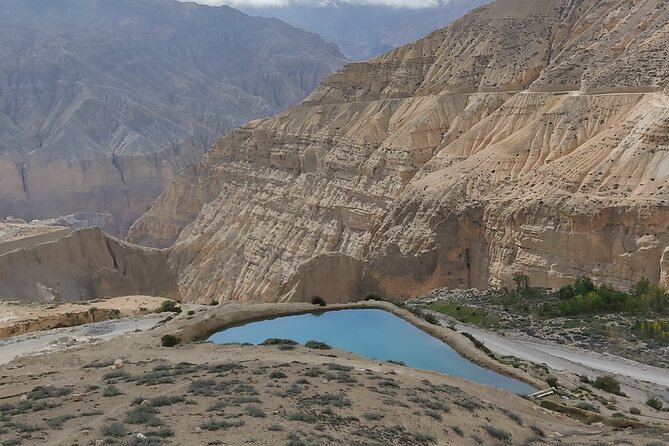
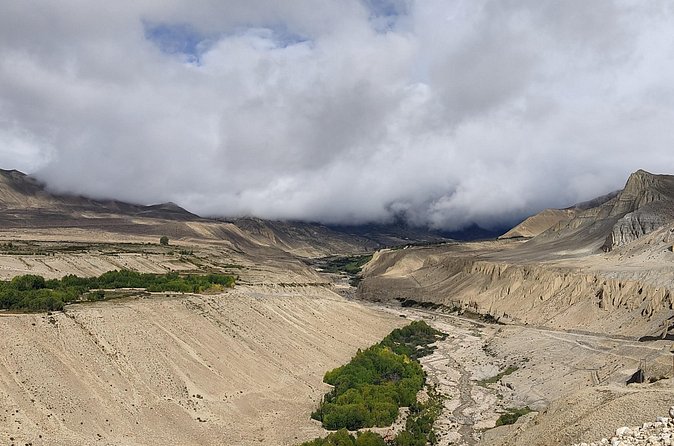
Upper Mustang is not simply another Himalayan walking route. The area has a strong Tibetan cultural character, with mud-brick villages, monasteries, prayer traditions, walled settlements, and cave complexes cut into steep rock faces. The scenery is dry, open, and sharply shaped, a world away from the greener hill country around Kathmandu and Pokhara.
The route also carries a sense of distance. You move through places such as Kagbeni, Ghami, and Tsarang instead of passing from one major resort to another. That makes the trek appealing if you want culture and place-based travel alongside physical effort.
I would not choose this trip if you want a soft adventure with every night in a comfortable hotel. The daily schedule often lists around 12 hours at each stop, which appears to describe the full day rather than 12 hours of walking, but the trek still requires stamina. Ask the operator for the expected walking hours, elevation gain, and overnight towns before you pay.
A few more treks around Kathmandu worth a look
- Everest Base Camp Trek – 14 Days
★ 5.0 · 1,499 reviews - Everest Base Camp Trek
★ 5.0 · 842 reviews - Everest Base Camp Trekking
★ 5.0 · 485 reviews
Days 1 and 2: Kathmandu, Pokhara, and Phewa Lake
Your first day begins at Hotel Chhimeki in Kathmandu, where airport pickup and drop-off are included. After settling in, you have time around Thamel, a useful place to adjust to Nepal, shop for last-minute items, and get ready for the trek.
The second day uses a long road transfer from Kathmandu to Pokhara. The route passes rivers, terraced fields, and rural scenery, so the drive is part of the experience rather than dead time. Still, a 12-hour transfer can be tiring, and you should not expect a quick hop between cities.
Pokhara gives you a calmer pause before the high country. The plan includes Phewa Tal, where you can walk beside the lake or rent a boat, followed by Tal Barahi Temple on a small island. These stops are short, but they offer a gentle start and a chance to see a different side of Nepal before the trek becomes more remote.
The overnight arrangements in Kathmandu are specified as Hotel Chhimeki for two nights. Accommodation in Pokhara is not clearly detailed in the supplied information, so confirm where you sleep there and what is included.
Day 3: Flying to Jomsom and walking to Kagbeni
The flight from Pokhara to Jomsom is listed at about 15 minutes. That sounds brief, but it connects two very different settings, taking you into the Kali Gandaki Valley and the gateway area for Upper Mustang.
Jomsom is known for strong winds and dramatic mountain surroundings. From here, the route continues on foot to Kagbeni, an old settlement with mud-brick houses, narrow lanes, and Buddhist monasteries. Kagbeni is an excellent first taste of Mustang because it feels historic and lived-in, not like a purpose-built trekking stop.
The day is marked as roughly 12 hours, so you should ask how much time is allocated to the flight, walking, and sightseeing. Flights are part of the listed transport plan, but the information does not explain how schedule changes are handled. Travel insurance is not included, and rescue costs are your responsibility.
Days 4 to 7: Chele, Syanboche, Ghami, and Tsarang
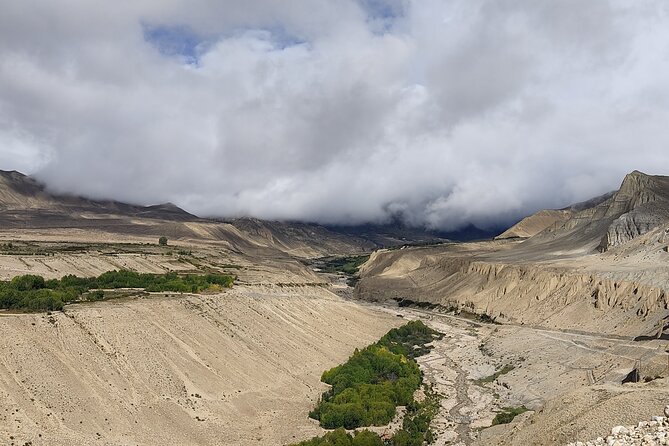
The walking section begins properly after Kagbeni. On the way to Chele, you pass dry valleys, old caves, and traditional villages. The appeal is the steady change in the terrain: the route feels more remote as settlements become less frequent and the rock formations grow more severe.
From Chele, the trail continues toward Syanboche through high, bare country. This is the kind of scenery you choose Upper Mustang for, but it can also feel exposed and repetitive if you prefer forests, rivers, and dense greenery. Good pacing matters here, and a private group may benefit from discussing breaks and walking speed with the guide.
Ghami offers a larger village setting and a chance to see historic monasteries. The route then reaches Tsarang, known for its monastery and fort. These stops give the trek its cultural weight. You are not simply crossing empty mountains. You are moving between settlements shaped by trade, religion, and life in a hard climate.
Accommodation during the trek is not included in the stated price. You will need to budget for teahouses or lodges, and the company describes them as handpicked, but no specific properties or nightly rates are provided. Ask about room arrangements, bathrooms, heating, and whether a private room is possible.
Same trailhead, a longer or shorter day out:
- Annapurna Circuit Trek with Tilicho Lake
★ 5.0 · 368 reviews - Everest Base Camp Trekking – 13 Day
★ 5.0 · 365 reviews - Everest Base Camp Trek
★ 5.0 · 350 reviews - Everest Base Camp Trek -14 Days
★ 5.0 · 321 reviews
Day 8: Reaching Lo Manthang
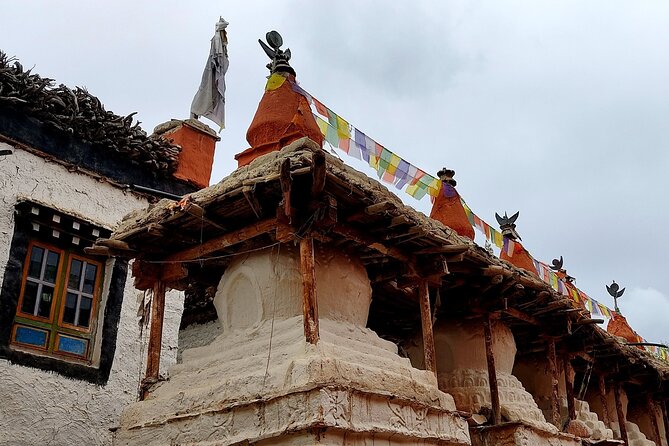
The approach to Lo Manthang is the dramatic center of the trip. This walled town is the former capital of Upper Mustang, with narrow lanes and traditional mud-brick homes. Its compact form makes it feel distinct from the scattered villages along the trail.
The route from Tsarang is listed as a full day. That means you should arrive ready for another substantial walking day rather than treating Lo Manthang as a quick sightseeing stop. Once there, the best use of your time is to slow down and notice the town’s layout, buildings, and religious character.
I like that the itinerary gives Lo Manthang more than a brief pass-through. You have a full day there on Day 9, which is important because the town deserves time beyond a photograph from the outer wall.
Day 9: Thubchen Gompa, Chhoser Cave, and a full day in town
Thubchen Gompa is one of the oldest and most important monasteries in Lo Manthang. The scheduled visit lasts about 30 minutes, so it is a short introduction rather than an extended study. Your guide can add value here by explaining the building, religious role, and local customs.
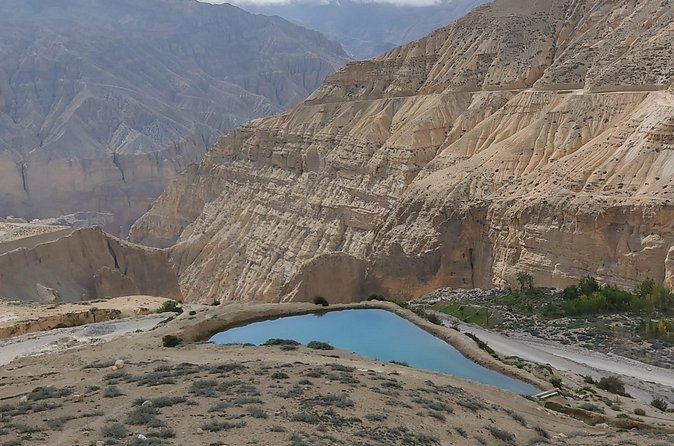
The trip then goes to Chhoser, known for its ancient cave complex. The listed visit lasts about 45 minutes. Cliff caves are among Upper Mustang’s most memorable features, and Chhoser provides a strong reason to choose this route over a trek based only on mountain views.
You also return to Lo Manthang for the rest of the day. That gives you time to walk the narrow streets and see the town at a slower pace. The schedule does not specify which monasteries, homes, or cave chambers you enter, so ask for a detailed sightseeing plan if those details matter to you.
Days 10 and 11: Returning through Dhakmar and Kagbeni
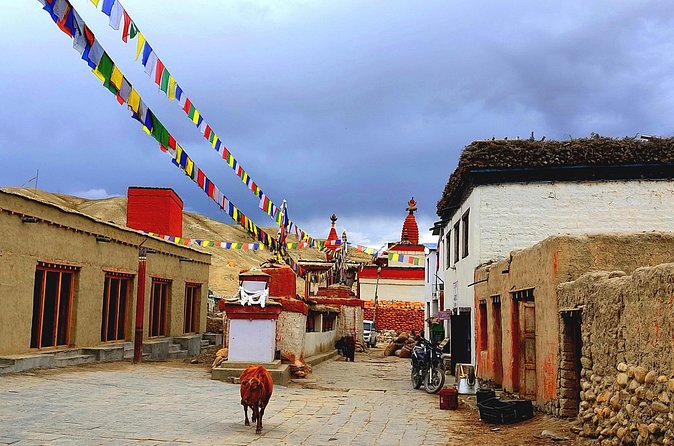
The return route first heads from Lo Manthang to Dhakmar. Retracing part of a route can sound less exciting, but the views often change when you face the opposite direction. Dhakmar is noted for its unusual rock formations and wide valleys, making it more than a place to sleep.
The following day takes you back to Kagbeni. This repeated stop can be useful because you may notice details missed on the first pass, but it also means the trip does not form a completely new loop. If you prefer constant novelty, this is worth considering.
These days underline the physical demand of the experience. You will have already spent several days at altitude before turning back, so pacing and hydration are important practical concerns. The company provides a first-aid medical box, but it does not cover rescue operations or travel insurance.
Days 12 to 14: Jomsom, Pokhara, and Kathmandu
From Jomsom, you fly back to Pokhara. The return flight is listed at about 30 minutes, followed by free time in Pokhara. This is a welcome recovery period after the trekking section, and you can return to the lakeside setting before the final road trip.
Day 13 brings the long drive back to Kathmandu. You have free time after arrival for rest, shopping, or a final walk around the capital. The last day provides airport transfer to Tribhuvan International Airport.
The sequence works well because it leaves a little breathing room after the trek. The weak point is that any extra Kathmandu night caused by a change in the scheduled plan is not included. The cancellation terms allow a full refund if you cancel at least three full days before the start time, while later cancellations and late changes are not refunded.
What the $1,212 price really covers
At $1,212 per person, the trip is not cheap, but it includes several expensive and complicated pieces: airport transfers, transport on the stated route, a licensed English-speaking guide, the Upper Mustang Restricted Area Permit for 10 days, the Annapurna Conservation Area Permit, two Kathmandu hotel nights, and the Jomsom flights listed in the schedule.
You also receive a duffel bag, map, company T-shirt, first-aid kit, and tax coverage. Those extras are useful, but they should not decide the purchase. The real value is the permit handling, private guide, and access to an area that requires more planning than a standard independent trek.
Your extra budget must cover trekking accommodation, meals, drinks, porters, visa fees, personal spending, tips, insurance, and rescue costs. The inclusions list dinner, while the exclusions say all meals are not included, so clarify exactly which dinner is covered and whether it applies to the whole trip or only a specific night.
I would call the price fair for a guided, permit-supported private trip, provided you understand it as a base price rather than a final total. Solo participants should ask how the private pricing changes, since the advertised figure is per person.
Guide quality, group size, and the practical trade-offs
The tour is private, and only your group participates. That is helpful if you want to set a comfortable pace, stop for photos, or spend longer at a monastery. It also means you do not share the cost with a larger group, so the price may feel less attractive to a solo trekker.
Devaraj receives especially strong praise for organization, communication, and guiding. Communication before departure is described as fast and professional, and that matters on a trek involving domestic flights, restricted permits, road transfers, and several walking stages. His daughter is also named in the pre-trip communication, though her role is not specified.
The company provides a government-licensed English-speaking guide. Still, ask who will lead your particular departure, how many people are in your group, and what support is available if someone cannot continue. Those details are not supplied here, and they affect the value of a high-altitude trek.
Who should book this trek
You should consider this trip if you want:
- A private trek with a guide rather than a self-planned route
- Tibetan-influenced culture and monasteries alongside dramatic dry terrain
- Lo Manthang, Chhoser Cave, Kagbeni, and several traditional villages
- Permit arrangements handled in advance
- A 14-day plan that combines Kathmandu, Pokhara, domestic flights, and trekking
You may want another trip if you need fully included meals and lodging, dislike long road transfers, or want a soft holiday with little physical effort. The moderate fitness requirement is important, and the high-altitude route is not suited to someone who wants a casual walking tour.
Is the Upper Mustang Trek a good buy?
Yes, if you see the $1,212 price as the foundation of a serious cultural trek rather than an all-inclusive holiday. I especially like the route’s focus on Lo Manthang, Chhoser Cave, monasteries, and village life, plus the private format and included restricted-area permits.
Before booking, get written confirmation of trek lodging, meal coverage, porter costs, expected walking hours, Pokhara accommodation, and the guide assigned to your group. If those details are clear and you are comfortable carrying some extra costs, this is a strong choice for a focused Upper Mustang experience. If you want predictable final pricing, more comfort, or shorter walking days, look for a package with more inclusions.
FAQ
How long is the Upper Mustang Trek?
The experience lasts approximately 14 days, from arrival in Kathmandu through departure from Tribhuvan International Airport.
Where does the experience start?
It starts at Hotel Chhimeki, 17 Purano Dhalko Marga, Kathmandu 44600, Nepal.
Is airport pickup included?
Yes. Airport pickup and drop-off are included.
Are the flights between Pokhara and Jomsom included?
Transportation is included according to the stated schedule, which includes flights between Pokhara and Jomsom.
Are permits included in the price?
Yes. The Upper Mustang Restricted Area Permit for 10 days and the Annapurna Conservation Area Permit are included.
Is accommodation included throughout the trek?
No. Two nights in Kathmandu at Hotel Chhimeki are included, but accommodation during the trek is not included.
Are meals included?
The inclusions list dinner, while the exclusions state that all meals are not included. Confirm with Trek Mania Nepal exactly which dinner is covered and what you must pay for separately.
What level of fitness is required?
A moderate level of physical fitness is required.
Is this a group tour?
No. It is a private activity for your group only.
Recently added around Kathmandu
- Ghorepani Poon Hill Trek★ 5.0 · 16 reviews
- Private Manaslu Circuit Trek at Himalayas★ 5.0 · 3 reviews
- Amazing 1 Day Trekking Experience in Kathmandu Nepal★ 5.0 · 24 reviews
- Ghorepani Poonhill Trek★ 5.0 · 5 reviews
- Upper Mustang Trekking★ 5.0 · 2 reviews
- Upper Mustang Trekking★ 5.0 · 4 reviews
- Upper Mustang Trek★ 5.0 · 5 reviews
- Upper Mustang Trekking★ 3.0 · 2 reviews
Kathmandu Trekking Tours, compared.