REVIEW · KATHMANDU
Upper Mustang Tiji Festival Trek 2024 – 18 Days
This is Nepal at its most unusual. I like the three-day Tiji Festival, where monks perform ritual dances before Choedhe Monastery, and I like the route’s steady change from river valleys to dry, high mountain country. The main catch is the physical demand: you will hike for several hours on many days, often above 3,000 meters, with steep and windy sections.
I also like that the $2,500 price includes restricted-area permits, guide costs, meals during the trek, accommodation on the route, and the flights linking Kathmandu, Pokhara, and Jomsom. The schedule is tightly packed, though, and the supplied festival dates are for May 19 to 21, 2020, not 2024. Confirm the current festival dates before paying.
This is a private trip for your own group, with airport pickup, a guide, and a paper ticket. You get culture, monasteries, cave dwellings, and striking mountain scenery rather than a simple walk from lodge to lodge.
Key Things to Know Before You Go
- Three days of Tiji in Lo-Manthang: The festival centers on ritual dances performed by monks at Choedhe Monastery.
- Restricted Upper Mustang access: The permit fee is included, which matters because this is not an ordinary independent trek.
- A long return route: You walk back through Dhakmar, Ghiling, Chhuksang, Muktinath, and Jomsom rather than simply retracing every step.
- High-altitude walking: The route reaches the 3,850-meter Lo Pass and includes the 3,624-meter Taklam La Pass.
- Useful air connections: Flights connect Kathmandu with Pokhara and Pokhara with Jomsom, saving long road journeys.
- A private format: Only your group takes part, which gives you more control over walking pace and village visits.
Why Upper Mustang Feels So Different
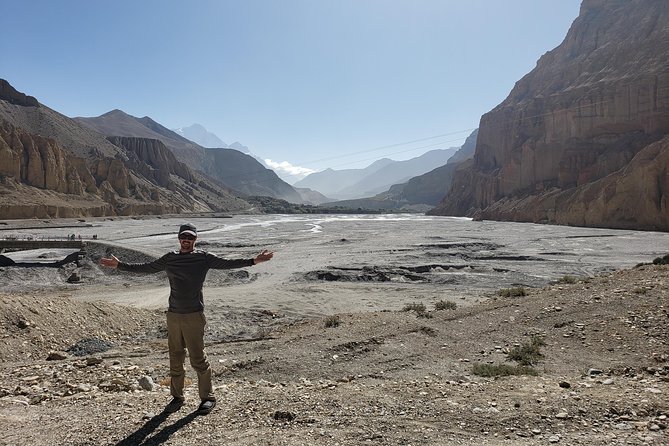
Upper Mustang is often described as Nepal’s last forbidden kingdom. The phrase is useful, as long as you understand what it means: access is restricted, the villages retain a distinct Tibetan Buddhist character, and the region feels far removed from the greener foothills around Kathmandu and Pokhara.
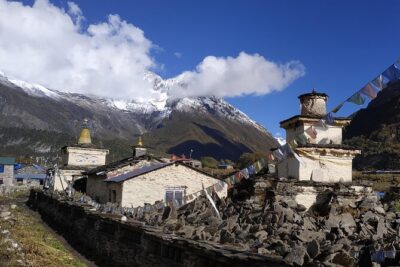
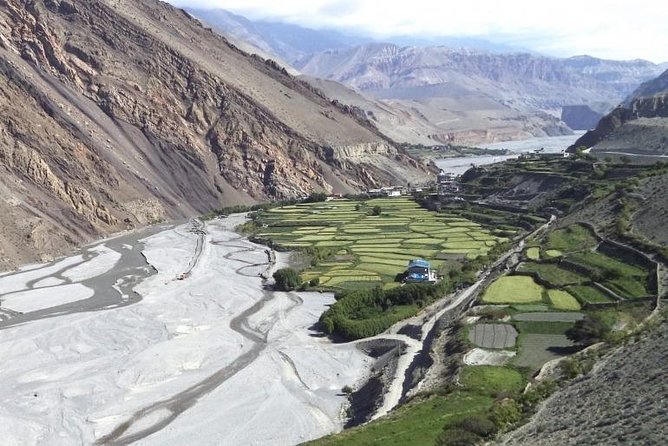
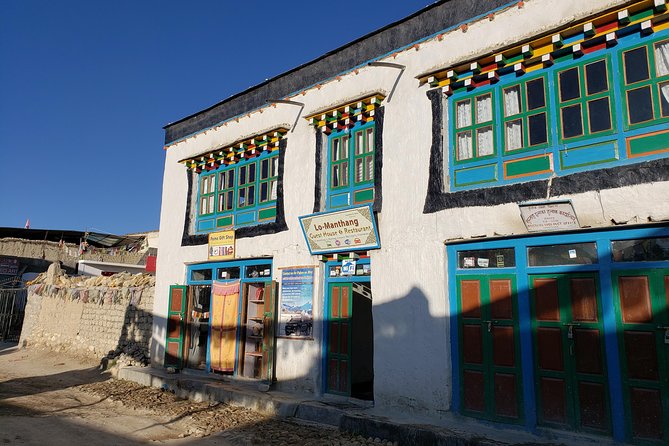
The scenery changes sharply after Jomsom. You walk beside the Kali Gandaki River, pass dry red and ochre cliffs, cross high ridges, and enter villages with whitewashed buildings and old monasteries. Vegetation is limited, but juniper trees and small streams appear in sheltered valleys.
I find the cultural side just as important as the scenery. The route includes Kagbeni, Tangbe, Tetang, Chhuksang, Samar, Ghiling, Dhakmar, and Lo-Manthang. Each stop gives you a closer look at village life, Buddhist practice, and the traditional architecture of Mustang.
The Tiji Festival gives the trip its focus. It tells the story of Dorje Jono battling his demon father to protect Upper Mustang from destruction. Ritual performance, music, costumes, and monastery courtyards turn Lo-Manthang into the center of the journey.
A few more treks around Kathmandu worth a look
- Everest Base Camp Trek – 14 Days
★ 5.0 · 1,499 reviews - Everest Base Camp Trek
★ 5.0 · 842 reviews - Everest Base Camp Trekking
★ 5.0 · 485 reviews
Days 1 to 3: Kathmandu and Pokhara
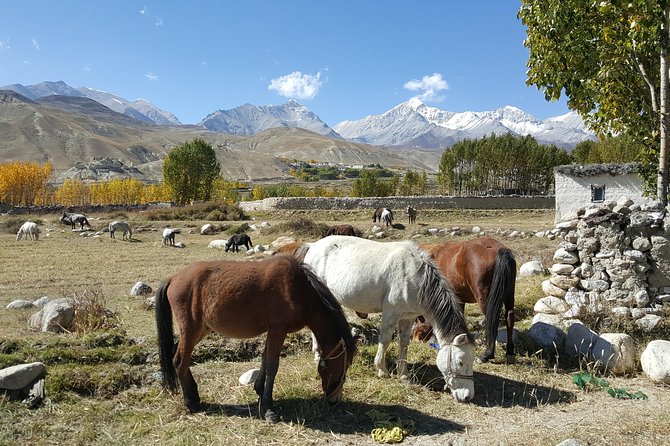
Your trip begins with pickup at Tribhuvan International Airport. A company representative transfers you to your pre-booked hotel, which is a welcome service after an international flight and avoids the usual airport confusion.
The next day is devoted to Kathmandu Valley. You visit Basantapur Durbar Square, Swayambhunath, Boudhanath Stupa, and Pashupatinath Temple by private tourist vehicle.
That is a useful introduction to Nepal, though it is a full sightseeing day. The four sites are spread across the valley, so expect a busy schedule rather than a slow morning of cafés and wandering. Entry fees to temples and monasteries during sightseeing are not included, so carry money for those costs.
On Day 3, you fly for about 25 minutes to Pokhara. After checking in and taking a short break, you go boating on Phewa Lake and visit Tal Barahi Temple. An evening walk and dinner by the lake provide a gentler change after Kathmandu’s traffic and monuments.
The Kathmandu and Pokhara hotel arrangements are not fully detailed in the supplied information. Lunch and dinner in both cities are also excluded, as are personal expenses such as laundry, phone calls, showers, drinks, and battery charging.
Days 4 to 8: From Kagbeni to Lo-Manthang
The mountain section begins with an early flight from Pokhara to Jomsom, lasting about 15 minutes. After breakfast in Jomsom, you hike three to four hours to Kagbeni.
Kagbeni is an excellent first stop. You can explore the old village and its ancient Buddhist monastery before the longer days begin. The hike is relatively short compared with what follows, but the high, dry setting makes it feel like a real change from Pokhara.
On Day 5, you walk five to six hours toward Tsaile. The route passes Tangbe at 3,060 meters, Tetang at 3,040 meters, and Chhuksang at 2,980 meters, where lunch is planned.
This is a demanding day because of the duration and altitude. The villages break up the walk, and the changing rock colors and valley shapes give you plenty to look at, but you should not treat the distance as a casual stroll.
Day 6 brings some of the route’s hardest terrain. You cross steep, dry ground above Samar, descend into a large gorge, pass junipers and streams, and climb toward the Taklam La Pass at 3,624 meters.
The route then crosses plateaus and narrow sections, with views toward Damodar Danda, Yakawa Kang, and Tilicho Peak. You finish by descending steeply to Ghiling. This is exactly the kind of day that requires moderate physical fitness, patience, and sensible pacing.
Day 7 takes you to Dhakmar. The description gives fewer details about the walking time, but the day includes Himalayan views and visits to ancient Buddhist monasteries. Dhakmar is known for its striking red cliffs, though the supplied schedule does not promise a specific sightseeing stop beyond the village and monasteries.
On Day 8, you reach Lo-Manthang. The route climbs gently to the 3,850-meter Lo Pass, where the walled city comes into view. This is one of the great arrival moments of the trek.
The pass is windy, and the altitude will be noticeable. Still, seeing Lo-Manthang spread below you gives the long approach a clear reward. You should arrive with enough energy for the festival days, not assume the hike ends once the walls appear.
Days 9 to 11: The Tiji Festival in Lo-Manthang
Lo-Manthang is the heart of this trip. The city’s walls, monasteries, and compact village streets give you time to slow down after the approach.
The first festival day begins after a morning in the village. In the afternoon, monks perform ritual dances at Choedhe Monastery. The dances represent the struggle of Dorje Jono against his demon father, a story tied to the protection of Upper Mustang.
You should expect ceremony rather than a staged tourist show. The setting matters: monks perform in front of a working monastery, while local people gather for an important annual event. Be respectful with photography and follow your guide’s advice about where to stand and when to move.
Day 10 includes visits to Namgyal Gompa, Choedhe Gompa, and Tingkhar before the second festival performance. Afterward, the schedule allows time to meet local people and learn about their culture and traditions.
This is one of the better-balanced days in the program. You are not simply watching the festival and leaving. You also see important religious sites and have a chance to understand how the event fits into local life.
Day 11 begins with a trek to Chhosar Cave, described as having 44 living rooms. You also visit old Buddhist monasteries before returning to Lo-Manthang for the final Tiji performance.
The Chhosar excursion adds variety. You get caves, monasteries, and a different view of the area around the walled city. It is another walking day, however, so anyone who expects three days of rest during the festival should adjust expectations.
One important warning concerns the date. The supplied program says Tiji was celebrated from May 19 to May 21, 2020. Since the tour is presented as a 2024 experience, you must confirm the actual festival dates for your departure year. Tiji is generally held in late May, but the dates should not be assumed.
Same trailhead, a longer or shorter day out:
- Annapurna Circuit Trek with Tilicho Lake
★ 5.0 · 368 reviews - Everest Base Camp Trekking – 13 Day
★ 5.0 · 365 reviews - Everest Base Camp Trek
★ 5.0 · 350 reviews - Everest Base Camp Trek -14 Days
★ 5.0 · 321 reviews
Days 12 to 16: A Different Way Back
The return begins with a route to Dhakmar through Gyakar village. Here you visit Ghar Gompa, described as more than 1,200 years old and known for its rock paintings.
Local belief says that a wish made at Ghar Gompa will come true. You can treat that as a spiritual tradition rather than a promise, but it gives the stop a personal quality. Places like this are often more memorable than a long checklist of monuments because they connect the setting with living belief.
Day 13 returns you to Ghiling. The schedule warns that daytime winds can be dusty and recommends exploring villages or hiking in the morning and evening. That is practical advice worth taking seriously. Start early, protect your eyes and face from dust, and avoid spending unnecessary time outdoors during the strongest wind.
Day 14 leads to Chhuksang, with mountain views and dramatic dry scenery along the way. You also visit a salt mine at Chhuksang, adding a local working detail to the route.
Day 15 is a major cultural change. You walk to Muktinath, a holy temple for Hindus, visited daily by Nepali and Indian pilgrims. The temple gives the trek a broader religious dimension, since the journey is not limited to Buddhist sites.
You also get Himalayan views from Muktinath. The day may feel especially meaningful if you appreciate seeing different faith traditions sharing the same mountain region.
On Day 16, you follow the Kali Gandaki River toward Jomsom. The route is described as relatively flat and downhill, with views of Dhaulagiri and Nilgiri. Even with easier terrain, five to six hours of walking is still a serious final trekking day.
You finish near Jomsom Airport, ready for the next morning’s flight. The route back is useful because it includes different villages and stops rather than sending you along exactly the same trail.
Days 17 and 18: Returning to Kathmandu
Day 17 begins with an early flight from Jomsom to Pokhara, followed by a flight to Kathmandu. Air connections are a major part of the tour’s value, since driving the full route would take much longer and could make the trip less attractive for anyone with limited holiday time.
In Kathmandu, you finish with a farewell dinner and Nepali cultural dance program. The final evening gives the trip a social ending, though dinner in Kathmandu is listed among the exclusions elsewhere in the program, so confirm exactly what the farewell meal includes.
On Day 18, company representatives transfer you to the international airport. Pickup and departure assistance are included, which is useful after a complicated mountain itinerary.
What the $2,500 Price Really Covers
At $2,500 per person, this is not a cheap short excursion. It is also not simply a walking package. The price includes the Upper Mustang restricted-area permit, guide salary, guide food, guide accommodation, guide insurance, trek meals, trek accommodation, Kathmandu to Pokhara flights, Pokhara to Jomsom flights, and the return flights.
That bundle gives the price real value. Restricted permits alone can add considerable cost, and the air connections save time. Meals during the trek also make budgeting easier, since breakfast, lunch, and dinner are included throughout the walking section.
The gaps matter. You pay separately for lunch and dinner in Kathmandu and Pokhara, sightseeing entry fees in those cities, drinks, phone calls, laundry, showers, battery charging, and bottled or boiled water. Extra nights caused by an early return from the mountains or a late departure are also excluded.
Past trips organized by the company have received praise for clean, comfortable accommodation and careful planning. Specific names connected with positive trip feedback include Mukesh, Samsher, Tsering, and a driver praised for preparation and availability. Your assigned team may differ, so treat those names as useful background rather than a promise about your own guide.
The Hard Parts You Should Not Underestimate
The itinerary calls for moderate physical fitness, but several days are plainly strenuous. You face five to six hours of walking on multiple days, steep climbs, high passes, dry conditions, dust, and altitude above 3,000 meters.
The schedule also moves quickly. You have sightseeing in Kathmandu, flights, a long approach to Lo-Manthang, three festival days, cave visits, and a multi-day return. You should be comfortable walking for hours and then getting up for the next day’s plan.
The private format helps. Your group can discuss pace and breaks with the guide, rather than adapting to a large mixed party. Still, private does not mean easy. The terrain and altitude remain the same.
The airport flights are another practical consideration. Mountain flights can affect timing, and the program includes little spare time. If an early return or late departure creates an extra night, that accommodation is not included.
Who Should Book This Trek?
I would recommend it to you if you want a cultural trek with a specific purpose, especially if the Tiji Festival is the main reason you are coming to Mustang. It suits hikers who enjoy monasteries, old villages, religious traditions, dry mountain scenery, and a structured itinerary.
It is less suitable if you want a relaxed holiday with short walks, flexible mornings, or guaranteed comfort every night. The route is long, the altitude is serious, and the festival dates must be checked carefully.
The strongest parts are the festival itself, the restricted-area access, the walled city of Lo-Manthang, Ghar Gompa, Chhosar Cave, Muktinath, and the changing scenery between Jomsom and Mustang. The weaker points are the tight schedule, unclear hotel details in some places, extra city costs, and the apparent mismatch between the 2020 festival dates and the 2024 title.
If the provider confirms the correct festival dates, current flight schedule, accommodation standard, water arrangements, and guide assignment, I think this is a worthwhile way to experience Upper Mustang. Book it if you want a serious mountain journey built around one of Nepal’s most distinctive religious festivals, not if you are mainly looking for a gentle sightseeing tour.
Cancellation is flexible only up to three full days before the local start time. After that, the payment is not refunded, and late changes are not accepted.
FAQ
How long is the Upper Mustang Tiji Festival Trek?
The experience lasts approximately 18 days, including Kathmandu, Pokhara, the trek into Upper Mustang, the three festival days, the return walk, and departure transfer.
What dates is the Tiji Festival held?
The supplied program gives festival dates of May 19 to May 21, 2020. You should confirm the correct dates for your intended year before booking.
Are flights included?
Yes. The package includes flights between Kathmandu and Pokhara, as well as flights between Pokhara and Jomsom. The program also includes the return flights through Pokhara to Kathmandu.
Is the Upper Mustang permit included?
Yes. The restricted-area permit fee for Upper Mustang is included in the price.
Are meals included during the trek?
Breakfast, lunch, and dinner are included during the trek. Lunch and dinner in Kathmandu and Pokhara are not included.
Is this a private tour?
Yes. Only your own group participates in the activity.
What level of fitness is required?
The tour states that you should have a moderate level of physical fitness. The route includes several five to six-hour hiking days, steep sections, high passes, and altitudes reaching 3,850 meters.
Recently added around Kathmandu
- Ghorepani Poon Hill Trek★ 5.0 · 16 reviews
- Private Manaslu Circuit Trek at Himalayas★ 5.0 · 3 reviews
- Amazing 1 Day Trekking Experience in Kathmandu Nepal★ 5.0 · 24 reviews
- Ghorepani Poonhill Trek★ 5.0 · 5 reviews
- Upper Mustang Trekking★ 5.0 · 2 reviews
- Upper Mustang Trekking★ 3.0 · 2 reviews
- Upper Mustang Trekking★ 5.0 · 4 reviews
- Upper Mustang Trek★ 5.0 · 5 reviews
Kathmandu Trekking Tours, compared.