
REVIEW · KATHMANDU
Manaslu Circuit Trek 17 Nights 18 Days
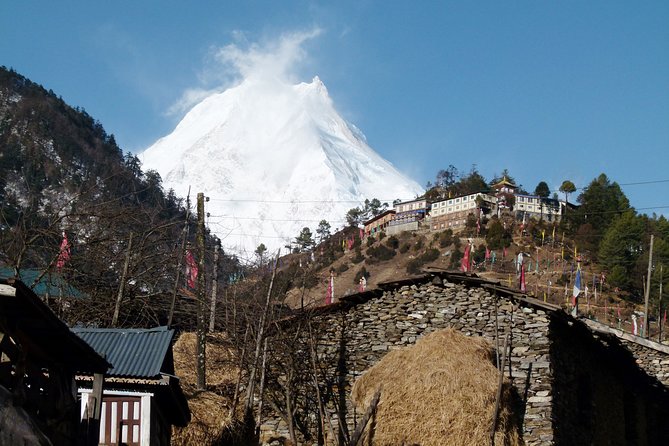
This is Nepal beyond the usual trail. The Manaslu Circuit combines a long river journey, Gurung villages, Buddhist monasteries, and the high crossing of Larkya La. I especially like the gradual change from subtropical forest to dry alpine country, and the way the route includes Kathmandu heritage sites before the trek begins. The company also handles restricted-area permits, staff insurance, porters, meals, and road transfers, which removes much of the paperwork from a difficult trip.
The main concern is physical demand. You spend many days walking for five to nine hours, reach more than 5,000 metres, and sleep in basic teahouses. The itinerary also contains a few details worth confirming before you pay, including the stated altitude of Larkya La and the overnight locations on Days 15 and 16.
The details that matter most
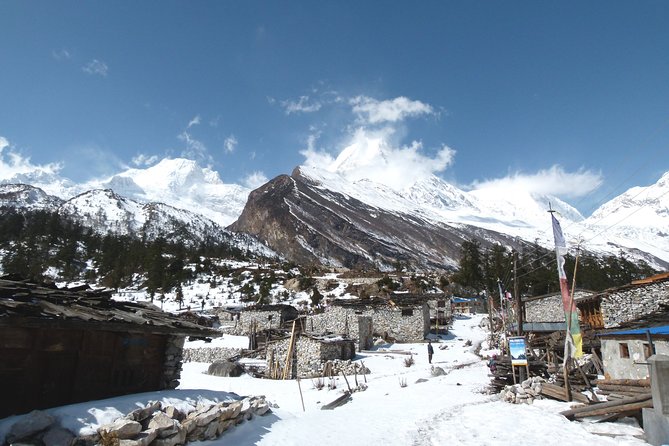
- A full Manaslu Circuit: You walk from Soti Khola through the Budhi Gandaki valley, cross Larkya La, and finish near the Annapurna Circuit.
- Strong acclimatization plan: A full rest day in Samagaon includes hikes to Pungyen Monastery and Birendra Tal.
- A serious high pass: The itinerary lists Larkya La at 5,213 metres, while the overview gives 5,106 metres. Confirm the current route details with the operator.
- A useful package at $2,700: Permits, guide, porter, meals during the trek, hotels in Kathmandu, sightseeing, and ground transport are included.
- A mix of private and local transport: You use a private vehicle from Kathmandu to Arughat, a local jeep to Soti Khola, and another jeep from Jagat to Besisahar.
- A company praised for organization: Anuj and the Explore Himalaya team receive strong praise for caring for clients from airport arrival through departure and for arranging a second trek successfully.
Why the Manaslu Circuit feels different
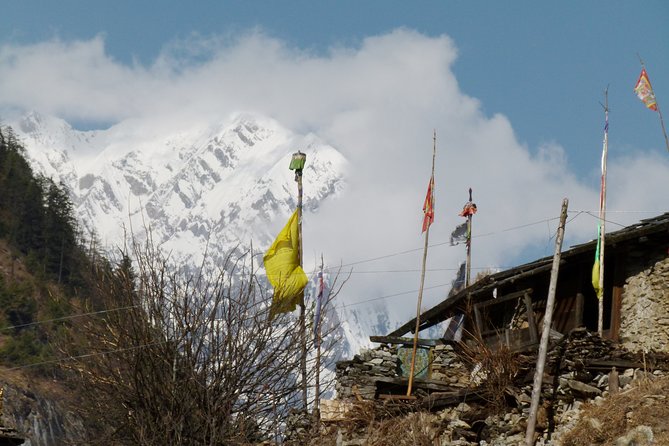
The Manaslu route circles an 8,156-metre peak, but the mountain is only part of the appeal. The trail follows the Budhi Gandaki River through a long, narrow valley where villages, suspension bridges, terraced fields, mani stones, chortens, monasteries, and yak-herding settlements mark the steady rise in altitude.
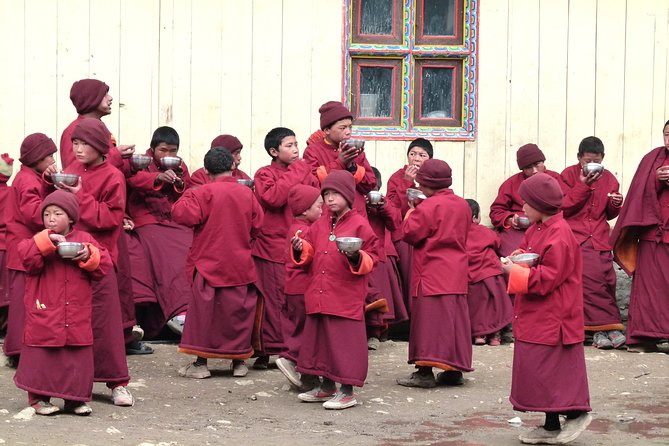
The cultural change is one of the best reasons to choose this trek. Lower sections are mainly associated with Gurung communities and farming villages. Higher up, Tibetan Buddhist customs become more visible through prayer walls, gompas, chortens, and carved stones. You are not simply walking toward a viewpoint. You are moving through several distinct communities linked by an old mountain route.
At the same time, this is not a gentle walk. The trail includes steep climbs, exposed sections, river crossings, rough roads, and a long pass day. A moderate fitness level is required in the formal description, but I would treat that as a minimum. You should be comfortable walking for several hours on consecutive days and should prepare seriously for altitude.
More Manaslu Treks in Kathmandu:
- Manaslu Circuit Trek
★ 5.0 · 292 reviews - Manaslu Circuit Trek:
★ 5.0 · 106 reviews - Manaslu Circuit Trek (15 Days)
★ 5.0 · 50 reviews
Kathmandu begins the trip with temples and courtyards
Your arrival starts with an airport pickup at Tribhuvan International Airport. A private, non-air-conditioned vehicle takes you to your hotel, and the package includes three nights at a three-star hotel in Kathmandu with breakfast.
Day 2 is a useful introduction rather than wasted time before the trek. You visit Pashupatinath, one of the major Hindu shrines dedicated to Shiva, then Boudhanath, Nepal’s large Buddhist stupa and an important centre with many Tibetan monasteries. The day ends in Patan, also called Lalitpur, where the Malla-era architecture of Durbar Square gives you a strong sense of Kathmandu Valley craftsmanship.
This sightseeing is included with an English-speaking local guide and entrance fees. That is good value, especially if this is your first visit to Nepal. The five-hour schedule should also leave you time to organize your bags before the road journey.
The road to Soti Khola is part of the adventure
Day 3 begins with a long drive toward Arughat Bazaar, usually five to six hours. You then switch to a local jeep for another one and a half to two hours to Soti Khola.
This is not a polished transfer. The road follows terraces, small settlements, and the Budhi Gandaki, and the final section can feel rough and tiring. Still, it puts you close to the trailhead without adding another walking day. The route includes a private vehicle from Kathmandu to Arughat, then a local jeep onward, so you get both organized logistics and the realities of rural Nepal.
Soti Khola is your first teahouse night. From here, the trip changes from transport-heavy to walking-focused.
Days 4 to 6 follow the Budhi Gandaki
The first walking day to Machha Khola takes about six hours. You pass dense forest, hillside villages, cultivated terraces, sandy riverbeds, and steep valley walls. The name Machha Khola means Fish River, a small detail that helps give the place a sense of character beyond being just another overnight stop.
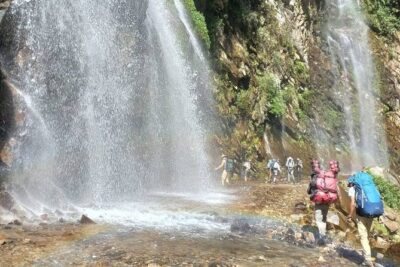
The next day to Jagat includes repeated ascents and descents, Khorlabesi, the hot spring at Tatopani, suspension bridges, and the narrow section around Dobhan. The river is particularly impressive here, dropping through a series of rapids before widening again. Some parts of the path are exposed and demanding, so good footwear and a steady pace matter.
From Jagat, the route climbs over a rocky ridge to Salleri and continues toward Sirdibas, Ghatta Khola, and Philim. Philim is a sizable Gurung village, and the trail then enters a steeper, more isolated gorge. You cross the Budhi Gandaki several times and walk through millet fields before the valley becomes rougher and less settled.
These early days are not the grand mountain-view section yet. Their value is in the changing river corridor, the suspension bridges, forest, farm terraces, and the feeling that the route is gradually leaving ordinary road access behind.
A few more treks around Kathmandu worth a look
- Everest Base Camp Trek – 14 Days
★ 5.0 · 1,499 reviews - Everest Base Camp Trek
★ 5.0 · 842 reviews - Everest Base Camp Trekking
★ 5.0 · 485 reviews - Annapurna Circuit Trek with Tilicho Lake
★ 5.0 · 368 reviews
Deng to Lho marks a clear cultural change
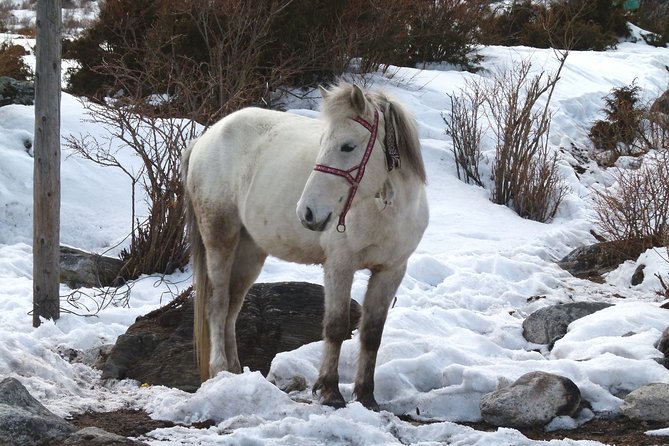
After Deng, the route crosses the river and climbs toward Rana and Ghap. The walking day takes about six hours and includes several river crossings, forest, prayer stones, and monasteries. The mani stones become more frequent, and the climate begins to feel cooler and drier as you gain height.
Ghap is an important transition point. From here, the trail climbs toward Namrung, where alpine surroundings and mountain views begin to take over from forest and farmland. You can expect another roughly six-hour walking day, so do not treat the first mountain views as a signal to speed up.
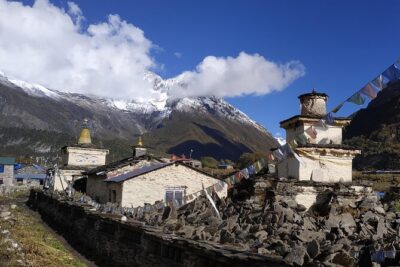
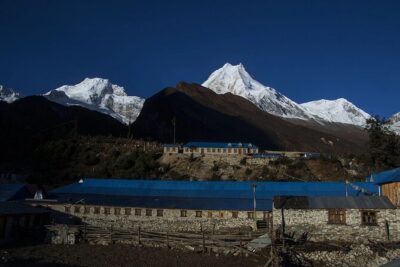
The next day reaches Lho through Lhi and Sho. Lhi is known for chortens and barley terraces. Sho, at about 3,000 metres, provides the first major views of Manaslu North and then the main Manaslu peak. Lho sits around 3,150 metres and has a small monastery, chortens, and mani walls, with views toward Ganesh I.
This section is one of my favourite parts of the route. You see the physical setting change, but you also see how architecture, crops, religious markers, and settlement patterns respond to the higher country.
Samagaon gives you the rest day you need
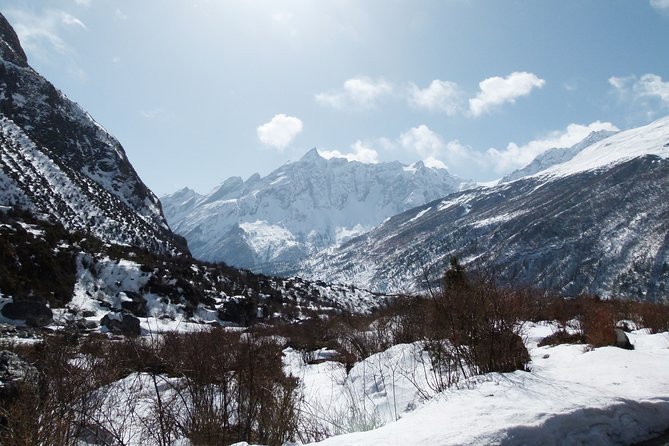
From Lho, the trail continues to Samagaon in about five hours. You pass Shyala, cross open ground near the river from the Pungyen glacier, and walk through a setting surrounded by high peaks. Samagaon is more than an overnight stop. It is the main acclimatization base before the final push toward the pass.
Day 10 is a rest day, but it is active in a sensible way. You explore the village, climb for about two and a half hours to Pungyen Monastery, and visit Birendra Tal, a glacial lake at 3,450 metres. Then you return to the teahouse.
That is a strong design choice. A complete day without any movement would not help you adjust as well as a modest hike followed by rest. The schedule also gives you time to experience village life instead of treating Samagaon as merely a bed for the night.
You should still listen to your guide and your body. The package includes a medical kit carried by the guide, but it does not include your medical expenses or emergency evacuation. Personal travel insurance with trekking and evacuation cover is essential.
Samdo and Larkya Phedi prepare you for the pass
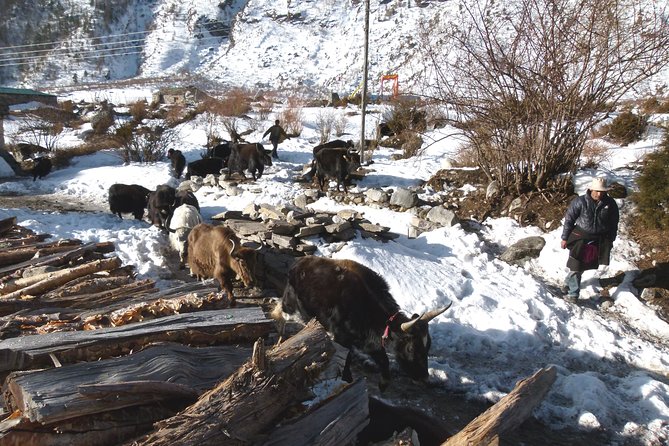
After Samagaon, the Budhi Gandaki becomes smaller and the route passes broad pasture, juniper, mani walls, and the last permanent settlement in the valley, Samdo. This village is associated with yak herders and sits in a stark, high setting with views toward Manaslu, Simrang, Hiunchuli, Ngadi, Larkye Peak, and other peaks.
Day 12 is a shorter four-hour outing from Samdo. The itinerary offers a choice of hiking behind the village toward a trade pass leading toward Tibet, or taking a longer route toward Gya-La. Both options include seasonal herder settlements and mountain views. Ask in advance which outing is planned, since the two choices may differ in length and difficulty.
The following day leads to Larkya Phedi, also called Dharmasala. You cross a wooden bridge, pass the remains of Larkya Bazaar, and see prayer flags, mani walls, streams, and the Larkya Glacier. The old bazaar once served as a trading point, but the trade declined and the settlement was abandoned.
The six-hour day is deliberately less punishing than the pass crossing. That matters. You want to arrive at the high camp ready for the next morning, not exhausted from an overly ambitious approach.
Larkya La is the trip’s biggest test
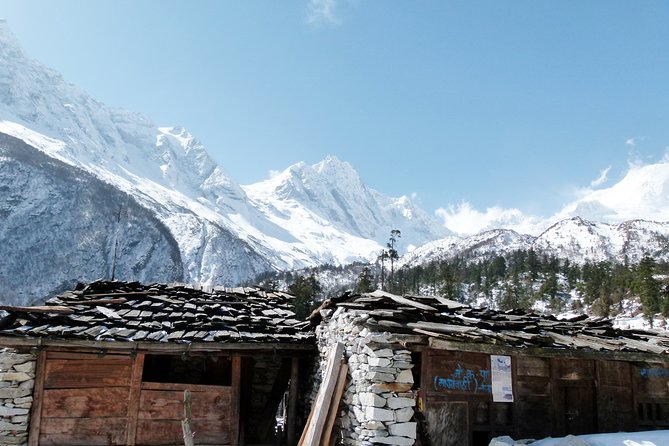
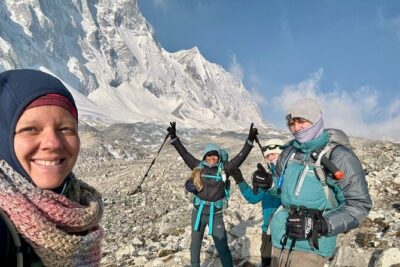
Day 14 is the hardest day, with about nine hours of walking. The route crosses glacial moraines, climbs gradually at first, then becomes steeper near the top. At the pass, you can see Humlung Himal, Cheo Himal, Kang Guru, and Annapurna II.
The descent also requires care. You cross more moraine before reaching easier grassy ground, then continue to Bhimthang for the night. Reaching this settlement after the pass should feel like a real accomplishment, but the day is long enough that weather, pace, altitude, and trail conditions matter greatly.
One important point needs checking: the trip overview gives Larkya La as 5,106 metres, while the detailed day plan says 5,213 metres. That is not a trivial difference at this altitude. Ask Explore Himalaya Travel and Adventure for the current official route height and expected conditions before departure.
The descent toward Tiliche changes the mood
After Bhimthang, the route follows the Marshyangdi valley for around five hours. You pass Sangure Kharka, cross the Dudh Khola, and descend through rhododendron forest toward cultivated land near Karche. The views include Manaslu, Lamjung Himal, Himlung Himal, and Cheo Himal.
The detailed schedule says you continue to Tiliche, but the stop heading names Gorkha, which appears inconsistent. Gorkha is also the historic place referenced in the general description, while Tiliche is the stated overnight location. Confirm the actual overnight plan, as this affects walking time, lodging, and the next day’s road transfer.
Day 16 joins the main Annapurna Circuit near Dharapani. You then descend along the Dudh Khola and Marshyangdi, passing through Tal, a village built on flat ground where a landslide once blocked the valley and formed a lake. The day ends at Jagat, according to the detailed schedule.
This is where the Manaslu route connects with a better-known trekking corridor. You may notice more foot traffic and a different feel on the trail. That contrast is useful: Manaslu gives you a quieter approach, then lets you finish through a major Himalayan route.
The return to Kathmandu takes most of a day
From Jagat, the package includes a local jeep to Besisahar, followed by a private vehicle to Kathmandu. The full return drive takes about seven hours, often beside the Marshyangdi and Trishuli rivers, with terraced farms and hill villages along the way.
Road travel in Nepal can be slow, so keep your final evening flexible. The company provides a hotel night in Kathmandu, and the airport transfer is included on Day 18. Your international flights, Nepal visa, Kathmandu lunches and dinners, snacks, drinks, hot showers, charging, WiFi, and personal equipment are not included.
What $2,700 buys you
At $2,700 per person, the package is not cheap, but it covers many costly and complicated parts of a restricted-area trek. Included services are:
- English-speaking local guide and porter
- Accommodation and all listed trek meals
- Manaslu Restricted Area permit
- Manaslu Conservation Area permit
- Annapurna Conservation Area permit
- Kathmandu hotel nights with breakfast
- Kathmandu Valley sightseeing, guide, and entrance fees
- Airport transfers
- Private and local road transport
- Staff clothing and equipment
- Medical kit carried by the guide
- Staff and porter insurance
The meal counts are listed as 17 breakfasts, 15 lunches, and 14 dinners. That suggests food is covered throughout the trekking section, but you should ask exactly which meals are included on transfer days and during Kathmandu stays.
The strongest practical praise for Explore Himalaya concerns organization. Anuj and the team are credited with taking care of the full experience from airport arrival to the flight home, and with handling arrangements well enough for one client to choose the company for a second trek. That is useful reassurance for a route where permits, porters, vehicles, and changing trail conditions all need coordination.
The advertised maximum is 100 people. That is a very large possible group for a remote trek, although the actual departure size is not stated. Ask how your group will be formed and whether guides and porters are assigned in smaller walking units.
Who should book this trek?
You should consider it if you want a serious Himalayan route with strong cultural variety, a high pass, and more remote walking than the standard Annapurna Circuit. It suits hikers who are comfortable with long days, basic teahouses, suspension bridges, uneven trails, and limited services.
It is a poor match if you want private bathrooms, dependable internet, short walking days, or a relaxed sightseeing holiday. You also need to budget for insurance, personal gear, visa costs, drinks, snacks, charging, WiFi, and possible emergency expenses.
Free cancellation is available when you cancel at least 24 hours before the stated start time. After that point, the amount paid is not refunded, and late changes are not accepted.
Should you book the Manaslu Circuit Trek?
I would book this trek if your main goal is a demanding route with meaningful village contact, Buddhist high-country culture, and the satisfaction of crossing Larkya La. The inclusion of permits, porters, meals, Kathmandu sightseeing, and ground transport makes the $2,700 price easier to justify.
Before booking, get written clarification on the pass altitude, the Day 15 and Day 16 overnight locations, the actual group size, and the meal schedule. If you are fit, properly insured, and ready for basic mountain conditions, this is a strong choice. If you are new to altitude trekking, choose a less demanding route or arrange extra preparation first.
FAQ
How long is the Manaslu Circuit Trek?
The trip lasts 18 days and 17 nights, including arrival and departure days, Kathmandu sightseeing, transport, trekking, and hotel stays.
What is the highest point on the trek?
The detailed itinerary lists Larkya La at 5,213 metres. The general description gives 5,106 metres, so you should confirm the current stated altitude with the operator.
Is airport pickup included?
Yes. Airport pickup and departure transfer are included in a private, non-air-conditioned vehicle, with an escort.
What accommodation is provided in Kathmandu?
The package includes three nights in a three-star Kathmandu hotel with breakfast. Lunch and dinner in Kathmandu are not included.
Are trekking meals included?
Breakfast, lunch, and dinner are included during the trekking portion in the listed quantities of 17 breakfasts, 15 lunches, and 14 dinners. Ask the operator to confirm how these meal counts apply to transfer days.
Are permits included?
Yes. The package includes the Manaslu Restricted Area permit, Manaslu Conservation Area permit, and Annapurna Conservation Area permit.
Is transport included between Kathmandu and the trail?
Yes. Private transport is provided from Kathmandu to Arughat, a local jeep continues from Arughat to Soti Khola, and the return includes a local jeep from Jagat to Besisahar followed by private transport to Kathmandu.
Is a guide and porter included?
Yes. An English-speaking local guide and porter are included, along with porter and staff clothing and equipment.
What fitness level is required?
The experience is listed for people with a moderate physical fitness level. In practice, you should be prepared for repeated five to six-hour walking days, a nine-hour pass day, steep and exposed sections, and walking above 5,000 metres.
Recently added around Kathmandu
- Ghorepani Poon Hill Trek★ 5.0 · 16 reviews
- Private Manaslu Circuit Trek at Himalayas★ 5.0 · 3 reviews
- Amazing 1 Day Trekking Experience in Kathmandu Nepal★ 5.0 · 24 reviews
- Ghorepani Poonhill Trek★ 5.0 · 5 reviews
- Upper Mustang Trekking★ 5.0 · 2 reviews
- Upper Mustang Trekking★ 3.0 · 2 reviews
- Upper Mustang Trekking★ 5.0 · 4 reviews
- Upper Mustang Trek★ 5.0 · 5 reviews
Manaslu Circuit Treks, compared.
16 Day Private Manaslu Circuit Trek from Kathmandu
Read our review →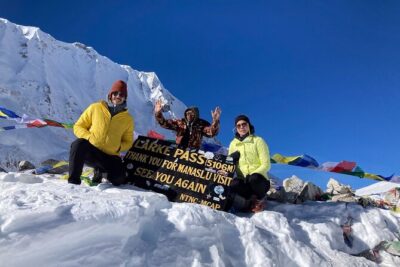
10 Days Manaslu Circuit Trek in Larke La Pass
Read our review →Browse the lists this tour appears in