
REVIEW · KATHMANDU
Manaslu Circuit Trek
The road gets rough, but the reward is huge. The Manaslu Circuit gives you big Himalayan views without the crowds found on Nepal’s best-known routes, while its small villages, Buddhist monasteries, glacier lakes, and changing scenery make each day feel distinct. I especially like the combination of natural beauty and local culture, plus the strong support from guides such as Sunil, Shyam, Janu, and Sushanta.
I also like that the $1,900 price covers the hard-to-arrange pieces: restricted-area permits, airport transfers, meals during the trek, a licensed guide, one porter for every two clients, guesthouses, and transport by 4WD. The main caution is the physical demand. Long walking days, rough road journeys, basic lodging, and the 5,160-meter Larkya La Pass make this a serious trek, not a gentle mountain holiday.
Key points at a glance
- A less crowded Himalayan route: Manaslu sees fewer trekkers than Nepal’s busiest circuits, giving villages and trails a more peaceful feel.
- The 5,160-meter Larkya La Pass: This is the trek’s hardest and most rewarding day, with steep climbing, snow and moraine, and broad views of Himlung Himal, Cheo Himal, Kang Kuru, and Annapurna II.
- Strong local support: A licensed English-speaking guide and one porter for every two clients are included, with a maximum group size of 15.
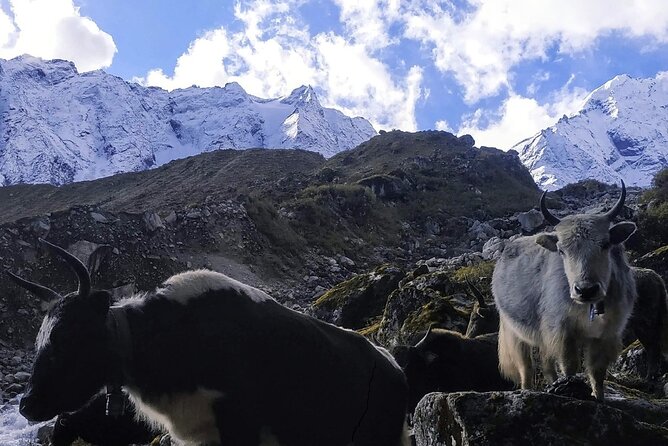
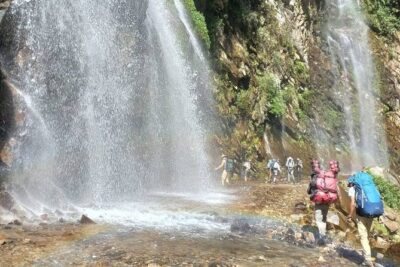
- A real range of scenery: Expect river gorges, bamboo and rhododendron forests, terraced fields, high plateaus, glacier lakes, snowy peaks, and waterfalls.
- Useful acclimatization time: The Samagaon day allows either a 4 to 5-hour outing to Pungyen Gompa and Birendra Tal or a longer 7 to 8-hour walk to Manaslu Base Camp.
- A costly but practical package: Permits, accommodation, most meals, transport, equipment loans, and staff are included, though insurance, drinks, tips, flights, and Kathmandu meals are extra.
Why the Manaslu Circuit feels different
Manaslu has been open to trekkers since 1991, and access remains controlled through special permits and organized trekking groups. That extra paperwork is not merely a nuisance. It helps limit numbers and keeps the route quieter than the Everest Base Camp and Annapurna circuits.
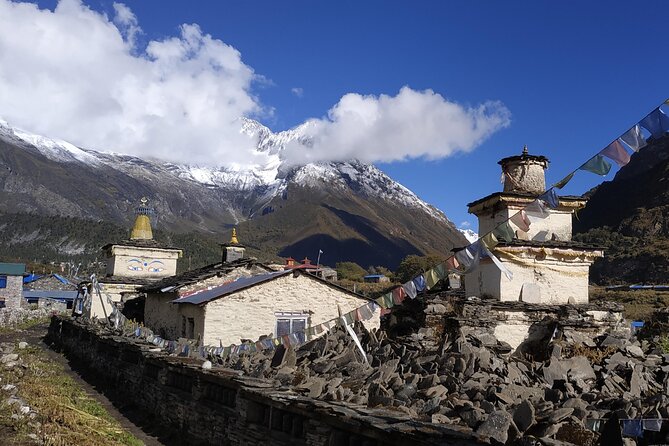
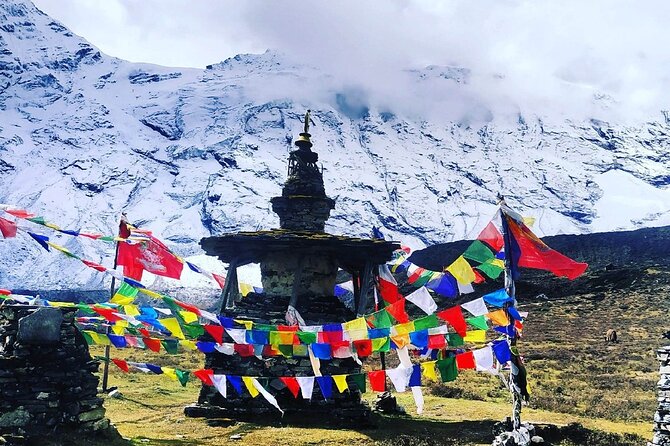
You pass through a region shaped by both Nepalese and Tibetan culture. Lower down, the route moves through farmland, forest, and steep river valleys. Higher up, stone villages, Buddhist monasteries, prayer flags, and broad views of Manaslu make the setting feel more remote.
The scenery changes often enough to keep the walking interesting. You begin beside powerful rivers and hot springs, pass flowering mustard fields and bamboo forests, then reach high settlements surrounded by snow and ice. At the end, the route joins the Annapurna Circuit section near Dharapani, giving you a final change of character before the drive back.
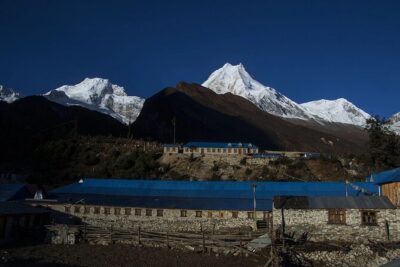
The route is not polished for mass tourism. Facilities are basic, especially around Dharmasala, where a small stone guesthouse provides dormitory lodging. That simplicity is part of the appeal, but you should be ready for shared rooms, limited comfort, and food choices that may narrow as you gain height.
More Manaslu Treks in Kathmandu:
- Manaslu Circuit Trek
★ 5.0 · 292 reviews - Manaslu Circuit Trek:
★ 5.0 · 106 reviews - Manaslu Circuit Trek (15 Days)
★ 5.0 · 50 reviews
Days 1 and 2: Kathmandu preparation and the rough road to Machha Khola
Your trip begins at Tribhuvan International Airport, where an Ace the Himalaya representative meets you and takes you to your Kathmandu hotel in a private vehicle. Two nights in a three-star Kathmandu hotel are included, along with guided sightseeing and entrance fees.
A pre-trek meeting takes place on either the first or second day. Bring your passport, three passport photos, and a readable travel insurance policy. This is also when you meet the trek leader, settle any remaining balance, and sign the required trip documents.
Day 2 is mostly about transport. The drive from Kathmandu to Dhading Besi takes around three to four hours on a paved road. After that, the surface becomes rough and winding as you continue toward Machha Khola, with the full journey taking about eight to ten hours depending on traffic and road conditions.
A private 4WD vehicle and experienced driver are included. That matters here because the road beyond Soti Khola is not paved in concrete. The drive is tiring, but it puts you close to the trailhead and avoids adding another long trekking day at the start.
Days 3 and 4: Hot springs, narrow gorges, and Deng
The walk from Machha Khola toward Jagat takes about six hours. You cross the Machha River and pass Khrola Besi before reaching Tatopani, a hot spring. The route then follows forest toward Dovan, with the Budi Gandaki River rushing below.
This section is a good introduction to the route’s changing scale. At lower elevations, the river is loud and forceful, while the valley gradually narrows and the walls rise sharply. The walking is scenic, but uneven trails and repeated river crossings can make the early days feel harder than the mileage suggests.
From Jagat, you climb toward terraced hills near Saguleri, where Sringi Himal reaches 7,177 meters. The trail continues through Sirish Gaon and into a tighter section of the Gandaki valley, with steep walls and bamboo forest.
You follow the Deng River upstream to the small village of Deng. This is one of the places where the circuit feels removed from ordinary sightseeing. Villages are small, the route is not crowded, and the setting is shaped more by the river and mountain terrain than by tourism.
Days 5 and 6: Mustard fields, ancient carvings, and Manaslu views
The walk to Ghap is shorter at around five hours, but it is described as harder than the earlier days. Flowering mustard fields add a bright note to the route, while the waterfall near Ghap provides a pleasant arrival point.
Look for ancient writing and artwork carved into the stones. Details like this reward a slower pace. You are not simply walking from lodge to lodge; the route contains traces of older religious and cultural life.
The following day takes about seven hours to Lho, with a lunch stop at Namrung. Views of Ganesh and Siringi Himal accompany the walk from Lihi and Lamagaon. You cross the Hinan River, which rises from Linda Glacier, then continue through Sho before reaching Lho Gaon.
Lho is one of the trek’s memorable villages. Mt. Manaslu appears above the settlement, and the mountain views become more commanding as you gain height. The route also brings a stronger Buddhist character, with the Ribung Gompa waiting above the village.
A few more treks around Kathmandu worth a look
- Everest Base Camp Trek – 14 Days
★ 5.0 · 1,499 reviews - Everest Base Camp Trek
★ 5.0 · 842 reviews - Everest Base Camp Trekking
★ 5.0 · 485 reviews - Annapurna Circuit Trek with Tilicho Lake
★ 5.0 · 368 reviews
Days 7 and 8: Lho to Samagaon and a valuable rest day
From Lho, you can see Naike Peak, Manaslu North at 7,774 meters, and Manaslu itself at 8,150 meters. The day to Samagaon takes about four hours, making it relatively short and useful before the higher sections.
The route leads toward the Buddhist monastery at Ribung Gompa before continuing to Samagaon. This is a good point to slow down, look around the village, and let your body adjust to the increasing altitude.
Day 8 is reserved for acclimatization, but it is not a day spent doing nothing. You can choose a 4 to 5-hour outing to Pungyen Gompa and glacial Birendra Tal, or take the longer 7 to 8-hour walk to Manaslu Base Camp and return to Samagaon.
The choice should match your energy and the conditions. Birendra Tal offers a shorter option, while Manaslu Base Camp gives stronger bragging rights and a longer day at altitude. The itinerary wisely places this pause before Samdo and Dharmasala, where the air is thinner and the facilities more basic.
Days 9 and 10: Samdo and the basic shelter at Dharmasala
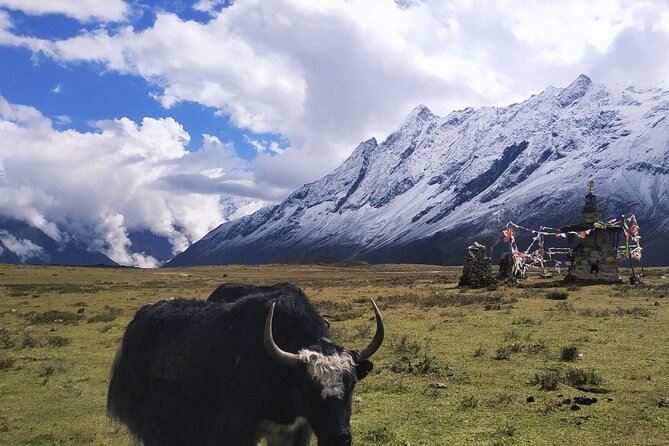
The walk to Samdo takes around five hours. You climb a terraced hill on the opposite bank of the Budhi Gandaki River, then continue toward one of the highest permanent settlements on the route.
Samdo feels remote in a way that the lower villages do not. The valley is more open, the vegetation is sparser, and the nearby mountains make the settlement feel close to the Tibetan border region. It is a short day on paper, but altitude can make the effort feel much greater.
The next day to Dharmasala, also called Larke Phedi, takes about five hours. The trail remains similar to the route from Samagaon to Samdo, with broad high-country scenery and limited plant life.
Accommodation here is basic. One small stone guesthouse offers food and dormitory-style lodging. You should expect this to be one of the least comfortable nights of the trek. It is also an important staging point for the pass, so the simple room serves a practical purpose.
Day 11: The demanding crossing of Larkya La Pass
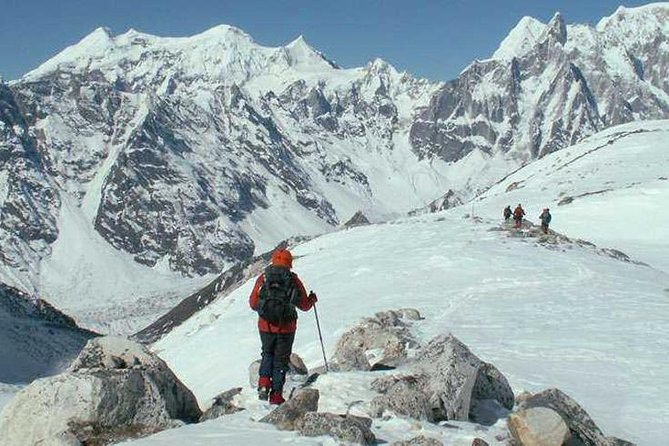
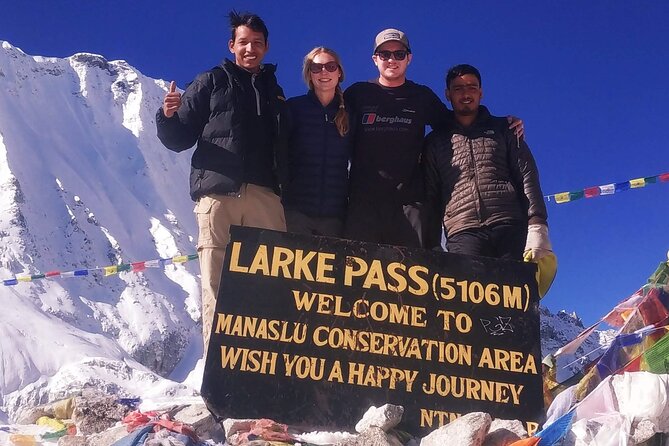
This is the trek’s defining day. The walk takes about nine hours and begins with a climb toward Cho Chanda before turning steeply uphill toward the snow-covered pass.
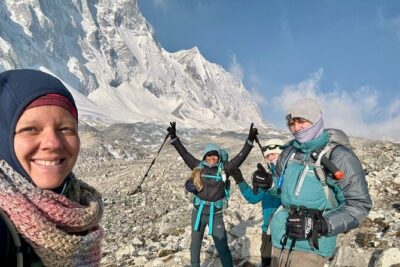
At 5,160 meters, Larkya La is high enough that pace and breathing matter more than speed. The ascent can be cold and tiring, and the descent through moraines is steep. Good footwear, warm layers, and a sensible approach to altitude are essential.
The reward is a wide mountain panorama. From the pass, you can see Himlung Himal at 7,126 meters, Cheo Himal at 6,820 meters, Gyagi Kung, Kang Kuru at 6,981 meters, and Annapurna II at 7,937 meters.
The descent continues toward Bhimtang. This long day is where the included guide matters most. The strongest praise for the company focuses on staff care, organization, reassurance, and motivation during difficult sections. Guides such as Janu, Sunil, Ganesh, and Sushanta are specifically praised for helping people feel safe and keeping the trek running smoothly.
Days 12 and 13: Forests, villages, and the Annapurna connection
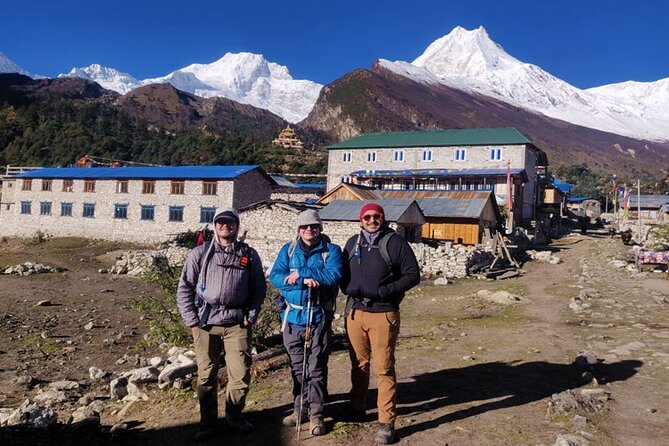
After the pass, the route becomes easier. You make a gentle climb through paddy fields toward the small Karcha La Pass, then descend through fig trees and rhododendron forest to Tilje.
This is a welcome change after the exposed high trail. Trees return, the air feels less severe, and the route once again passes through cultivated land. The seven-hour walking day is still substantial, but the terrain is kinder.
The next day takes about six hours to Tal. You pass through more heavily populated villages and stop for lunch at Dharapani, at 1,860 meters. From there, you enter the Annapurna Circuit section.
The trail crosses streams and wheat fields before a suspension bridge over the Marshyangdi River. Tal sits beside the river and has a large waterfall, giving the final trekking day a pleasant sense of arrival. After the remote upper Manaslu region, the denser settlement pattern here is noticeable.
Days 14 and 15: A long return to Kathmandu
A 4WD vehicle takes you from Tal toward Kathmandu via Besisahar. The road is rough and bumpy as far as Besisahar, then becomes smoother on the highway.
The drive takes about eight to nine hours. Hills and rivers provide something to watch, but this is still a long road day after nearly two weeks of walking. If you dislike extended vehicle journeys, keep that in mind when judging the total effort of the trip.
The final day is reserved for airport transfer. An airport representative takes you to Kathmandu International Airport for your departure.
What the $1,900 price really covers
At $1,900 per person, this is not a cheap independent trek, but it includes several items that are difficult and expensive to arrange alone.
Included are airport transfers, two Kathmandu hotel nights, guided Kathmandu sightseeing, 12 nights in trekking guesthouses, a licensed English-speaking guide, and one porter for every two clients. All restricted-area trekking permits, government taxes, VAT, and official charges are also covered.
Meals include 14 breakfasts, 13 lunches, and 13 dinners. A down jacket and sleeping bag are loaned for the trek, which can save you from buying bulky gear for one trip.
You still need to budget for international airfare, a Nepal entry visa, travel insurance with high-altitude rescue and evacuation, drinks, personal equipment, tips, and lunch and dinner in Kathmandu. Tips are expected, so add that to your planning rather than treating it as an optional surprise.
The maximum group size is 15, though some departures may be much smaller. A private group of just two people plus a guide and porter has been possible, which creates a more personal experience. The strongest praise consistently goes to the local staff, especially their care, organization, route knowledge, and good humor during long days.
Who should book this trek?
You should consider it if you have moderate physical fitness, enjoy long walking days, and want a quieter route with strong mountain scenery and village life. It suits people who value local guides, small groups, basic guesthouses, and a sense of remoteness more than polished comfort.
You should think twice if you dislike rough roads, shared dormitory rooms, long transport days, or uncertain mountain weather. The trip requires flexibility, especially around the high pass.
Cancellation terms are strict close to departure. A full refund is available when you cancel at least six full days before the start time, while cancellations two to six days ahead receive a 50 percent refund. Poor weather may lead to a date change or full refund.
Final verdict: A strong choice for serious walkers
I would recommend the Manaslu Circuit Trek to hikers who want Nepal’s big peaks with fewer people around them. The route earns its price through permits, transport, staff, meals, accommodation, and equipment support, while the local guides appear to be the heart of the operation.
Book it for the quiet villages, changing scenery, Tibetan Buddhist culture, and Larkya La views. Skip it if you want easy roads, hotel comfort, or a relaxed schedule. For a fit walker prepared for long days and simple facilities, this is a demanding but rewarding way to see a less crowded side of Nepal.
FAQ
How long is the Manaslu Circuit Trek?
The experience lasts approximately 15 days, including arrival and departure transfers, trekking days, Kathmandu time, and transport between the trail and the city.
Where does the trek begin?
The organized trip begins with airport pickup at Tribhuvan International Airport in Kathmandu. The walking portion starts around Machha Khola after the long 4WD journey from Kathmandu.
What is the highest point on the trek?
The highest point is Larkya La Pass at approximately 5,160 meters.
Is the trek suitable for beginners?
The trip requires a moderate physical fitness level. It includes long walking days, steep sections, high altitude, rough roads, and basic accommodation, so it is not designed as an easy introductory walk.
Are trekking permits included?
Yes. The package includes all trekking permits, including the restricted-area permit required for the Manaslu region.
What accommodation is provided?
You receive twin-share or double accommodation in a three-star Kathmandu hotel for two nights. During the trek, accommodation is in guesthouses with twin-share and dormitory rooms. Dharmasala has dormitory-style lodging.
Are meals included?
Breakfast is included for 14 days, while 13 lunches and 13 dinners are included. Lunch and dinner in Kathmandu are not included. Alcoholic and other hot or cold drinks are also extra.
Is airport transportation included?
Yes. Airport pickup on arrival and airport drop-off at the end of the trip are included.
What is not included in the price?
International airfare, the Nepal entry visa, travel insurance with emergency high-altitude rescue and evacuation, personal trekking equipment, drinks, tips for the trekking staff and driver, and Kathmandu lunches and dinners are not included.
Recently added around Kathmandu
- Ghorepani Poon Hill Trek★ 5.0 · 16 reviews
- Private Manaslu Circuit Trek at Himalayas★ 5.0 · 3 reviews
- Amazing 1 Day Trekking Experience in Kathmandu Nepal★ 5.0 · 24 reviews
- Upper Mustang Trekking★ 5.0 · 2 reviews
- Ghorepani Poonhill Trek★ 5.0 · 5 reviews
- Upper Mustang Trekking★ 3.0 · 2 reviews
- Upper Mustang Trekking★ 5.0 · 4 reviews
- Upper Mustang Trek★ 5.0 · 5 reviews
Manaslu Circuit Treks, compared.
16 Day Private Manaslu Circuit Trek from Kathmandu
Read our review →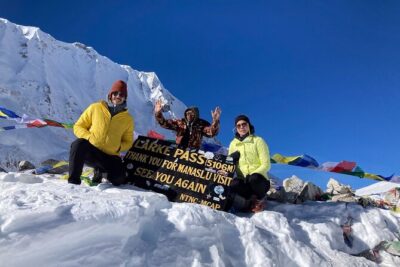
10 Days Manaslu Circuit Trek in Larke La Pass
Read our review →Browse the lists this tour appears in