
REVIEW · MOROCCO
8-Day Morocco Adventure: Imperial Cities & Sahara Desert Trek
Morocco packs a lot into eight days. This private route links Rabat, Chefchaouen, Fez, the Sahara, and Marrakech with private air-conditioned transport, local guides, riad stays, and a camel ride. You get Roman ruins, medieval lanes, desert silence, mountain roads, and Moroccan cities in one sweeping trip.
I like the range of experiences, especially the night in a private desert tent and the guided visit through Fez’s old medina. I also like the flexibility of a private tour, where drivers such as Youssef, Abdel, Mahmoud, and Anir have been praised for being safe, attentive, and willing to adjust the pace.
The main concern is the schedule. The tour is sold as eight days for $825 per person, yet parts of the description repeatedly call it a 10-day tour. Several days also involve long drives, so you should confirm the exact dates, route, hotel plan, and final price before paying.
Key points at a glance
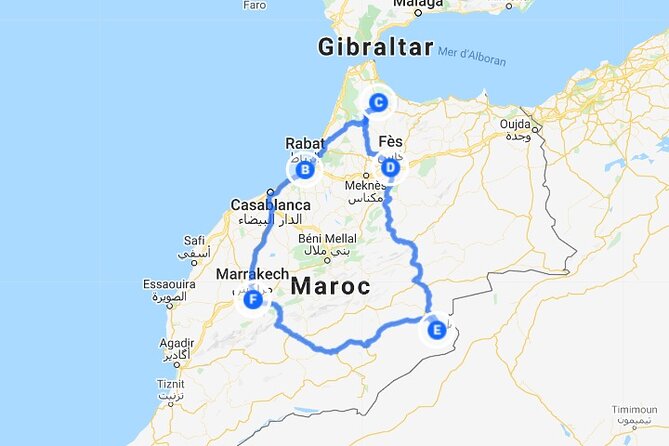
- A full Morocco circuit: Rabat, Chefchaouen, Volubilis, Meknes, Fez, Merzouga, Todra Gorge, Ait Ben Haddou, Marrakech, and Casablanca all appear in the route.
- The Sahara night is the centerpiece: Ride one camel per person to an Erg Chebbi camp, watch the sunset, eat dinner, and hear music under the stars.
- Private transport changes the experience: You travel by private air-conditioned vehicle rather than following a large coach timetable.
- Fez gets proper guided time: A five-hour visit covers the medina, Mellah, palace area, tanneries, potters, and a traditional lunch stop.
- Meals are only partly covered: Seven breakfasts and two dinners are included, while lunches, most dinners, and monument admission fees are extra.
- Expect long road days: Chefchaouen, Fez to Merzouga, and the route from the desert to Marrakech require patience and an appetite for changing scenery.
What this Morocco route does well
Morocco rewards a trip that moves between regions. One morning you can be among Roman columns at Volubilis, then later in a Meknes medina, a cedar forest, or a desert camp. This itinerary gives you that variety without asking you to arrange separate taxis, hotels, guides, and transfers.
I especially like the mix of major sights and smaller details. The route includes famous places such as Hassan II Mosque and Ait Ben Haddou, but it also takes you through Midelt, Erfoud, the Valley of the Roses, and the road of a thousand kasbahs. Those in-between sections help you see how quickly Morocco changes from coast to mountains to dry plains.
The private format is a major advantage. Your group has its own driver and vehicle, and the description says only your party participates. That gives you more control than a fixed bus tour, though the actual amount of flexibility will depend on the driver and the day’s long distances.
The strongest praise has gone to the people running the trips. Abdel has been described as polite and experienced, Mahmoud as especially caring and entertaining, and Abdessamad as friendly and careful on the roads. One family with children aged 11, 12, and 14 appreciated the staff’s patience, while another group valued clear communication before and during the trip.
Those details matter. On a route this long, a good driver is not a small bonus. You will spend many hours in the vehicle, and a calm, responsive person can make the difference between a tiring transfer and an enjoyable part of the trip.
A few more treks around Morocco worth a look
- Mt Toubkal Ascent Express Trek 2 Days 1 Nights
★ 4.7 · 962 reviews - Marrakesh: 2-Day Mt. Toubkal Trek with 1-Night Stay & Meals
★ 4.7 · 795 reviews - Marrakech: 2-Day Atlas Mountains Trek with Village Stay
★ 4.8 · 717 reviews
Day 1: Rabat, then the blue streets of Chefchaouen
The tour begins with Rabat, Morocco’s capital. You have about two hours to see the city before a long drive north toward Chefchaouen. The short Rabat visit gives you an introduction to the country’s political and royal center, but it is not enough for a deep city tour.
The drive to Chefchaouen takes about five to six hours. You will pass through changing countryside and the Rif Mountains before reaching the famous blue-painted town. The time in Chefchaouen is listed as about two hours, so you should think of this as a compact introduction rather than a slow afternoon of wandering.
Chefchaouen is best suited to walking without a strict checklist. Its narrow streets, blue walls, stairways, and mountain setting provide a clear visual change from Rabat. The drawback is simple: the day combines a city visit, a mountain drive, and another town, so much of it will be spent in the vehicle.
If you prefer long stays in each place, this opening day may feel rushed. If your goal is to sample several parts of Morocco on one trip, it makes good use of limited time.
Day 2: Volubilis and Meknes before Fez
After breakfast, you head toward Volubilis through Wazan and the Rif Mountains. The Roman ruins are one of the most useful historical stops on the route because they show that Morocco’s story reaches well beyond its Islamic dynasties and desert trade.
The archaeological site includes Roman remains and mosaics, though admission is not listed as included. Set aside money for entrance fees throughout the trip, since monument tickets are generally extra.
Next comes Meknes, a former imperial city with 17th-century connections. The plan includes the medina, Bab el Mansour, lunch, and Moulay Ismail’s shrine. Bab el Mansour is the visual highlight, while the medina offers a more focused look at Moroccan urban life than the much larger old city of Fez.
You arrive in Fez in the evening for dinner and a night in a riad. That arrival timing is useful because it leaves the following day for a full guided visit, but it also makes Day 2 a fairly packed transfer day.
Day 3: Five hours inside Fez’s old medina
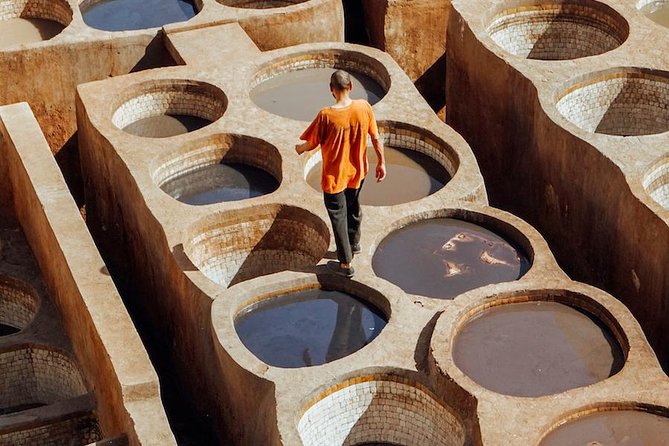
This is one of the itinerary’s strongest days. Fez’s old medina is one of the world’s largest walled urban areas, and a local guide is genuinely helpful here. The streets can be narrow and confusing, with shops, food stalls, craft workshops, and homes packed close together.
The guided visit includes the Fez Mellah, the palace area, tanneries, potters, spices, carpets, and other Moroccan crafts. You also stop for lunch at a traditional restaurant in the medina. The listed visit lasts about five hours, giving you enough time to see more than the most obvious lanes.
I like that Fez is not treated as a quick photo stop. The city requires context. A local guide can explain what you are seeing and help connect the craft traditions, religious buildings, palace district, and market streets.
You should still expect a busy walking day. The medina’s narrow routes may be tiring, and the tour includes commercial craft stops as part of the experience. That is normal in guided city visits, but you should feel comfortable asking how much time is available for independent browsing.
Same trailhead, a longer or shorter day out:
- From Marrakech: 3-Day Mount Toubkal Climbing Trek
★ 4.7 · 597 reviews - From Marrakesh: 2-Day Mount Toubkal Trek
★ 4.7 · 591 reviews - From Agadir: Camel Ride and Flamingo Trek
★ 4.7 · 371 reviews - From Marrakech: Atlas Mountains Summit Trek
★ 4.9 · 228 reviews
Day 4: Across the Atlas Mountains to Merzouga
Day 4 is a major transition. You leave Fez and cross the Middle Atlas toward Midelt, passing Ifrane and Azrou. Ifrane is described as a ski resort, while Azrou is known for cedar woodwork and handicrafts.
The route then continues toward Erfoud and the Sahara. This is a scenic road day, but it is also one of the longest and most tiring sections of the tour. The itinerary provides a stop for lunch in Midelt, yet lunch is not included in the package price.
The value here is not a single monument. It is the changing scenery outside the cities: mountain roads, cedar forests, dry plains, palm groves, and desert terrain. You should bring water, snacks, and something useful for the vehicle, such as a book, music, or downloaded podcasts.
Once you reach the Erg Chebbi dunes, a short off-road section takes you to the camels. Your luggage is transferred to a 4×4, so you do not need to take every bag on the camel ride.
The Erg Chebbi camp and the camel ride
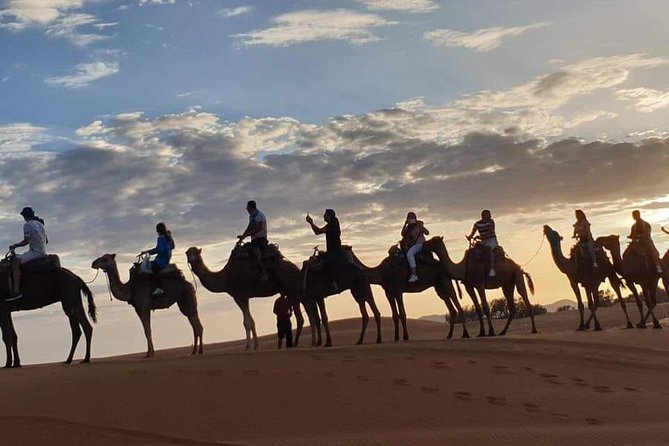
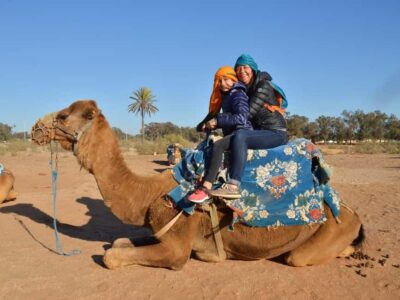
The desert night is the emotional center of the trip. You ride one camel per person across the golden dunes, with the timing arranged around sunset. You then reach a camp with private tents, en suite bathrooms, and showers.
That setup is important. This is not the most basic form of desert camping. You still sleep in a tent, but private facilities make the night easier for people who want the desert setting without giving up all comfort.
After dinner, the staff and camel handlers light a fire and play music. The combination of sunset, open sand, dinner, and a dark sky gives you the kind of evening that is hard to reproduce in a city hotel.
Bring a warm layer even if the daytime is hot. Temperatures can change after sunset, and the camp is exposed. Also carry a small overnight bag, since the rest of your luggage travels separately by 4×4.
The camel ride itself may not suit everyone. The route includes a return by camel or 4×4 the next morning, so ask for the vehicle option if riding becomes uncomfortable. One practical tip is to carry a little cash for tips, especially for the camel handler helping with the ride and sunset photos.
Day 5: From the dunes to Todra Gorge and Dades
The morning begins with sunrise and breakfast in the camp. You then leave the dunes by camel or 4×4 and return to the road toward Erfoud, known for fossil work.
The drive continues through palm groves and dry country before reaching Todra Gorge. The plan includes a short walk through the gorge, followed by the onward journey to Dades Gorge for dinner and an overnight stay.
This is another day where the road itself is part of the attraction. You will see a very different side of Morocco from the imperial cities, with rock walls, palms, dry valleys, and villages along the route.
The weakness is the amount of time spent moving after the desert night. If you want a full hike in Todra Gorge or a long stop in Erfoud, the listed schedule may not provide it. I would treat these visits as introductions rather than full excursions.
Day 6: The road of a thousand kasbahs to Marrakech
After breakfast, you take a short walk in the gorges before following the Dades Valley. The route passes through El Kelaa M’Gouna, associated with the Valley of the Roses, and continues along the road of a thousand kasbahs.
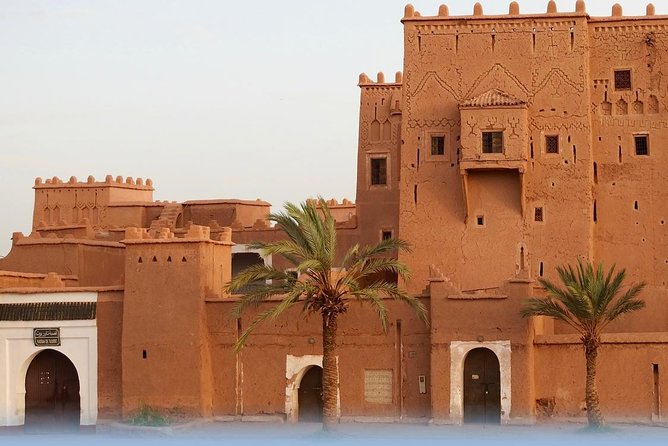
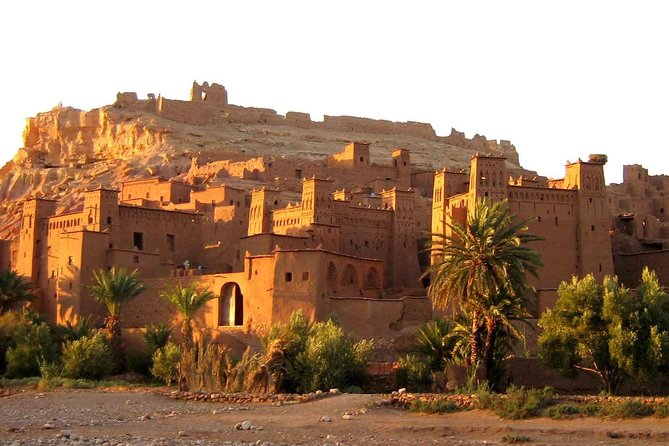
You then visit Ouarzazate and stop for lunch at Ait Ben Haddou. The fortified village is a UNESCO-listed site and has appeared in films including Gladiator and Lawrence of Arabia. Its fame can make it feel familiar before you arrive, but walking among the earthen buildings still gives the place a strong sense of scale and age.
Admission is listed as free in the itinerary, but confirm which local services or monument areas are included. Lunch is extra.
The final section crosses the Tichka Pass toward Marrakech. Mountain roads and the long distance make this a full day. You should not expect much free time in Marrakech on arrival. The reward is the dramatic change from dry valleys and kasbahs to a major Moroccan city.
Day 7: Marrakech, from Koutoubia to the souks
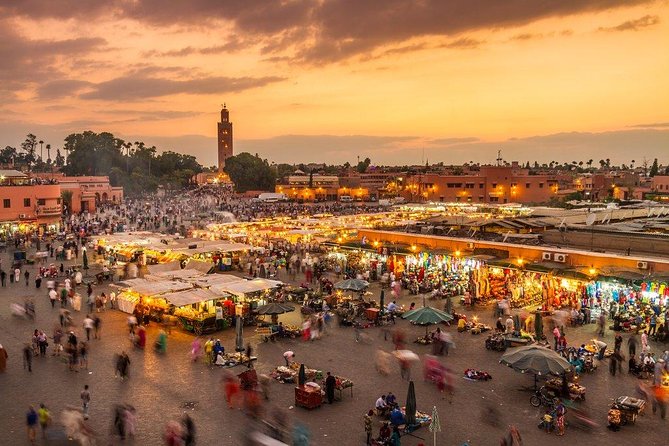
Marrakech receives a guided city day of about four hours. The route includes Koutoubia Mosque, Jemaa el-Fna, the souks, palaces, museums, Gueliz, Menara Garden, and Majorelle Garden.
That is a lot for four hours. You will get a useful orientation, but you will need to choose where to linger. The souks and Jemaa el-Fna can easily absorb a full afternoon on their own, while the gardens and modern Gueliz sit in a different part of the city.
The guide can help you understand how the old and newer parts of Marrakech fit together. City guides in both Fez and Marrakech have been praised for being friendly, which is encouraging for anyone who wants cultural explanation rather than only transport between photo stops.
Entrance fees are not included for this day. Ask in advance which gardens, museums, and palaces are part of the route and which require separate payment.
Day 8: Casablanca and Hassan II Mosque
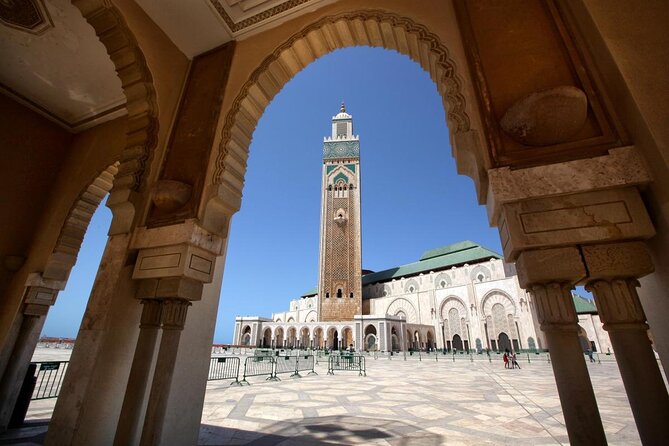
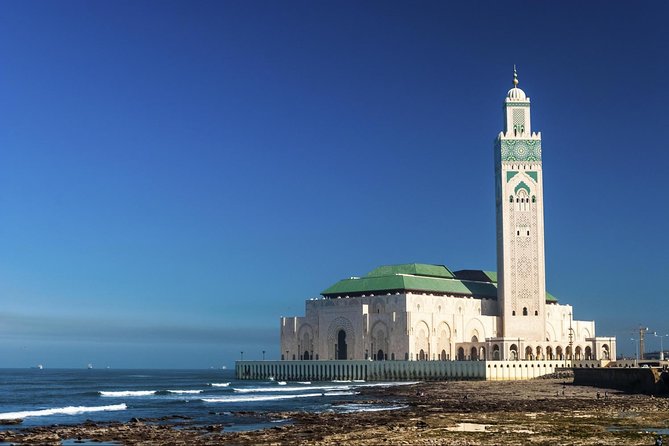
The final day returns to Casablanca, with a visit to Hassan II Mosque and the Corniche before you rest at the hotel. Hassan II Mosque is the main sight here, while the Corniche provides a coastal finish after the inland cities and desert.
The description says the service ends after returning to the hotel. That means you should not assume an airport transfer or an onward connection is included unless the provider confirms it.
Casablanca is the least explored city on the route. You receive a short final visit rather than a full city program, so this itinerary works best if you are using Casablanca as the start and end point rather than choosing it as your main Moroccan destination.
What the $825 price really covers
At $825 per person, the advertised eight-day price works out to about $103 per day. For a private vehicle, fuel, driver, local taxes, hotels, seven breakfasts, two dinners, city guides, and a camel ride, that can be good value if the itinerary is truly eight days and the accommodation standard matches the description.
The private transport is the biggest part of the value. Arranging this route independently would require several intercity transfers, desert transport, hotel bookings, and guides in Fez and Marrakech. You are paying for coordination as well as the vehicle.
The cost is less all-inclusive than it first appears. You need to budget for lunches, most dinners, monument entrances, drinks, and tips. The package includes only two dinners, despite the many nights on the road.
There is also a basic arithmetic problem to settle. The title says eight days, the day-by-day plan has eight days, and the price is presented for that format. Yet the written details repeatedly refer to a 10-day tour. Get the exact duration and included nights in writing before booking.
Free cancellation is available up to 24 hours before the start time. Late cancellations and last-minute changes are not refunded, and poor weather or failure to reach the minimum number of participants can lead to a different date or a full refund.
Who should book this tour
I would recommend it to you if you want a broad first look at Morocco and prefer having transport, hotels, and desert arrangements handled for you. It suits couples, families, and private groups that value their own vehicle and want to avoid organizing each leg independently.
It is also a good match for people who care more about range than slow travel. You will see many regions, but you will not have several free days in each city.
I would be cautious if you dislike long drives, want a relaxed desert trek, or need a tightly defined luxury standard. The route is ambitious, and several days combine sightseeing with major road transfers.
Should you book the Morocco adventure?
Book it if the confirmed plan is really eight days, you are comfortable with long drives, and you want the Sahara included in a wide Morocco circuit. The strongest reasons are the private transport, the well-placed Fez guide day, the private desert tents, and the range of places covered for the price.
Before booking, ask for the final hotel list, exact number of nights, guide arrangements, entrance fees, airport transfer details, and the full meal plan. If those answers are clear and the schedule fits your pace, this offers a practical way to see Morocco’s major cities and desert in one trip.
FAQ
Is this tour eight days or 10 days?
The day-by-day plan covers eight days, but the written description also refers several times to a 10-day tour. Confirm the exact duration with Morocco First Gate before booking.
Is transportation included?
Yes. The package includes private air-conditioned transportation, a driver, fuel, and local taxes.
Is the tour private?
Yes. The experience is described as a private activity for your group only.
Are meals included?
Seven breakfasts and two dinners are included. Lunches and other dinners are not included, so you should budget for them separately.
Is the camel ride included?
Yes. The package includes one camel per person. Luggage is transported to the desert camp by 4×4.
Are monument entrance fees included?
No. Entrance fees for monuments are not included. The Fez and Marrakech portions specifically note that admission tickets are extra.
Recently added around Morocco
- Berber villages trek Day trip★ 5.0 · 12 reviews
- 2 Days Trek to Atlas Mountains berber villages★ 5.0 · 25 reviews
- Day Trekking Atlas Mountains★ 4.5 · 10 reviews
- two days valley trek in the Atlas mountains★ 4.5 · 2 reviews
- Trekking 8 days in the Moroccan desert from Marrakech★ 5.0 · 4 reviews
- 2 days Toubkal adventure Trek★ 5.0 · 5 reviews
- Mount Toubkal Trek: 2-Day Adventure★ 5.0 · 26 reviews
- Toubkal Ascent Trek – Atlas Mountains – 2 days (Private Trek)★ 5.0 · 8 reviews
Morocco Trekking Tours, compared.
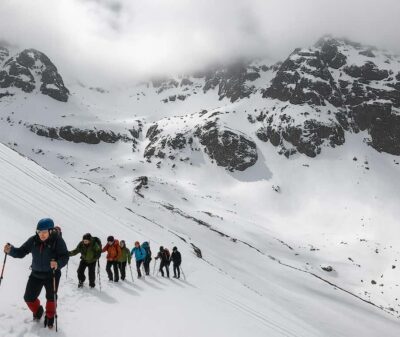
Mt Toubkal Ascent Express Trek 2 Days 1 Nights
Read our review →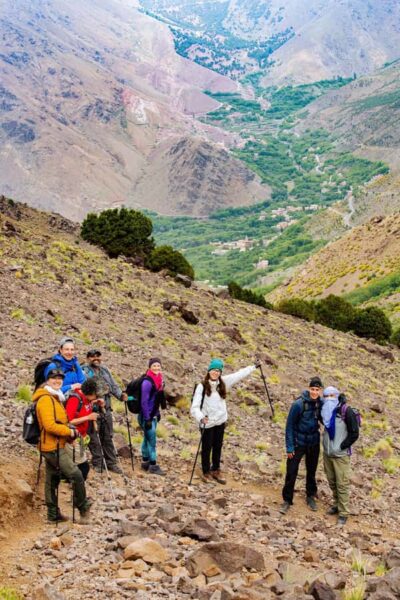
2-Day Mt. Toubkal Trek with 1-Night Stay & Meals
Read our review →
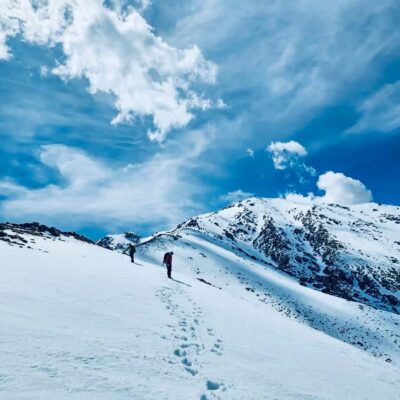
Summiting and Hiking the Atlas Mountains Day Trek from Marrakech
Read our review →Browse the lists this tour appears in